

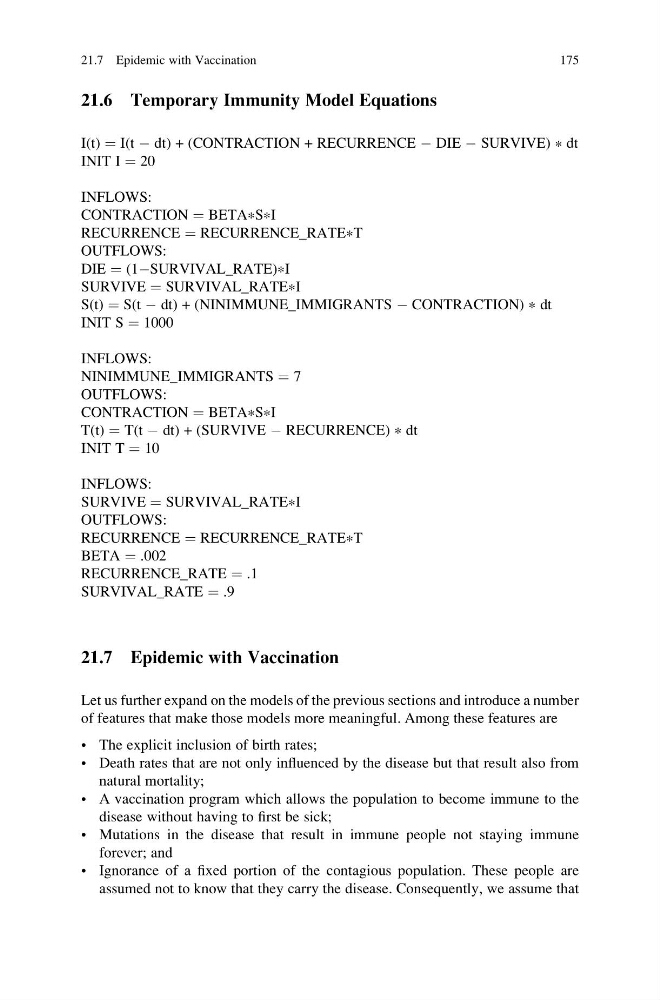
21.6 Temporary Immunity Model Equations
I(t) ¼ I(t À dt) + (CONTRACTION + RECURRENCE À DIE À SURVIVE) * dt
INIT I ¼ 20
INFLOWS:
CONTRACTION ¼ BETA * S * I
RECURRENCE ¼ RECURRENCE_RATE * T
OUTFLOWS:
DIE ¼ (1ÀSURVIVAL_RATE) * I
SURVIVE ¼ SURVIVAL_RATE * I
S(t) ¼ S(t À dt) + (NINIMMUNE_IMMIGRANTS À CONTRACTION) * dt
INIT S ¼ 1000
INFLOWS:
NINIMMUNE_IMMIGRANTS ¼ 7
OUTFLOWS:
CONTRACTION ¼ BETA * S * I
T(t) ¼ T(t À dt) + (SURVIVE À RECURRENCE) * dt
INIT T ¼ 10
INFLOWS:
SURVIVE ¼ SURVIVAL_RATE * I
OUTFLOWS:
RECURRENCE ¼ RECURRENCE_RATE * T
BETA ¼ .002
RECURRENCE_RATE ¼ .1
SURVIVAL_RATE ¼ .9
21.7 Epidemic with Vaccination
Let us further expand on the models of the previous sections and introduce a number
of features that make those models more meaningful. Among these features are
• The explicit inclusion of birth rates;
• Death rates that are not only influenced by the disease but that result also from
natural mortality;
• A vaccination program which allows the population to become immune to the
disease without having to first be sick;
• Mutations in the disease that result in immune people not staying immune
forever; and
• Ignorance of a fixed portion of the contagious population. These people are
assumed not to know that they carry the disease. Consequently, we assume that
21.7 Epidemic with Vaccination
175
I(t) ¼ I(t À dt) + (CONTRACTION + RECURRENCE À DIE À SURVIVE) * dt
INIT I ¼ 20
INFLOWS:
CONTRACTION ¼ BETA * S * I
RECURRENCE ¼ RECURRENCE_RATE * T
OUTFLOWS:
DIE ¼ (1ÀSURVIVAL_RATE) * I
SURVIVE ¼ SURVIVAL_RATE * I
S(t) ¼ S(t À dt) + (NINIMMUNE_IMMIGRANTS À CONTRACTION) * dt
INIT S ¼ 1000
INFLOWS:
NINIMMUNE_IMMIGRANTS ¼ 7
OUTFLOWS:
CONTRACTION ¼ BETA * S * I
T(t) ¼ T(t À dt) + (SURVIVE À RECURRENCE) * dt
INIT T ¼ 10
INFLOWS:
SURVIVE ¼ SURVIVAL_RATE * I
OUTFLOWS:
RECURRENCE ¼ RECURRENCE_RATE * T
BETA ¼ .002
RECURRENCE_RATE ¼ .1
SURVIVAL_RATE ¼ .9
21.7 Epidemic with Vaccination
Let us further expand on the models of the previous sections and introduce a number
of features that make those models more meaningful. Among these features are
• The explicit inclusion of birth rates;
• Death rates that are not only influenced by the disease but that result also from
natural mortality;
• A vaccination program which allows the population to become immune to the
disease without having to first be sick;
• Mutations in the disease that result in immune people not staying immune
forever; and
• Ignorance of a fixed portion of the contagious population. These people are
assumed not to know that they carry the disease. Consequently, we assume that
21.7 Epidemic with Vaccination
175