

21.5 Temporary Immunity
In the previous sections of this chapter we have modeled a disease that spreads in a
population by turning susceptible, nonimmune individuals into infective ones.
Following infection, the individuals were assumed to either die or remain immune
for the rest of their lives. In both cases, the outflows from the stock of infective
individuals disappeared into clouds—we did not keep track of them. We need to
change this setup if we wish to model the case of a disease that only leads to
temporary immunity. In that case, the flow of individuals who survive must end in a
reservoir, rather than a cloud. What are the effects of temporary immunity on the
population modeled in Sect. 20.1?
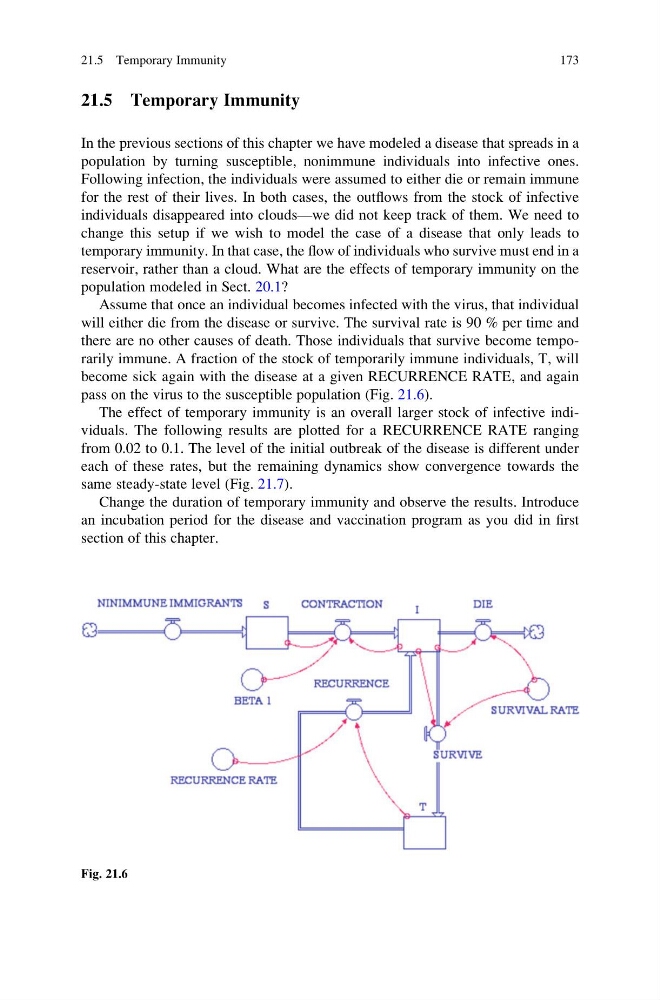
Assume that once an individual becomes infected with the virus, that individual
will either die from the disease or survive. The survival rate is 90 % per time and
there are no other causes of death. Those individuals that survive become temporarily immune. A fraction of the stock of temporarily immune individuals, T, will
become sick again with the disease at a given RECURRENCE RATE, and again
pass on the virus to the susceptible population (Fig. 21.6).
The effect of temporary immunity is an overall larger stock of infective individuals. The following results are plotted for a RECURRENCE RATE ranging
from 0.02 to 0.1. The level of the initial outbreak of the disease is different under
each of these rates, but the remaining dynamics show convergence towards the
same steady-state level (Fig. 21.7).
Change the duration of temporary immunity and observe the results. Introduce
an incubation period for the disease and vaccination program as you did in first
section of this chapter.
Fig. 21.6
21.5 Temporary Immunity
173
In the previous sections of this chapter we have modeled a disease that spreads in a
population by turning susceptible, nonimmune individuals into infective ones.
Following infection, the individuals were assumed to either die or remain immune
for the rest of their lives. In both cases, the outflows from the stock of infective
individuals disappeared into clouds—we did not keep track of them. We need to
change this setup if we wish to model the case of a disease that only leads to
temporary immunity. In that case, the flow of individuals who survive must end in a
reservoir, rather than a cloud. What are the effects of temporary immunity on the
population modeled in Sect. 20.1?
Assume that once an individual becomes infected with the virus, that individual
will either die from the disease or survive. The survival rate is 90 % per time and
there are no other causes of death. Those individuals that survive become temporarily immune. A fraction of the stock of temporarily immune individuals, T, will
become sick again with the disease at a given RECURRENCE RATE, and again
pass on the virus to the susceptible population (Fig. 21.6).
The effect of temporary immunity is an overall larger stock of infective individuals. The following results are plotted for a RECURRENCE RATE ranging
from 0.02 to 0.1. The level of the initial outbreak of the disease is different under
each of these rates, but the remaining dynamics show convergence towards the
same steady-state level (Fig. 21.7).
Change the duration of temporary immunity and observe the results. Introduce
an incubation period for the disease and vaccination program as you did in first
section of this chapter.
Fig. 21.6
21.5 Temporary Immunity
173