

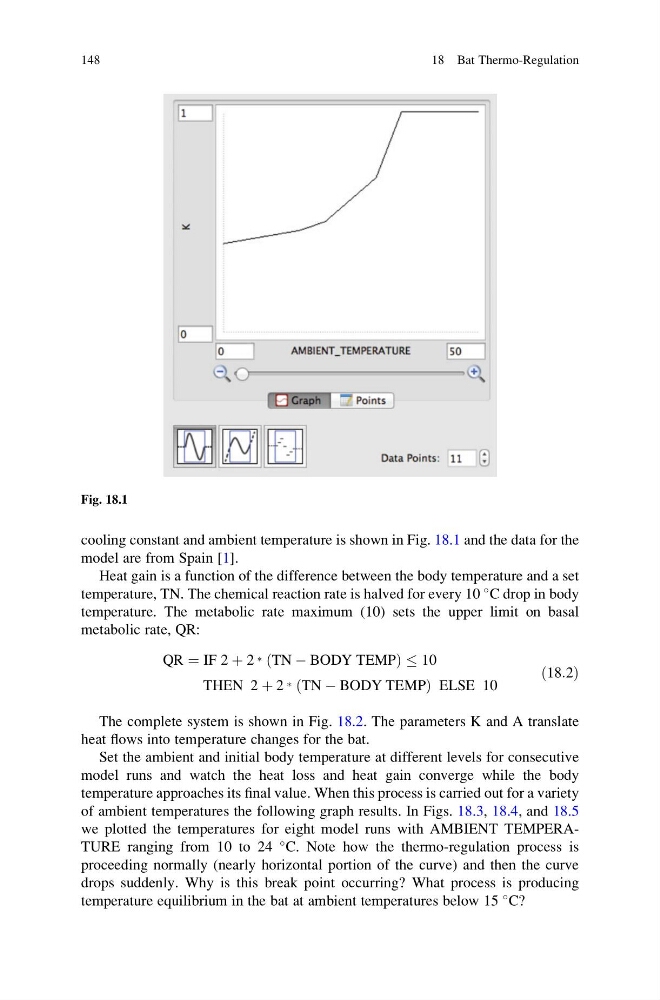
cooling constant and ambient temperature is shown in Fig. 18.1 and the data for the
model are from Spain [1].
Heat gain is a function of the difference between the body temperature and a set
temperature, TN. The chemical reaction rate is halved for every 10
C drop in body
temperature. The metabolic rate maximum (10) sets the upper limit on basal
metabolic rate, QR:
QR ¼ IF 2 þ 2 Ã TN À BODY TEMP
ð
Þ 10
THEN 2 þ 2 Ã TN À BODY TEMP
ð
Þ ELSE 10
ð18:2Þ
The complete system is shown in Fig. 18.2. The parameters K and A translate
heat flows into temperature changes for the bat.
Set the ambient and initial body temperature at different levels for consecutive
model runs and watch the heat loss and heat gain converge while the body
temperature approaches its final value. When this process is carried out for a variety
of ambient temperatures the following graph results. In Figs. 18.3, 18.4, and 18.5
we plotted the temperatures for eight model runs with AMBIENT TEMPERATURE ranging from 10 to 24
C. Note how the thermo-regulation process is
proceeding normally (nearly horizontal portion of the curve) and then the curve
drops suddenly. Why is this break point occurring? What process is producing
temperature equilibrium in the bat at ambient temperatures below 15
C?
Fig. 18.1
148
18 Bat Thermo-Regulation
model are from Spain [1].
Heat gain is a function of the difference between the body temperature and a set
temperature, TN. The chemical reaction rate is halved for every 10
C drop in body
temperature. The metabolic rate maximum (10) sets the upper limit on basal
metabolic rate, QR:
QR ¼ IF 2 þ 2 Ã TN À BODY TEMP
ð
Þ 10
THEN 2 þ 2 Ã TN À BODY TEMP
ð
Þ ELSE 10
ð18:2Þ
The complete system is shown in Fig. 18.2. The parameters K and A translate
heat flows into temperature changes for the bat.
Set the ambient and initial body temperature at different levels for consecutive
model runs and watch the heat loss and heat gain converge while the body
temperature approaches its final value. When this process is carried out for a variety
of ambient temperatures the following graph results. In Figs. 18.3, 18.4, and 18.5
we plotted the temperatures for eight model runs with AMBIENT TEMPERATURE ranging from 10 to 24
C. Note how the thermo-regulation process is
proceeding normally (nearly horizontal portion of the curve) and then the curve
drops suddenly. Why is this break point occurring? What process is producing
temperature equilibrium in the bat at ambient temperatures below 15
C?
Fig. 18.1
148
18 Bat Thermo-Regulation