

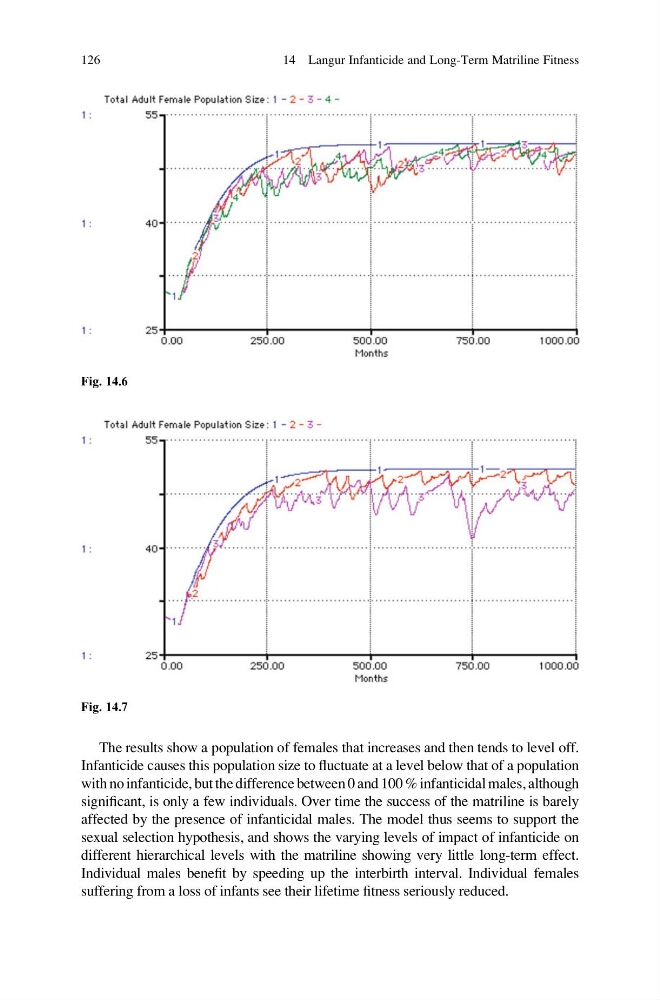
The results show a population of females that increases and then tends to level off.
Infanticide causes this population size to fluctuate at a level below that of a population
with no infanticide, but the difference between 0 and 100 % infanticidal males, although
significant, is only a few individuals. Over time the success of the matriline is barely
affected by the presence of infanticidal males. The model thus seems to support the
sexual selection hypothesis, and shows the varying levels of impact of infanticide on
different hierarchical levels with the matriline showing very little long-term effect.
Individual males benefit by speeding up the interbirth interval. Individual females
suffering from a loss of infants see their lifetime fitness seriously reduced.
Fig. 14.6
Fig. 14.7
126
14 Langur Infanticide and Long-Term Matriline Fitness
Infanticide causes this population size to fluctuate at a level below that of a population
with no infanticide, but the difference between 0 and 100 % infanticidal males, although
significant, is only a few individuals. Over time the success of the matriline is barely
affected by the presence of infanticidal males. The model thus seems to support the
sexual selection hypothesis, and shows the varying levels of impact of infanticide on
different hierarchical levels with the matriline showing very little long-term effect.
Individual males benefit by speeding up the interbirth interval. Individual females
suffering from a loss of infants see their lifetime fitness seriously reduced.
Fig. 14.6
Fig. 14.7
126
14 Langur Infanticide and Long-Term Matriline Fitness