

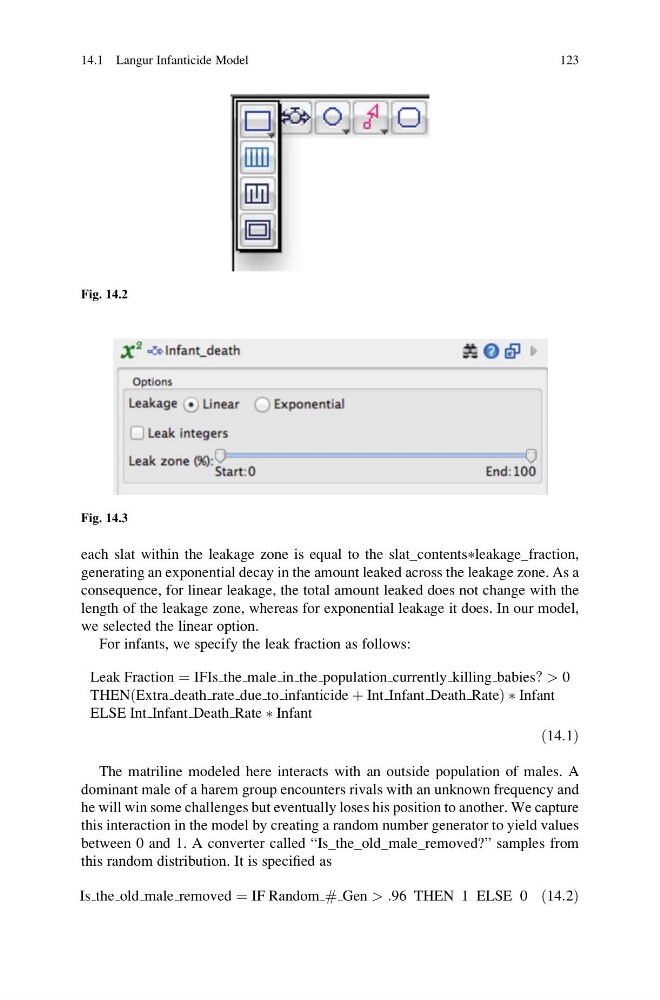
each slat within the leakage zone is equal to the slat_contents * leakage_fraction,
generating an exponential decay in the amount leaked across the leakage zone. As a
consequence, for linear leakage, the total amount leaked does not change with the
length of the leakage zone, whereas for exponential leakage it does. In our model,
we selected the linear option.
For infants, we specify the leak fraction as follows:
Leak Fraction ¼ IFIs the male in the population currently killing babies? > 0
THEN Extra death rate due to infanticide þ Int Infant Death Rate
ð
Þ Ã Infant
ELSE Int Infant Death Rate à Infant
ð14:1Þ
The matriline modeled here interacts with an outside population of males. A
dominant male of a harem group encounters rivals with an unknown frequency and
he will win some challenges but eventually loses his position to another. We capture
this interaction in the model by creating a random number generator to yield values
between 0 and 1. A converter called “Is_the_old_male_removed?” samples from
this random distribution. It is specified as
Is the old male removed ¼ IF Random # Gen > :96 THEN 1 ELSE 0 ð14:2Þ
Fig. 14.2
Fig. 14.3
14.1 Langur Infanticide Model
123
generating an exponential decay in the amount leaked across the leakage zone. As a
consequence, for linear leakage, the total amount leaked does not change with the
length of the leakage zone, whereas for exponential leakage it does. In our model,
we selected the linear option.
For infants, we specify the leak fraction as follows:
Leak Fraction ¼ IFIs the male in the population currently killing babies? > 0
THEN Extra death rate due to infanticide þ Int Infant Death Rate
ð
Þ Ã Infant
ELSE Int Infant Death Rate à Infant
ð14:1Þ
The matriline modeled here interacts with an outside population of males. A
dominant male of a harem group encounters rivals with an unknown frequency and
he will win some challenges but eventually loses his position to another. We capture
this interaction in the model by creating a random number generator to yield values
between 0 and 1. A converter called “Is_the_old_male_removed?” samples from
this random distribution. It is specified as
Is the old male removed ¼ IF Random # Gen > :96 THEN 1 ELSE 0 ð14:2Þ
Fig. 14.2
Fig. 14.3
14.1 Langur Infanticide Model
123