

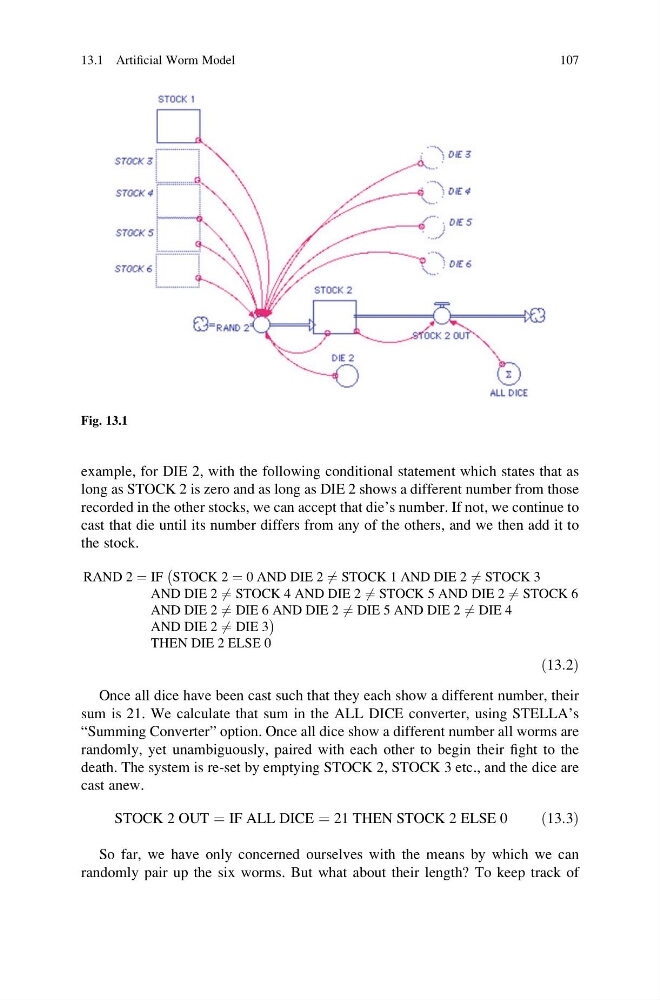
example, for DIE 2, with the following conditional statement which states that as
long as STOCK 2 is zero and as long as DIE 2 shows a different number from those
recorded in the other stocks, we can accept that die’s number. If not, we continue to
cast that die until its number differs from any of the others, and we then add it to
the stock.
RAND 2 ¼ IF
À
STOCK 2 ¼ 0 AND DIE 2 6 ¼ STOCK 1 AND DIE 2 6 ¼ STOCK 3
AND DIE 2 6 ¼ STOCK 4 AND DIE 2 6 ¼ STOCK 5 AND DIE 2 6 ¼ STOCK 6
AND DIE 2 6 ¼ DIE 6 AND DIE 2 6 ¼ DIE 5 AND DIE 2 6 ¼ DIE 4
AND DIE 2 6 ¼ DIE 3
Á
THEN DIE 2 ELSE 0
ð13:2Þ
Once all dice have been cast such that they each show a different number, their
sum is 21. We calculate that sum in the ALL DICE converter, using STELLA’s
“Summing Converter” option. Once all dice show a different number all worms are
randomly, yet unambiguously, paired with each other to begin their fight to the
death. The system is re-set by emptying STOCK 2, STOCK 3 etc., and the dice are
cast anew.
STOCK 2 OUT ¼ IF ALL DICE ¼ 21 THEN STOCK 2 ELSE 0
ð13:3Þ
So far, we have only concerned ourselves with the means by which we can
randomly pair up the six worms. But what about their length? To keep track of
Fig. 13.1
13.1 Artificial Worm Model
107
long as STOCK 2 is zero and as long as DIE 2 shows a different number from those
recorded in the other stocks, we can accept that die’s number. If not, we continue to
cast that die until its number differs from any of the others, and we then add it to
the stock.
RAND 2 ¼ IF
À
STOCK 2 ¼ 0 AND DIE 2 6 ¼ STOCK 1 AND DIE 2 6 ¼ STOCK 3
AND DIE 2 6 ¼ STOCK 4 AND DIE 2 6 ¼ STOCK 5 AND DIE 2 6 ¼ STOCK 6
AND DIE 2 6 ¼ DIE 6 AND DIE 2 6 ¼ DIE 5 AND DIE 2 6 ¼ DIE 4
AND DIE 2 6 ¼ DIE 3
Á
THEN DIE 2 ELSE 0
ð13:2Þ
Once all dice have been cast such that they each show a different number, their
sum is 21. We calculate that sum in the ALL DICE converter, using STELLA’s
“Summing Converter” option. Once all dice show a different number all worms are
randomly, yet unambiguously, paired with each other to begin their fight to the
death. The system is re-set by emptying STOCK 2, STOCK 3 etc., and the dice are
cast anew.
STOCK 2 OUT ¼ IF ALL DICE ¼ 21 THEN STOCK 2 ELSE 0
ð13:3Þ
So far, we have only concerned ourselves with the means by which we can
randomly pair up the six worms. But what about their length? To keep track of
Fig. 13.1
13.1 Artificial Worm Model
107