

300 B alleles. From 500 alleles we can have 250 genotypes, so the Hardy–Weinberg
law tells us that we should end up with 0.4 * 0.4 * 250 or 40 AA genotypes,
2 * 0.4 * 0.6 * 250 or 120 AB genotypes and finally, 0.6 * 0.6 * 250 or 90 BB genotypes.
Of course, the allele frequencies change from generation to generation as
mutation occurs. Here, we assume that mutation is a random process and can
occur in both directions. For the model we assume that a random fraction of A
alleles turns into B alleles and vice versa, and we only deal with the net of the
mutation in both directions. We define
NET MUTATION ¼ RANDOM À0:05, 0:05
ð
Þ
à A ALLELES þ B ALLELES
ð
Þ
ð 12:1Þ
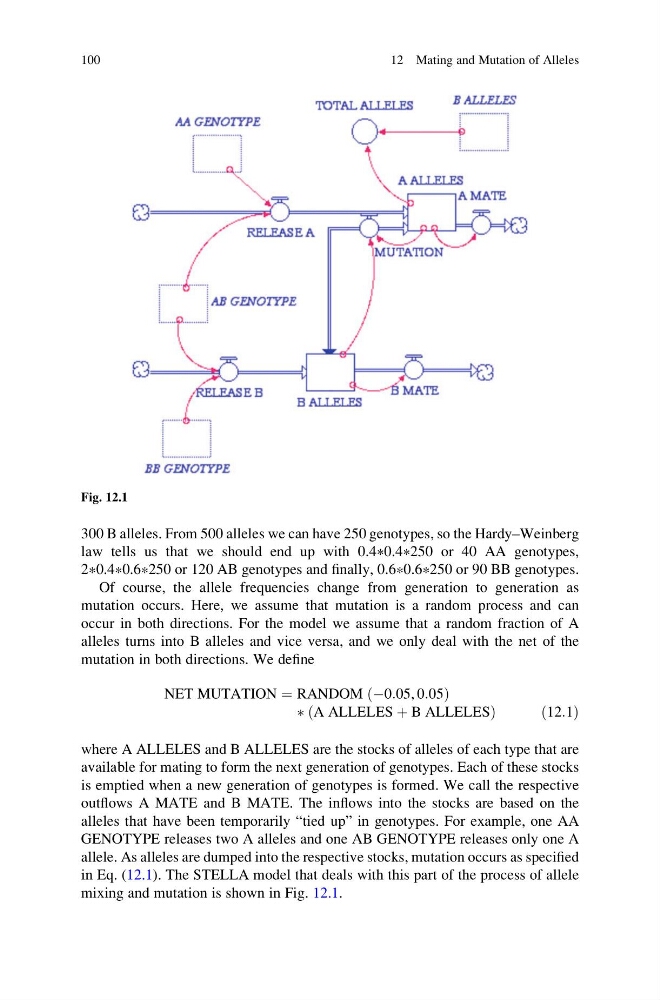
where A ALLELES and B ALLELES are the stocks of alleles of each type that are
available for mating to form the next generation of genotypes. Each of these stocks
is emptied when a new generation of genotypes is formed. We call the respective
outflows A MATE and B MATE. The inflows into the stocks are based on the
alleles that have been temporarily “tied up” in genotypes. For example, one AA
GENOTYPE releases two A alleles and one AB GENOTYPE releases only one A
allele. As alleles are dumped into the respective stocks, mutation occurs as specified
in Eq. (12.1). The STELLA model that deals with this part of the process of allele
mixing and mutation is shown in Fig. 12.1.
Fig. 12.1
100
12 Mating and Mutation of Alleles
law tells us that we should end up with 0.4 * 0.4 * 250 or 40 AA genotypes,
2 * 0.4 * 0.6 * 250 or 120 AB genotypes and finally, 0.6 * 0.6 * 250 or 90 BB genotypes.
Of course, the allele frequencies change from generation to generation as
mutation occurs. Here, we assume that mutation is a random process and can
occur in both directions. For the model we assume that a random fraction of A
alleles turns into B alleles and vice versa, and we only deal with the net of the
mutation in both directions. We define
NET MUTATION ¼ RANDOM À0:05, 0:05
ð
Þ
à A ALLELES þ B ALLELES
ð
Þ
ð 12:1Þ
where A ALLELES and B ALLELES are the stocks of alleles of each type that are
available for mating to form the next generation of genotypes. Each of these stocks
is emptied when a new generation of genotypes is formed. We call the respective
outflows A MATE and B MATE. The inflows into the stocks are based on the
alleles that have been temporarily “tied up” in genotypes. For example, one AA
GENOTYPE releases two A alleles and one AB GENOTYPE releases only one A
allele. As alleles are dumped into the respective stocks, mutation occurs as specified
in Eq. (12.1). The STELLA model that deals with this part of the process of allele
mixing and mutation is shown in Fig. 12.1.
Fig. 12.1
100
12 Mating and Mutation of Alleles