

298
Hugh Possingham, Ian Ball, and Sandy Andelman
Table 17.3. New South Wales comparison.
a,b
Algorithm
Sites in solution
Run time
Greedy
61
1 min
Rarity based
70
2–3 min
Simulated annealing
54
40 min
a
Adapted from Ball et al. (in press).
b
Data set is from the western division of New South Wales, Australia. The optimum value for this
problem is known to be 54 sites.
The acceptance level determines what size change will be accepted. Negative
changes (decreasing the value of the system) will always be accepted. When the
acceptance level approaches 0, then the only acceptable changes are those that
reduce the value of the system. The use of the exponential term means that the
system spends proportionally little time accepting very bad changes and much
more time resolving small differences.
The relative ability of this method is demonstrated in an example using data
from the western region of New South Wales, Australia (Ball et al., in press). In
this region, there are 1,885 sites and 248 species of conservation concern. The
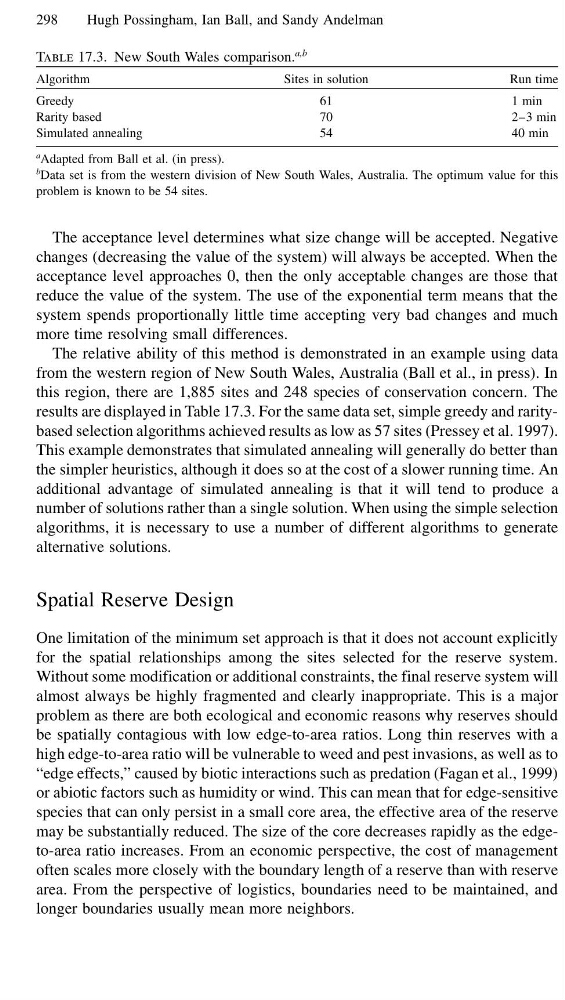
results are displayed in Table 17.3. For the same data set, simple greedy and raritybased selection algorithms achieved results as low as 57 sites (Pressey et al. 1997).
This example demonstrates that simulated annealing will generally do better than
the simpler heuristics, although it does so at the cost of a slower running time. An
additional advantage of simulated annealing is that it will tend to produce a
number of solutions rather than a single solution. When using the simple selection
algorithms, it is necessary to use a number of different algorithms to generate
alternative solutions.
Spatial Reserve Design
One limitation of the minimum set approach is that it does not account explicitly
for the spatial relationships among the sites selected for the reserve system.
Without some modification or additional constraints, the final reserve system will
almost always be highly fragmented and clearly inappropriate. This is a major
problem as there are both ecological and economic reasons why reserves should
be spatially contagious with low edge-to-area ratios. Long thin reserves with a
high edge-to-area ratio will be vulnerable to weed and pest invasions, as well as to
“edge effects,” caused by biotic interactions such as predation (Fagan et al., 1999)
or abiotic factors such as humidity or wind. This can mean that for edge-sensitive
species that can only persist in a small core area, the effective area of the reserve
may be substantially reduced. The size of the core decreases rapidly as the edgeto-area ratio increases. From an economic perspective, the cost of management
often scales more closely with the boundary length of a reserve than with reserve
area. From the perspective of logistics, boundaries need to be maintained, and
longer boundaries usually mean more neighbors.
Hugh Possingham, Ian Ball, and Sandy Andelman
Table 17.3. New South Wales comparison.
a,b
Algorithm
Sites in solution
Run time
Greedy
61
1 min
Rarity based
70
2–3 min
Simulated annealing
54
40 min
a
Adapted from Ball et al. (in press).
b
Data set is from the western division of New South Wales, Australia. The optimum value for this
problem is known to be 54 sites.
The acceptance level determines what size change will be accepted. Negative
changes (decreasing the value of the system) will always be accepted. When the
acceptance level approaches 0, then the only acceptable changes are those that
reduce the value of the system. The use of the exponential term means that the
system spends proportionally little time accepting very bad changes and much
more time resolving small differences.
The relative ability of this method is demonstrated in an example using data
from the western region of New South Wales, Australia (Ball et al., in press). In
this region, there are 1,885 sites and 248 species of conservation concern. The
results are displayed in Table 17.3. For the same data set, simple greedy and raritybased selection algorithms achieved results as low as 57 sites (Pressey et al. 1997).
This example demonstrates that simulated annealing will generally do better than
the simpler heuristics, although it does so at the cost of a slower running time. An
additional advantage of simulated annealing is that it will tend to produce a
number of solutions rather than a single solution. When using the simple selection
algorithms, it is necessary to use a number of different algorithms to generate
alternative solutions.
Spatial Reserve Design
One limitation of the minimum set approach is that it does not account explicitly
for the spatial relationships among the sites selected for the reserve system.
Without some modification or additional constraints, the final reserve system will
almost always be highly fragmented and clearly inappropriate. This is a major
problem as there are both ecological and economic reasons why reserves should
be spatially contagious with low edge-to-area ratios. Long thin reserves with a
high edge-to-area ratio will be vulnerable to weed and pest invasions, as well as to
“edge effects,” caused by biotic interactions such as predation (Fagan et al., 1999)
or abiotic factors such as humidity or wind. This can mean that for edge-sensitive
species that can only persist in a small core area, the effective area of the reserve
may be substantially reduced. The size of the core decreases rapidly as the edgeto-area ratio increases. From an economic perspective, the cost of management
often scales more closely with the boundary length of a reserve than with reserve
area. From the perspective of logistics, boundaries need to be maintained, and
longer boundaries usually mean more neighbors.