

17. Mathematical Methods for Identifying Representative Reserve Networks
293
Minimum Representation Problem
An important criterion for a reserve system is that it represents as much of the
available biodiversity as possible (Pressey et al. 1993; Morton et al. 1995). By this
criterion, a reserve system should contain at least one example of every vegetation
type and/or one population of every species present within the region of interest.
Because there are constraints on the amount of land that can be set aside for nature
conservation, it would seem prudent to choose a set of sites that achieves comprehensive representation for the minimum cost (Pressey et al. 1993). This is
called the minimum representation problem, and if the cost is a linear function of
the number of sites in the system, it can be expressed as an integer linear programming problem (Cocks and Baird 1989; Possingham et al. 1993; Underhill 1994;
Willis et al. 1996). When only a single occurrence of each species is required and
there is a finite number of discrete sites from which to choose, this is termed a setcovering problem.
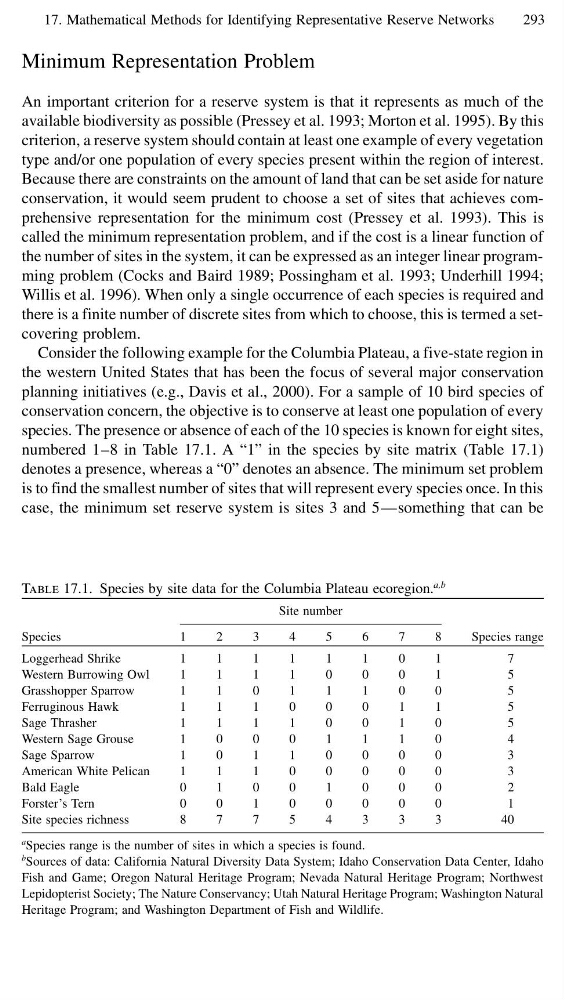
Consider the following example for the Columbia Plateau, a five-state region in
the western United States that has been the focus of several major conservation
planning initiatives (e.g., Davis et al., 2000). For a sample of 10 bird species of
conservation concern, the objective is to conserve at least one population of every
species. The presence or absence of each of the 10 species is known for eight sites,
numbered 1–8 in Table 17.1. A “1” in the species by site matrix (Table 17.1)
denotes a presence, whereas a “0” denotes an absence. The minimum set problem
is to find the smallest number of sites that will represent every species once. In this
case, the minimum set reserve system is sites 3 and 5—something that can be
Table 17.1. Species by site data for the Columbia Plateau ecoregion.
a,b
Species
Site number
1
2
3
4
5
6
7
8
Species range
Loggerhead Shrike
1
1
1
1
1
1
0
1
7
Western Burrowing Owl
1
1
1
1
0
0
0
1
5
Grasshopper Sparrow
1
1
0
1
1
1
0
0
5
Ferruginous Hawk
1
1
1
0
0
0
1
1
5
Sage Thrasher
1
1
1
1
0
0
1
0
5
Western Sage Grouse
1
0
0
0
1
1
1
0
4
Sage Sparrow
1
0
1
1
0
0
0
0
3
American White Pelican
1
1
1
0
0
0
0
0
3
Bald Eagle
0
1
0
0
1
0
0
0
2
Forster’s Tern
0
0
1
0
0
0
0
0
1
Site species richness
8
7
7
5
4
3
3
3
40
a Species range is the number of sites in which a species is found.
b Sources of data: California Natural Diversity Data System; Idaho Conservation Data Center, Idaho
Fish and Game; Oregon Natural Heritage Program; Nevada Natural Heritage Program; Northwest
Lepidopterist Society; The Nature Conservancy; Utah Natural Heritage Program; Washington Natural
Heritage Program; and Washington Department of Fish and Wildlife.
293
Minimum Representation Problem
An important criterion for a reserve system is that it represents as much of the
available biodiversity as possible (Pressey et al. 1993; Morton et al. 1995). By this
criterion, a reserve system should contain at least one example of every vegetation
type and/or one population of every species present within the region of interest.
Because there are constraints on the amount of land that can be set aside for nature
conservation, it would seem prudent to choose a set of sites that achieves comprehensive representation for the minimum cost (Pressey et al. 1993). This is
called the minimum representation problem, and if the cost is a linear function of
the number of sites in the system, it can be expressed as an integer linear programming problem (Cocks and Baird 1989; Possingham et al. 1993; Underhill 1994;
Willis et al. 1996). When only a single occurrence of each species is required and
there is a finite number of discrete sites from which to choose, this is termed a setcovering problem.
Consider the following example for the Columbia Plateau, a five-state region in
the western United States that has been the focus of several major conservation
planning initiatives (e.g., Davis et al., 2000). For a sample of 10 bird species of
conservation concern, the objective is to conserve at least one population of every
species. The presence or absence of each of the 10 species is known for eight sites,
numbered 1–8 in Table 17.1. A “1” in the species by site matrix (Table 17.1)
denotes a presence, whereas a “0” denotes an absence. The minimum set problem
is to find the smallest number of sites that will represent every species once. In this
case, the minimum set reserve system is sites 3 and 5—something that can be
Table 17.1. Species by site data for the Columbia Plateau ecoregion.
a,b
Species
Site number
1
2
3
4
5
6
7
8
Species range
Loggerhead Shrike
1
1
1
1
1
1
0
1
7
Western Burrowing Owl
1
1
1
1
0
0
0
1
5
Grasshopper Sparrow
1
1
0
1
1
1
0
0
5
Ferruginous Hawk
1
1
1
0
0
0
1
1
5
Sage Thrasher
1
1
1
1
0
0
1
0
5
Western Sage Grouse
1
0
0
0
1
1
1
0
4
Sage Sparrow
1
0
1
1
0
0
0
0
3
American White Pelican
1
1
1
0
0
0
0
0
3
Bald Eagle
0
1
0
0
1
0
0
0
2
Forster’s Tern
0
0
1
0
0
0
0
0
1
Site species richness
8
7
7
5
4
3
3
3
40
a Species range is the number of sites in which a species is found.
b Sources of data: California Natural Diversity Data System; Idaho Conservation Data Center, Idaho
Fish and Game; Oregon Natural Heritage Program; Nevada Natural Heritage Program; Northwest
Lepidopterist Society; The Nature Conservancy; Utah Natural Heritage Program; Washington Natural
Heritage Program; and Washington Department of Fish and Wildlife.