

224
Fr´ ed´ eric Gosselin and Jean-Dominique Lebreton
P i t , i t +1 = Pr (Y t+1 = i t+1 | Y t = i t ) = Pr(Y t+1 = i t+1 | Y t = i t , Y t−1 , . . ., Y 0 )
Thus, for every t and j in N, we have
Pr(Y t+1 = j) =
∞
͚
i=0
Pr(Y t = i) p i,j
that is, in matrix terms
= P
= P
t+1
. .
. .
. .
. . . .
. .
. .
. .
. .
. . . .
. .
. .
. .
. .
. .
Pr(Y t+1 = 0)
p 0,0 p 1,0 . . . p i,0 . . . Pr(Y t = 0)
Pr(Y t = 0)
Pr(Y
Pr(Y t+1 = 1)
p 0,1 p 1,1 . . . p i,1 . . . Pr(Y t = 1)
Pr(Y t = 1)
Pr(Y
=
Pr(Y t+1 = j)
p 0, j p 1, j . . . p i, j . . . Pr(Y t = i)
Pr(Y t = i)
Pr(Y
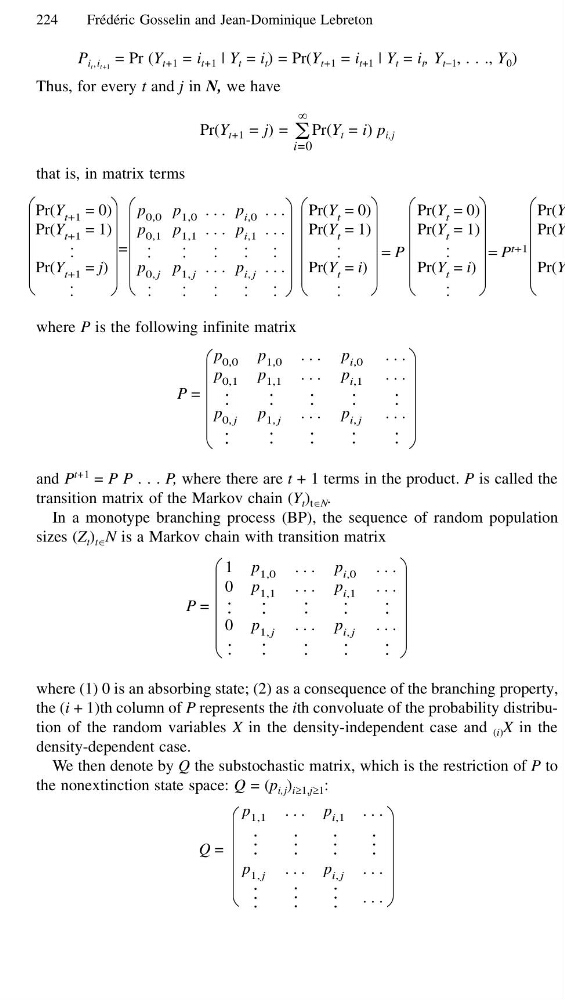
where P is the following infinite matrix
p 0,0 p 1,0 . . . p i,0 . . .
p 0,1 p 1,1 . . . p i,1 . . .
P =
p 0, j p 1, j . . . p i, j . . .
. .
. .
. .
. .
. .
. .
. .
. .
. .
. .
and P
t+1 = P P . . . P, where there are t + 1 terms in the product. P is called the
transition matrix of the Markov chain (Y t ) t∈N .
In a monotype branching process (BP), the sequence of random population
sizes (Z t ) t∈ N is a Markov chain with transition matrix
1 p 1,0 . . . p i,0 . . .
0 p 1,1 . . . p i,1 . . .
P =
0 p 1, j . . . p i, j . . .
. .
. .
. . . .
. .
. .
. .
. .
. .
. .
where (1) 0 is an absorbing state; (2) as a consequence of the branching property,
the (i + 1)th column of P represents the ith convoluate of the probability distribution of the random variables X in the density-independent case and (i) X in the
density-dependent case.
We then denote by Q the substochastic matrix, which is the restriction of P to
the nonextinction state space: Q = (p i,j ) i≥1,j≥1 :
p 1,1 . . . p i,1 . . .
Q =
p 1, j . . . p i, j . . .
. . .
. . .
. . .
. . .
. . .
. . .
. . .
. . .
Fr´ ed´ eric Gosselin and Jean-Dominique Lebreton
P i t , i t +1 = Pr (Y t+1 = i t+1 | Y t = i t ) = Pr(Y t+1 = i t+1 | Y t = i t , Y t−1 , . . ., Y 0 )
Thus, for every t and j in N, we have
Pr(Y t+1 = j) =
∞
͚
i=0
Pr(Y t = i) p i,j
that is, in matrix terms
= P
= P
t+1
. .
. .
. .
. . . .
. .
. .
. .
. .
. . . .
. .
. .
. .
. .
. .
Pr(Y t+1 = 0)
p 0,0 p 1,0 . . . p i,0 . . . Pr(Y t = 0)
Pr(Y t = 0)
Pr(Y
Pr(Y t+1 = 1)
p 0,1 p 1,1 . . . p i,1 . . . Pr(Y t = 1)
Pr(Y t = 1)
Pr(Y
=
Pr(Y t+1 = j)
p 0, j p 1, j . . . p i, j . . . Pr(Y t = i)
Pr(Y t = i)
Pr(Y
where P is the following infinite matrix
p 0,0 p 1,0 . . . p i,0 . . .
p 0,1 p 1,1 . . . p i,1 . . .
P =
p 0, j p 1, j . . . p i, j . . .
. .
. .
. .
. .
. .
. .
. .
. .
. .
. .
and P
t+1 = P P . . . P, where there are t + 1 terms in the product. P is called the
transition matrix of the Markov chain (Y t ) t∈N .
In a monotype branching process (BP), the sequence of random population
sizes (Z t ) t∈ N is a Markov chain with transition matrix
1 p 1,0 . . . p i,0 . . .
0 p 1,1 . . . p i,1 . . .
P =
0 p 1, j . . . p i, j . . .
. .
. .
. . . .
. .
. .
. .
. .
. .
. .
where (1) 0 is an absorbing state; (2) as a consequence of the branching property,
the (i + 1)th column of P represents the ith convoluate of the probability distribution of the random variables X in the density-independent case and (i) X in the
density-dependent case.
We then denote by Q the substochastic matrix, which is the restriction of P to
the nonextinction state space: Q = (p i,j ) i≥1,j≥1 :
p 1,1 . . . p i,1 . . .
Q =
p 1, j . . . p i, j . . .
. . .
. . .
. . .
. . .
. . .
. . .
. . .
. . .