

202
Fr´ ed´ eric Gosselin and Jean-Dominique Lebreton
divergence to infinity, moving through infinitely many transient states during the
course of divergence, remains possible. This is one of the many counterintuitive
intricacies of stochastic processes, here as a consequence of the infinite number of
states.
Individuals’ Replacement and the Branching Property
The transition from t − 1 to t can be represented as usual for Markov chains by a
transition matrix, which, in the case of BPs, has infinitely many rows and columns. Fortunately, in BPs, the transition from Z t−1 to Z t can alternatively be
efficiently represented as the sum of individuals’ contributions. According to this
point of view, from time t − 1 to t, each individual j is replaced by a random
number of individuals X t−1,j , taking non-negative integer values 0, 1, 2, . . . . The
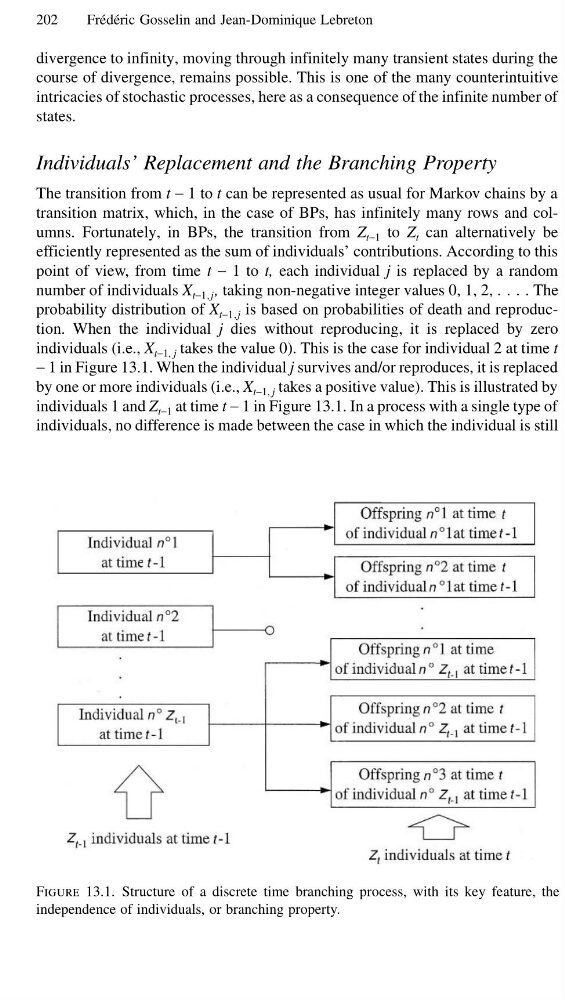
probability distribution of X t−1,j is based on probabilities of death and reproduction. When the individual j dies without reproducing, it is replaced by zero
individuals (i.e., X t−1, j takes the value 0). This is the case for individual 2 at time t
− 1 in Figure 13.1. When the individual j survives and/or reproduces, it is replaced
by one or more individuals (i.e., X t−1, j takes a positive value). This is illustrated by
individuals 1 and Z t−1 at time t − 1 in Figure 13.1. In a process with a single type of
individuals, no difference is made between the case in which the individual is still
Figure 13.1. Structure of a discrete time branching process, with its key feature, the
independence of individuals, or branching property.
Fr´ ed´ eric Gosselin and Jean-Dominique Lebreton
divergence to infinity, moving through infinitely many transient states during the
course of divergence, remains possible. This is one of the many counterintuitive
intricacies of stochastic processes, here as a consequence of the infinite number of
states.
Individuals’ Replacement and the Branching Property
The transition from t − 1 to t can be represented as usual for Markov chains by a
transition matrix, which, in the case of BPs, has infinitely many rows and columns. Fortunately, in BPs, the transition from Z t−1 to Z t can alternatively be
efficiently represented as the sum of individuals’ contributions. According to this
point of view, from time t − 1 to t, each individual j is replaced by a random
number of individuals X t−1,j , taking non-negative integer values 0, 1, 2, . . . . The
probability distribution of X t−1,j is based on probabilities of death and reproduction. When the individual j dies without reproducing, it is replaced by zero
individuals (i.e., X t−1, j takes the value 0). This is the case for individual 2 at time t
− 1 in Figure 13.1. When the individual j survives and/or reproduces, it is replaced
by one or more individuals (i.e., X t−1, j takes a positive value). This is illustrated by
individuals 1 and Z t−1 at time t − 1 in Figure 13.1. In a process with a single type of
individuals, no difference is made between the case in which the individual is still
Figure 13.1. Structure of a discrete time branching process, with its key feature, the
independence of individuals, or branching property.