

160
Selina S. Heppell, Deborah T. Crouse, and Larry B. Crowder
existed; for instance, fledglings could become helpers, floaters, solitary males, or
breeders in their second year. An elasticity analysis indicated that fecundity,
2-year-old survival or longer, and helper-to-breeder transition probability were
the most critical parameters in the model.
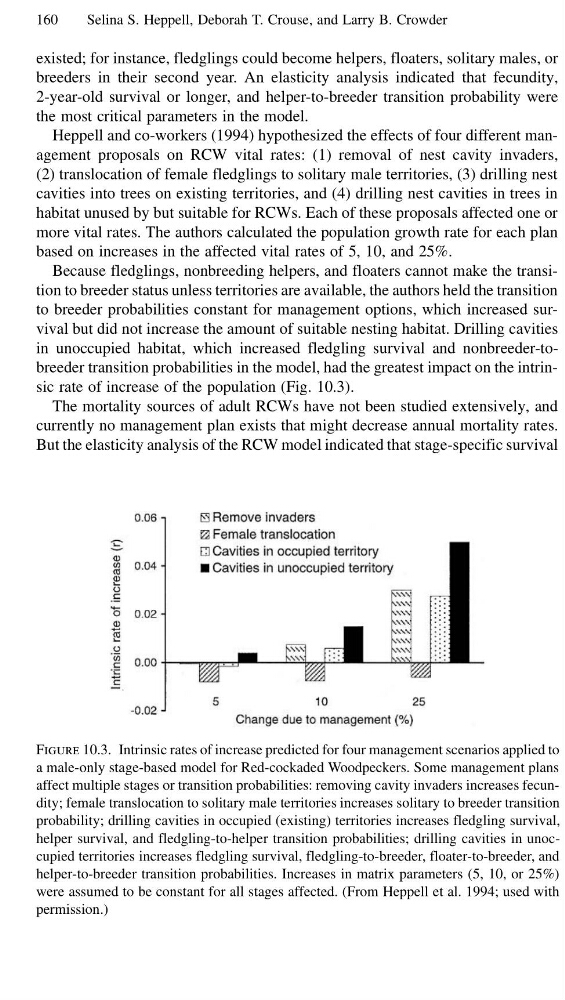
Heppell and co-workers (1994) hypothesized the effects of four different management proposals on RCW vital rates: (1) removal of nest cavity invaders,
(2) translocation of female fledglings to solitary male territories, (3) drilling nest
cavities into trees on existing territories, and (4) drilling nest cavities in trees in
habitat unused by but suitable for RCWs. Each of these proposals affected one or
more vital rates. The authors calculated the population growth rate for each plan
based on increases in the affected vital rates of 5, 10, and 25%.
Because fledglings, nonbreeding helpers, and floaters cannot make the transition to breeder status unless territories are available, the authors held the transition
to breeder probabilities constant for management options, which increased survival but did not increase the amount of suitable nesting habitat. Drilling cavities
in unoccupied habitat, which increased fledgling survival and nonbreeder-tobreeder transition probabilities in the model, had the greatest impact on the intrinsic rate of increase of the population (Fig. 10.3).
The mortality sources of adult RCWs have not been studied extensively, and
currently no management plan exists that might decrease annual mortality rates.
But the elasticity analysis of the RCW model indicated that stage-specific survival
Figure 10.3. Intrinsic rates of increase predicted for four management scenarios applied to
a male-only stage-based model for Red-cockaded Woodpeckers. Some management plans
affect multiple stages or transition probabilities: removing cavity invaders increases fecundity; female translocation to solitary male territories increases solitary to breeder transition
probability; drilling cavities in occupied (existing) territories increases fledgling survival,
helper survival, and fledgling-to-helper transition probabilities; drilling cavities in unoccupied territories increases fledgling survival, fledgling-to-breeder, floater-to-breeder, and
helper-to-breeder transition probabilities. Increases in matrix parameters (5, 10, or 25%)
were assumed to be constant for all stages affected. (From Heppell et al. 1994; used with
permission.)
Selina S. Heppell, Deborah T. Crouse, and Larry B. Crowder
existed; for instance, fledglings could become helpers, floaters, solitary males, or
breeders in their second year. An elasticity analysis indicated that fecundity,
2-year-old survival or longer, and helper-to-breeder transition probability were
the most critical parameters in the model.
Heppell and co-workers (1994) hypothesized the effects of four different management proposals on RCW vital rates: (1) removal of nest cavity invaders,
(2) translocation of female fledglings to solitary male territories, (3) drilling nest
cavities into trees on existing territories, and (4) drilling nest cavities in trees in
habitat unused by but suitable for RCWs. Each of these proposals affected one or
more vital rates. The authors calculated the population growth rate for each plan
based on increases in the affected vital rates of 5, 10, and 25%.
Because fledglings, nonbreeding helpers, and floaters cannot make the transition to breeder status unless territories are available, the authors held the transition
to breeder probabilities constant for management options, which increased survival but did not increase the amount of suitable nesting habitat. Drilling cavities
in unoccupied habitat, which increased fledgling survival and nonbreeder-tobreeder transition probabilities in the model, had the greatest impact on the intrinsic rate of increase of the population (Fig. 10.3).
The mortality sources of adult RCWs have not been studied extensively, and
currently no management plan exists that might decrease annual mortality rates.
But the elasticity analysis of the RCW model indicated that stage-specific survival
Figure 10.3. Intrinsic rates of increase predicted for four management scenarios applied to
a male-only stage-based model for Red-cockaded Woodpeckers. Some management plans
affect multiple stages or transition probabilities: removing cavity invaders increases fecundity; female translocation to solitary male territories increases solitary to breeder transition
probability; drilling cavities in occupied (existing) territories increases fledgling survival,
helper survival, and fledgling-to-helper transition probabilities; drilling cavities in unoccupied territories increases fledgling survival, fledgling-to-breeder, floater-to-breeder, and
helper-to-breeder transition probabilities. Increases in matrix parameters (5, 10, or 25%)
were assumed to be constant for all stages affected. (From Heppell et al. 1994; used with
permission.)