

9. Assessing Land-Use Impacts on Bull Trout Using Bayesian Belief Networks
129
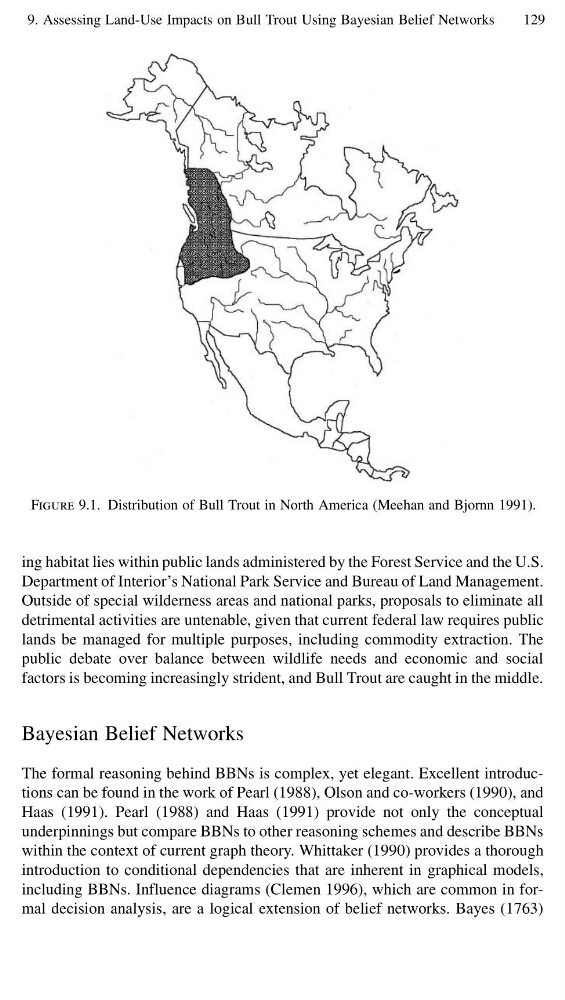
Figure 9.1. Distribution of Bull Trout in North America (Meehan and Bjornn 1991).
ing habitat lies within public lands administered by the Forest Service and the U.S.
Department of Interior’s National Park Service and Bureau of Land Management.
Outside of special wilderness areas and national parks, proposals to eliminate all
detrimental activities are untenable, given that current federal law requires public
lands be managed for multiple purposes, including commodity extraction. The
public debate over balance between wildlife needs and economic and social
factors is becoming increasingly strident, and Bull Trout are caught in the middle.
Bayesian Belief Networks
The formal reasoning behind BBNs is complex, yet elegant. Excellent introductions can be found in the work of Pearl (1988), Olson and co-workers (1990), and
Haas (1991). Pearl (1988) and Haas (1991) provide not only the conceptual
underpinnings but compare BBNs to other reasoning schemes and describe BBNs
within the context of current graph theory. Whittaker (1990) provides a thorough
introduction to conditional dependencies that are inherent in graphical models,
including BBNs. Influence diagrams (Clemen 1996), which are common in formal decision analysis, are a logical extension of belief networks. Bayes (1763)
129
Figure 9.1. Distribution of Bull Trout in North America (Meehan and Bjornn 1991).
ing habitat lies within public lands administered by the Forest Service and the U.S.
Department of Interior’s National Park Service and Bureau of Land Management.
Outside of special wilderness areas and national parks, proposals to eliminate all
detrimental activities are untenable, given that current federal law requires public
lands be managed for multiple purposes, including commodity extraction. The
public debate over balance between wildlife needs and economic and social
factors is becoming increasingly strident, and Bull Trout are caught in the middle.
Bayesian Belief Networks
The formal reasoning behind BBNs is complex, yet elegant. Excellent introductions can be found in the work of Pearl (1988), Olson and co-workers (1990), and
Haas (1991). Pearl (1988) and Haas (1991) provide not only the conceptual
underpinnings but compare BBNs to other reasoning schemes and describe BBNs
within the context of current graph theory. Whittaker (1990) provides a thorough
introduction to conditional dependencies that are inherent in graphical models,
including BBNs. Influence diagrams (Clemen 1996), which are common in formal decision analysis, are a logical extension of belief networks. Bayes (1763)