

Switching Between Deposit and Suspension Feeding in Coastal Zoobenthos
(f)
(g)
Food
accumulates
Pleopod current
79
Fig.4.1a-d. a Upper figures Deposit-feeding Corophium volutator collects particles from
the sediment surface with a scraping motion of the enlarged second antennae (from
Meadows and Reid 1966); lower figure, left suspension-feeding Corophium where particles are brought into the tube by the pleopodal current and caught on the filter of setae
of the second gnathopods; lower figure, right surface deposit-feeding Corophium where
particles are brought to the mouthparts from the antennal bolus by the first gnathopods
and manipulated (from Miller 1984). b Left figure Phyllochaetopterus prolifica utilising
two feeding modes other than the suspension-feeding mucus-bag method: when the
currents are moderately strong, the palps are held erect until impacted by a food
particle; the uppermost individual is about to engulf a particle caught in this fashion; the
other individual is deposit feeding on the fouled tube of the first individual (from
Fauchald and Jumars 1979); middle figure dorsal view of three segments showing the
position of mucus-bags and the formation of food balls (from Barnes 1964); right figure
lateral view of anterior and middle body region of Spiochaetopterus oculatus with
mucus-bags indicated (from Barnes 1965). c Left figure component steps in suspension
feeding by a spionid polychaete (from Shimeta and Koehl 1997); right figure dorsal
surface of entire worm Scolelepis squamata and a section ofpalp (from Dauer 1983). d
Position of Scrobicularia plana and inhalant siphonal activity while surface deposit
feeding (from Hughes 1969). e Extended Amphiura filiformis arms during passive
suspension feeding; horizontal arrows indicate current direction and velocity gradient,
and schematic drawings show morphometries of the tube feet and angle between the
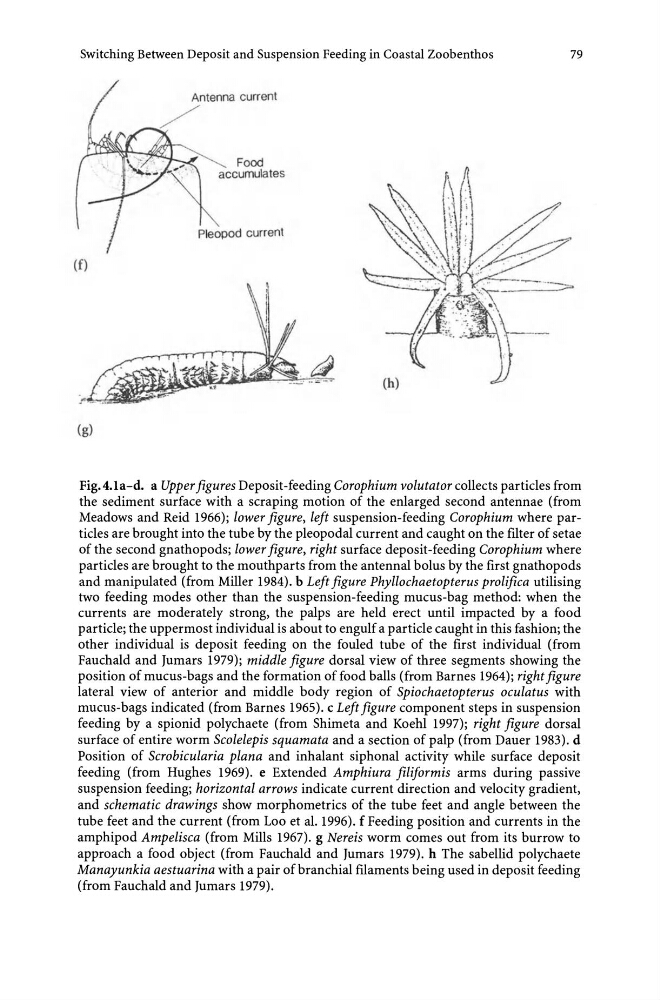
tube feet and the current (from Loo et al. 1996). f Feeding position and currents in the
amphipod Ampelisca (from Mills 1967). g Nereis worm comes out from its burrow to
approach a food object (from Fauchald and Jumars 1979). h The sabellid polychaete
Manayunkia aestuarina with a pair of branchial filaments being used in deposit feeding
(from Fauchald and Jumars 1979).
(f)
(g)
Food
accumulates
Pleopod current
79
Fig.4.1a-d. a Upper figures Deposit-feeding Corophium volutator collects particles from
the sediment surface with a scraping motion of the enlarged second antennae (from
Meadows and Reid 1966); lower figure, left suspension-feeding Corophium where particles are brought into the tube by the pleopodal current and caught on the filter of setae
of the second gnathopods; lower figure, right surface deposit-feeding Corophium where
particles are brought to the mouthparts from the antennal bolus by the first gnathopods
and manipulated (from Miller 1984). b Left figure Phyllochaetopterus prolifica utilising
two feeding modes other than the suspension-feeding mucus-bag method: when the
currents are moderately strong, the palps are held erect until impacted by a food
particle; the uppermost individual is about to engulf a particle caught in this fashion; the
other individual is deposit feeding on the fouled tube of the first individual (from
Fauchald and Jumars 1979); middle figure dorsal view of three segments showing the
position of mucus-bags and the formation of food balls (from Barnes 1964); right figure
lateral view of anterior and middle body region of Spiochaetopterus oculatus with
mucus-bags indicated (from Barnes 1965). c Left figure component steps in suspension
feeding by a spionid polychaete (from Shimeta and Koehl 1997); right figure dorsal
surface of entire worm Scolelepis squamata and a section ofpalp (from Dauer 1983). d
Position of Scrobicularia plana and inhalant siphonal activity while surface deposit
feeding (from Hughes 1969). e Extended Amphiura filiformis arms during passive
suspension feeding; horizontal arrows indicate current direction and velocity gradient,
and schematic drawings show morphometries of the tube feet and angle between the
tube feet and the current (from Loo et al. 1996). f Feeding position and currents in the
amphipod Ampelisca (from Mills 1967). g Nereis worm comes out from its burrow to
approach a food object (from Fauchald and Jumars 1979). h The sabellid polychaete
Manayunkia aestuarina with a pair of branchial filaments being used in deposit feeding
(from Fauchald and Jumars 1979).