

Suspension Feeders on Sandy Beaches
80
S 64
"
..,
'" 48
~
E
,g 32
Ie
.&
Q)
16
E
Donax truncu/us 100
Galicia, Spain (ca.42°N) J
n'18
_50ind.ni2
EL' effluent line
LT' low tide
%50~
l OgJ
n-85
%50~
108
J
n-97
%50~
108L:.97
%50
o
';::LL:
100~'97
%50
o
0102030405060
body size in mm
69
Emerita ana/oga
south central Chile (co. 39
0 S.:. 1:] I n'163
_ 2000ind.ni2
~
' ::i 48
Q)
" ;< 32
2.
E
£ 16
'"
.,
Q;
0 ~LT
E
109] I n.1690
%50~
%' 3L:'
l00~'23
%50
. " , - - - -
lOgL,:'15
%50
o
51015202530
body size in mm
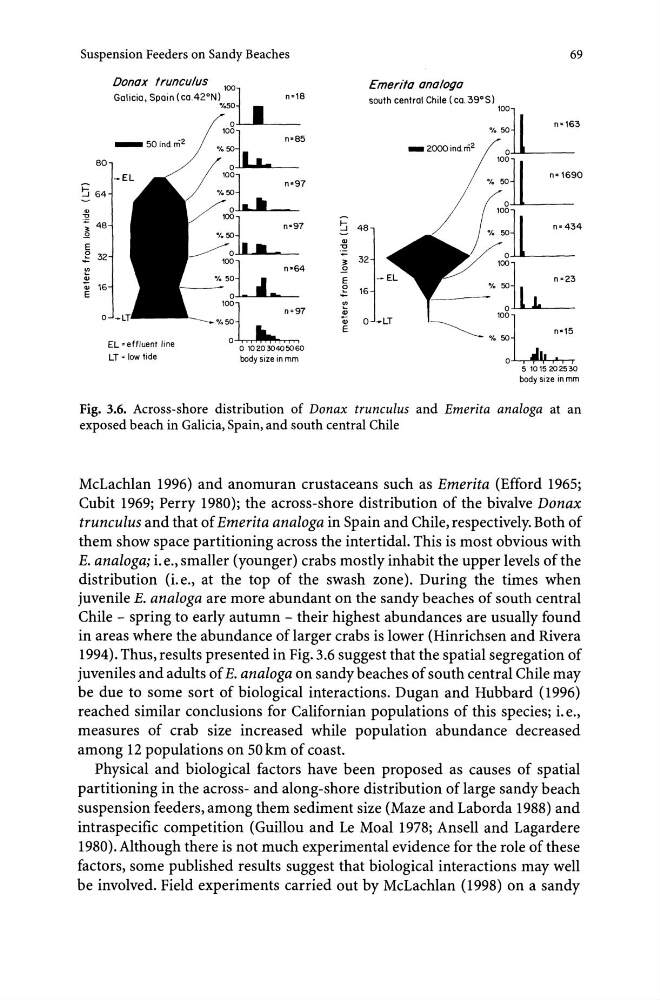
Fig. 3.6. Across-shore distribution of Donax trunculus and Emerita analoga at an
exposed beach in Galicia, Spain, and south central Chile
McLachlan 1996) and anomuran crustaceans such as Emerita (Efford 1965;
Cubit 1969; Perry 1980); the across-shore distribution of the bivalve Donax
trunculus and that of Emerita analoga in Spain and Chile, respectively. Both of
them show space partitioning across the intertidal. This is most obvious with
E. analoga; Le., smaller (younger) crabs mostly inhabit the upper levels of the
distribution (i.e., at the top of the swash zone). During the times when
juvenile E. analoga are more abundant on the sandy beaches of south central
Chile - spring to early autumn - their highest abundances are usually found
in areas where the abundance of larger crabs is lower (Hinrichsen and Rivera
1994). Thus, results presented in Fig. 3.6 suggest that the spatial segregation of
juveniles and adults of E. analoga on sandy beaches of south central Chile may
be due to some sort of biological interactions. Dugan and Hubbard (1996)
reached similar conclusions for Californian populations of this species; L e.,
measures of crab size increased while population abundance decreased
among 12 populations on 50 km of coast.
Physical and biological factors have been proposed as causes of spatial
partitioning in the across- and along-shore distribution of large sandy beach
suspension feeders, among them sediment size (Maze and Laborda 1988) and
intraspecific competition (Guillou and Le Moal 1978; Ansell and Lagardere
1980). Although there is not much experimental evidence for the role of these
factors, some published results suggest that biological interactions may well
be involved. Field experiments carried out by McLachlan (1998) on a sandy
80
S 64
"
..,
'" 48
~
E
,g 32
Ie
.&
Q)
16
E
Donax truncu/us 100
Galicia, Spain (ca.42°N) J
n'18
_50ind.ni2
EL' effluent line
LT' low tide
%50~
l OgJ
n-85
%50~
108
J
n-97
%50~
108L:.97
%50
o
';::LL:
100~'97
%50
o
0102030405060
body size in mm
69
Emerita ana/oga
south central Chile (co. 39
0 S.:. 1:] I n'163
_ 2000ind.ni2
~
' ::i 48
Q)
" ;< 32
2.
E
£ 16
'"
.,
Q;
0 ~LT
E
109] I n.1690
%50~
%' 3L:'
l00~'23
%50
. " , - - - -
lOgL,:'15
%50
o
51015202530
body size in mm
Fig. 3.6. Across-shore distribution of Donax trunculus and Emerita analoga at an
exposed beach in Galicia, Spain, and south central Chile
McLachlan 1996) and anomuran crustaceans such as Emerita (Efford 1965;
Cubit 1969; Perry 1980); the across-shore distribution of the bivalve Donax
trunculus and that of Emerita analoga in Spain and Chile, respectively. Both of
them show space partitioning across the intertidal. This is most obvious with
E. analoga; Le., smaller (younger) crabs mostly inhabit the upper levels of the
distribution (i.e., at the top of the swash zone). During the times when
juvenile E. analoga are more abundant on the sandy beaches of south central
Chile - spring to early autumn - their highest abundances are usually found
in areas where the abundance of larger crabs is lower (Hinrichsen and Rivera
1994). Thus, results presented in Fig. 3.6 suggest that the spatial segregation of
juveniles and adults of E. analoga on sandy beaches of south central Chile may
be due to some sort of biological interactions. Dugan and Hubbard (1996)
reached similar conclusions for Californian populations of this species; L e.,
measures of crab size increased while population abundance decreased
among 12 populations on 50 km of coast.
Physical and biological factors have been proposed as causes of spatial
partitioning in the across- and along-shore distribution of large sandy beach
suspension feeders, among them sediment size (Maze and Laborda 1988) and
intraspecific competition (Guillou and Le Moal 1978; Ansell and Lagardere
1980). Although there is not much experimental evidence for the role of these
factors, some published results suggest that biological interactions may well
be involved. Field experiments carried out by McLachlan (1998) on a sandy