

Dynamics in European and North American Soft-Bottom Mussel Beds
41
K
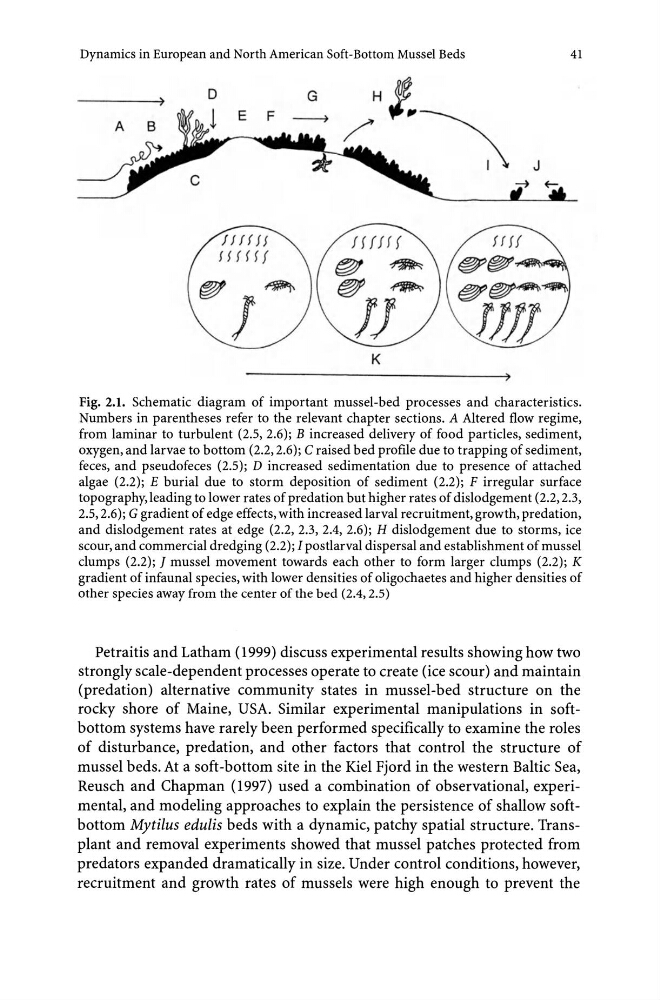
Fig. 2.1. Schematic diagram of important mussel-bed processes and characteristics.
Numbers in parentheses refer to the relevant chapter sections. A Altered flow regime,
from laminar to turbulent (2.5, 2.6); B increased delivery of food particles, sediment,
oxygen, and larvae to bottom (2.2,2.6); C raised bed profile due to trapping of sediment,
feces, and pseudofeces (2.5); D increased sedimentation due to presence of attached
algae (2.2); E burial due to storm deposition of sediment (2.2); F irregular surface
topography, leading to lower rates of predation but higher rates of dislodgement (2.2,2.3,
2.5,2.6); G gradient of edge effects, with increased larval recruitment, growth, predation,
and dislodgement rates at edge (2.2, 2.3, 2.4, 2.6); H dislodgement due to storms, ice
scour, and commercial dredging (2.2); I postlarval dispersal and establishment of mussel
clumps (2.2); J mussel movement towards each other to form larger clumps (2.2); K
gradient of infaunal species, with lower densities of oligochaetes and higher densities of
other species away from the center of the bed (2.4,2.5)
Petraitis and Latham (1999) discuss experimental results showing how two
strongly scale-dependent processes operate to create (ice scour) and maintain
(predation) alternative community states in mussel-bed structure on the
rocky shore of Maine, USA. Similar experimental manipulations in softbottom systems have rarely been performed specifically to examine the roles
of disturbance, predation, and other factors that control the structure of
mussel beds. At a soft-bottom site in the Kiel Fjord in the western Baltic Sea,
Reusch and Chapman (1997) used a combination of observational, experimental, and modeling approaches to explain the persistence of shallow softbottom Mytilus edulis beds with a dynamic, patchy spatial structure. Transplant and removal experiments showed that mussel patches protected from
predators expanded dramatically in size. Under control conditions, however,
recruitment and growth rates of mussels were high enough to prevent the
41
K
Fig. 2.1. Schematic diagram of important mussel-bed processes and characteristics.
Numbers in parentheses refer to the relevant chapter sections. A Altered flow regime,
from laminar to turbulent (2.5, 2.6); B increased delivery of food particles, sediment,
oxygen, and larvae to bottom (2.2,2.6); C raised bed profile due to trapping of sediment,
feces, and pseudofeces (2.5); D increased sedimentation due to presence of attached
algae (2.2); E burial due to storm deposition of sediment (2.2); F irregular surface
topography, leading to lower rates of predation but higher rates of dislodgement (2.2,2.3,
2.5,2.6); G gradient of edge effects, with increased larval recruitment, growth, predation,
and dislodgement rates at edge (2.2, 2.3, 2.4, 2.6); H dislodgement due to storms, ice
scour, and commercial dredging (2.2); I postlarval dispersal and establishment of mussel
clumps (2.2); J mussel movement towards each other to form larger clumps (2.2); K
gradient of infaunal species, with lower densities of oligochaetes and higher densities of
other species away from the center of the bed (2.4,2.5)
Petraitis and Latham (1999) discuss experimental results showing how two
strongly scale-dependent processes operate to create (ice scour) and maintain
(predation) alternative community states in mussel-bed structure on the
rocky shore of Maine, USA. Similar experimental manipulations in softbottom systems have rarely been performed specifically to examine the roles
of disturbance, predation, and other factors that control the structure of
mussel beds. At a soft-bottom site in the Kiel Fjord in the western Baltic Sea,
Reusch and Chapman (1997) used a combination of observational, experimental, and modeling approaches to explain the persistence of shallow softbottom Mytilus edulis beds with a dynamic, patchy spatial structure. Transplant and removal experiments showed that mussel patches protected from
predators expanded dramatically in size. Under control conditions, however,
recruitment and growth rates of mussels were high enough to prevent the