

366
K.Reise
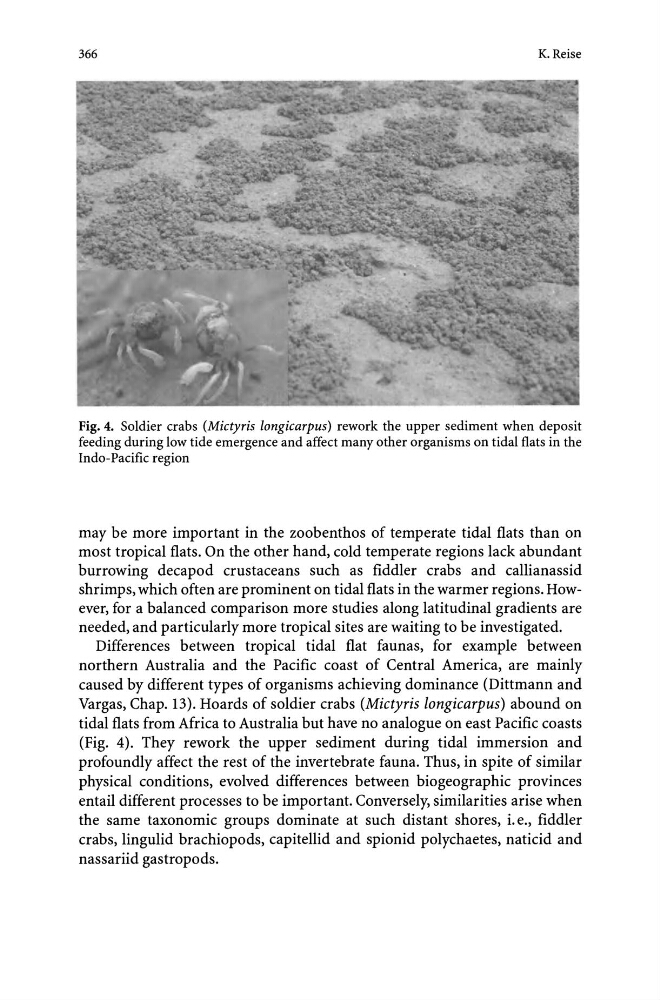
Fig. 4. Soldier crabs (Mictyris longicarpus) rework the upper sediment when deposit
feeding during low tide emergence and affect many other organisms on tidal flats in the
Indo-Pacific region
may be more important in the zoobenthos of temperate tidal flats than on
most tropical flats. On the other hand, cold temperate regions lack abundant
burrowing decapod crustaceans such as fiddler crabs and callianassid
shrimps, which often are prominent on tidal flats in the warmer regions. However, for a balanced comparison more studies along latitudinal gradients are
needed, and particularly more tropical sites are waiting to be investigated.
Differences between tropical tidal flat faunas, for example between
northern Australia and the Pacific coast of Central America, are mainly
caused by different types of organisms achieving dominance (Dittmann and
Vargas, Chap. 13). Hoards of soldier crabs (Mictyris longicarpus) abound on
tidal flats from Africa to Australia but have no analogue on east Pacific coasts
(Fig. 4). They rework the upper sediment during tidal immersion and
profoundly affect the rest of the invertebrate fauna. Thus, in spite of similar
physical conditions, evolved differences between biogeographic provinces
entail different processes to be important. Conversely, similarities arise when
the same taxonomic groups dominate at such distant shores, i. e., fiddler
crabs, lingulid brachiopods, capitellid and spionid polychaetes, naticid and
nassariid gastropods.
K.Reise
Fig. 4. Soldier crabs (Mictyris longicarpus) rework the upper sediment when deposit
feeding during low tide emergence and affect many other organisms on tidal flats in the
Indo-Pacific region
may be more important in the zoobenthos of temperate tidal flats than on
most tropical flats. On the other hand, cold temperate regions lack abundant
burrowing decapod crustaceans such as fiddler crabs and callianassid
shrimps, which often are prominent on tidal flats in the warmer regions. However, for a balanced comparison more studies along latitudinal gradients are
needed, and particularly more tropical sites are waiting to be investigated.
Differences between tropical tidal flat faunas, for example between
northern Australia and the Pacific coast of Central America, are mainly
caused by different types of organisms achieving dominance (Dittmann and
Vargas, Chap. 13). Hoards of soldier crabs (Mictyris longicarpus) abound on
tidal flats from Africa to Australia but have no analogue on east Pacific coasts
(Fig. 4). They rework the upper sediment during tidal immersion and
profoundly affect the rest of the invertebrate fauna. Thus, in spite of similar
physical conditions, evolved differences between biogeographic provinces
entail different processes to be important. Conversely, similarities arise when
the same taxonomic groups dominate at such distant shores, i. e., fiddler
crabs, lingulid brachiopods, capitellid and spionid polychaetes, naticid and
nassariid gastropods.