

Synthesis: Comparative Ecology of Sedimentary Shores
361
inhalant siphon to suck in the detritus that accumulates in the troughs between ripples, only when the tide is out (Reise 1987). Presumably, when the
tidal flats are submerged, there are too many fish eager to crop the siphons.
Comparing feeding behavior of shore animals across distant coasts may indicate what the major food resources are or which kind of predation pressures
prevail. Experiments and behavioral studies are essential to determine the
causes for switches in feeding modes.
Biogenic Stabilization and Disturbances
Organisms transform their sedimentary environment by stabilizing as well as
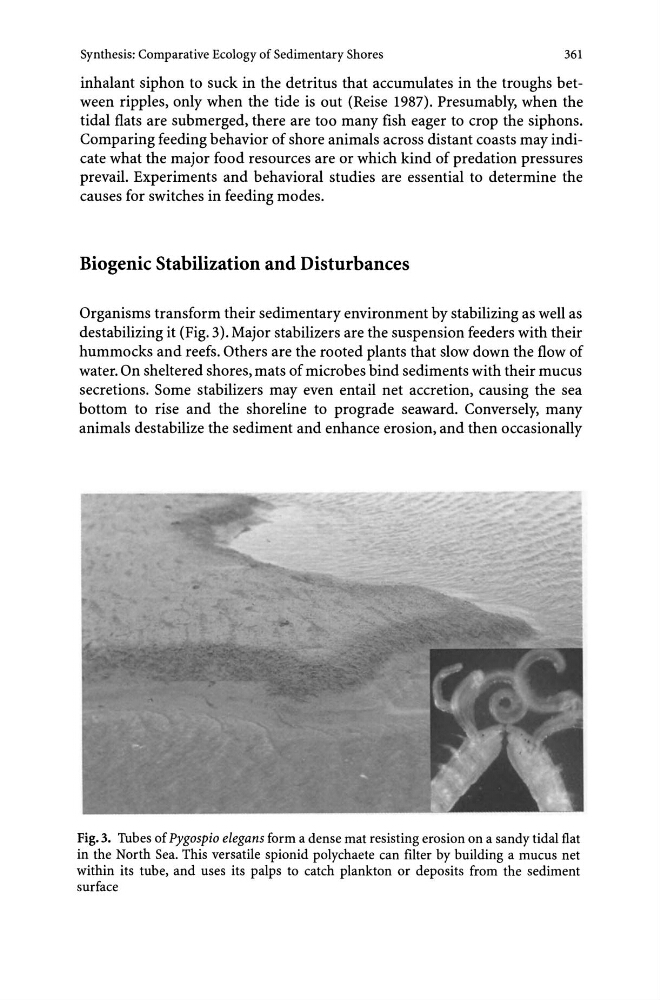
destabilizing it (Fig. 3). Major stabilizers are the suspension feeders with their
hummocks and reefs. Others are the rooted plants that slow down the flow of
water. On sheltered shores, mats of microbes bind sediments with their mucus
secretions. Some stabilizers may even entail net accretion, causing the sea
bottom to rise and the shoreline to prograde seaward. Conversely, many
animals destabilize the sediment and enhance erosion, and then occasionally
Fig. 3. Tubes of Pygospio elegans form a dense mat resisting erosion on a sandy tidal flat
in the North Sea. This versatile spionid polychaete can filter by building a mucus net
within its tube, and uses its palps to catch plankton or deposits from the sediment
surface
361
inhalant siphon to suck in the detritus that accumulates in the troughs between ripples, only when the tide is out (Reise 1987). Presumably, when the
tidal flats are submerged, there are too many fish eager to crop the siphons.
Comparing feeding behavior of shore animals across distant coasts may indicate what the major food resources are or which kind of predation pressures
prevail. Experiments and behavioral studies are essential to determine the
causes for switches in feeding modes.
Biogenic Stabilization and Disturbances
Organisms transform their sedimentary environment by stabilizing as well as
destabilizing it (Fig. 3). Major stabilizers are the suspension feeders with their
hummocks and reefs. Others are the rooted plants that slow down the flow of
water. On sheltered shores, mats of microbes bind sediments with their mucus
secretions. Some stabilizers may even entail net accretion, causing the sea
bottom to rise and the shoreline to prograde seaward. Conversely, many
animals destabilize the sediment and enhance erosion, and then occasionally
Fig. 3. Tubes of Pygospio elegans form a dense mat resisting erosion on a sandy tidal flat
in the North Sea. This versatile spionid polychaete can filter by building a mucus net
within its tube, and uses its palps to catch plankton or deposits from the sediment
surface