

342
D. Raffaelli and M. Emmerson
predators
(D) 1 l·1
yd-··:l~
other invertebrates
a
subsidy
other locations
organic matter
nutrients
b
organic matter l1li
macro-algae
/-1
nutrients
recipient
predators
invertebrates
macro-algae
effects on lower
trophic level ?
no effect
no effect
effects on higher
trophic level?
increase in predators
decrease in most
invertebrates
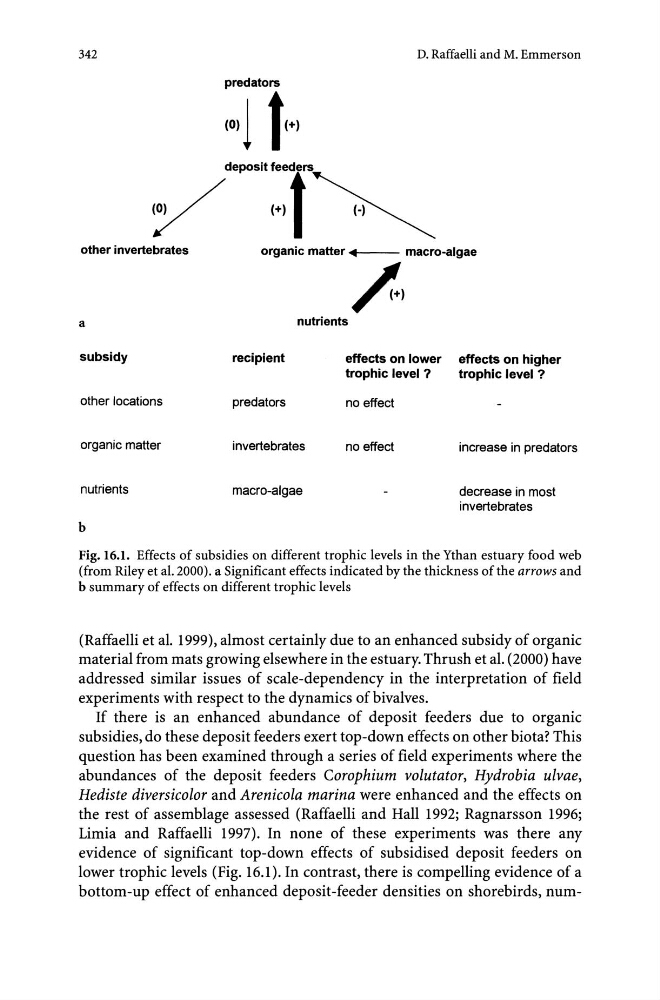
Fig. 16.1. Effects of subsidies on different trophic levels in the Ythan estuary food web
(from Riley et al. 2000). a Significant effects indicated by the thickness of the arrows and
b summary of effects on different trophic levels
(Raffaelli et al. 1999), almost certainly due to an enhanced subsidy of organic
material from mats growing elsewhere in the estuary. Thrush et al. (2000) have
addressed similar issues of scale-dependency in the interpretation of field
experiments with respect to the dynamics of bivalves.
If there is an enhanced abundance of deposit feeders due to organic
subsidies, do these deposit feeders exert top-down effects on other biota? This
question has been examined through a series of field experiments where the
abundances of the deposit feeders Corophium volutator, Hydrobia ulvae,
Hediste diversicolor and Arenicola marina were enhanced and the effects on
the rest of assemblage assessed (Raffaelli and Hall 1992; Ragnarsson 1996;
Limia and Raffaelli 1997). In none of these experiments was there any
evidence of significant top-down effects of subsidised deposit feeders on
lower trophic levels (Fig. 16.1). In contrast, there is compelling evidence of a
bottom-up effect of enhanced deposit-feeder densities on shorebirds, num-
D. Raffaelli and M. Emmerson
predators
(D) 1 l·1
yd-··:l~
other invertebrates
a
subsidy
other locations
organic matter
nutrients
b
organic matter l1li
macro-algae
/-1
nutrients
recipient
predators
invertebrates
macro-algae
effects on lower
trophic level ?
no effect
no effect
effects on higher
trophic level?
increase in predators
decrease in most
invertebrates
Fig. 16.1. Effects of subsidies on different trophic levels in the Ythan estuary food web
(from Riley et al. 2000). a Significant effects indicated by the thickness of the arrows and
b summary of effects on different trophic levels
(Raffaelli et al. 1999), almost certainly due to an enhanced subsidy of organic
material from mats growing elsewhere in the estuary. Thrush et al. (2000) have
addressed similar issues of scale-dependency in the interpretation of field
experiments with respect to the dynamics of bivalves.
If there is an enhanced abundance of deposit feeders due to organic
subsidies, do these deposit feeders exert top-down effects on other biota? This
question has been examined through a series of field experiments where the
abundances of the deposit feeders Corophium volutator, Hydrobia ulvae,
Hediste diversicolor and Arenicola marina were enhanced and the effects on
the rest of assemblage assessed (Raffaelli and Hall 1992; Ragnarsson 1996;
Limia and Raffaelli 1997). In none of these experiments was there any
evidence of significant top-down effects of subsidised deposit feeders on
lower trophic levels (Fig. 16.1). In contrast, there is compelling evidence of a
bottom-up effect of enhanced deposit-feeder densities on shorebirds, num-