

330
J. van der Meer et al.
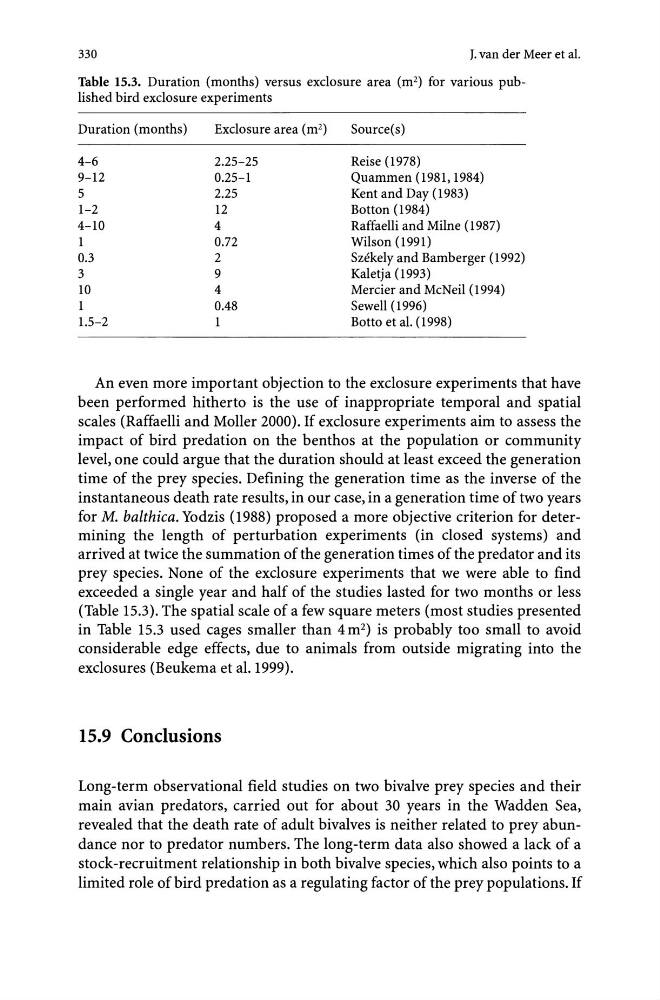
Table 15.3. Duration (months) versus exclosure area (m 2 ) for various published bird exclosure experiments
Duration (months)
Exclosure area (m 2 )
Source(s)
4-6
2.25-25
Reise (1978)
9-12
0.25-1
Quammen (1981, 1984)
5
2.25
Kent and Day ( 1983)
1-2
12
Botton (1984)
4-10
4
Raffaelli and Milne (1987)
0.72
Wilson (1991)
0.3
2
Szekely and Bamberger (1992)
3
9
Kaletja (1993)
10
4
Mercier and McNeil (1994)
0.48
Sewell (1996)
1.5-2
Botto et al. (1998)
An even more important objection to the exclosure experiments that have
been performed hitherto is the use of inappropriate temporal and spatial
scales (Raffaelli and Moller 2000). If exclosure experiments aim to assess the
impact of bird predation on the benthos at the population or community
level, one could argue that the duration should at least exceed the generation
time of the prey species. Defining the generation time as the inverse of the
instantaneous death rate results, in our case, in a generation time of two years
for M. balthica. Yodzis (1988) proposed a more objective criterion for determining the length of perturbation experiments (in closed systems) and
arrived at twice the summation of the generation times of the predator and its
prey species. None of the exclosure experiments that we were able to find
exceeded a single year and half of the studies lasted for two months or less
(Table 15.3). The spatial scale of a few square meters (most studies presented
in Table 15.3 used cages smaller than 4m2) is probably too small to avoid
considerable edge effects, due to animals from outside migrating into the
exclosures (Beukema et al. 1999).
15.9 Conclusions
Long-term observational field studies on two bivalve prey species and their
main avian predators, carried out for about 30 years in the Wadden Sea,
revealed that the death rate of adult bivalves is neither related to prey abundance nor to predator numbers. The long-term data also showed a lack of a
stock-recruitment relationship in both bivalve species, which also points to a
limited role of bird predation as a regulating factor of the prey populations. If
J. van der Meer et al.
Table 15.3. Duration (months) versus exclosure area (m 2 ) for various published bird exclosure experiments
Duration (months)
Exclosure area (m 2 )
Source(s)
4-6
2.25-25
Reise (1978)
9-12
0.25-1
Quammen (1981, 1984)
5
2.25
Kent and Day ( 1983)
1-2
12
Botton (1984)
4-10
4
Raffaelli and Milne (1987)
0.72
Wilson (1991)
0.3
2
Szekely and Bamberger (1992)
3
9
Kaletja (1993)
10
4
Mercier and McNeil (1994)
0.48
Sewell (1996)
1.5-2
Botto et al. (1998)
An even more important objection to the exclosure experiments that have
been performed hitherto is the use of inappropriate temporal and spatial
scales (Raffaelli and Moller 2000). If exclosure experiments aim to assess the
impact of bird predation on the benthos at the population or community
level, one could argue that the duration should at least exceed the generation
time of the prey species. Defining the generation time as the inverse of the
instantaneous death rate results, in our case, in a generation time of two years
for M. balthica. Yodzis (1988) proposed a more objective criterion for determining the length of perturbation experiments (in closed systems) and
arrived at twice the summation of the generation times of the predator and its
prey species. None of the exclosure experiments that we were able to find
exceeded a single year and half of the studies lasted for two months or less
(Table 15.3). The spatial scale of a few square meters (most studies presented
in Table 15.3 used cages smaller than 4m2) is probably too small to avoid
considerable edge effects, due to animals from outside migrating into the
exclosures (Beukema et al. 1999).
15.9 Conclusions
Long-term observational field studies on two bivalve prey species and their
main avian predators, carried out for about 30 years in the Wadden Sea,
revealed that the death rate of adult bivalves is neither related to prey abundance nor to predator numbers. The long-term data also showed a lack of a
stock-recruitment relationship in both bivalve species, which also points to a
limited role of bird predation as a regulating factor of the prey populations. If