

328
'"
0
0
:;
"0
·s
t;
~ 0
OJ
.Q
0.0
o
o
o
o
o
o
o
•
••
00&;.: . ,
o
0
•
o
o·
,..
o
o 0 0
•
o
o
o
0.5
1.0
1.5
2.0
2.5
log adult density
J. van der Meer et al.
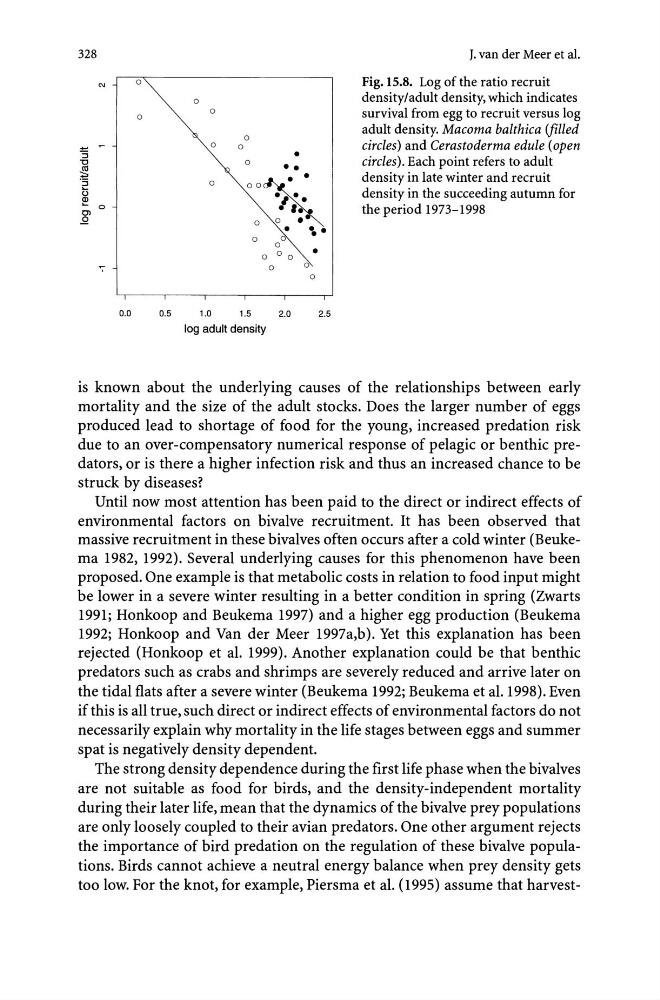
Fig. 15.8. Log of the ratio recruit
density/adult density, which indicates
survival from egg to recruit versus log
adult density. Macoma balthica (filled
circles) and Cerastoderma edule (open
circles). Each point refers to adult
density in late winter and recruit
density in the succeeding autumn for
the period 1973-1998
is known about the underlying causes of the relationships between early
mortality and the size of the adult stocks. Does the larger number of eggs
produced lead to shortage of food for the young, increased predation risk
due to an over-compensatory numerical response of pelagic or benthic predators, or is there a higher infection risk and thus an increased chance to be
struck by diseases?
Until now most attention has been paid to the direct or indirect effects of
environmental factors on bivalve recruitment. It has been observed that
massive recruitment in these bivalves often occurs after a cold winter (Beukema 1982, 1992). Several underlying causes for this phenomenon have been
proposed. One example is that metabolic costs in relation to food input might
be lower in a severe winter resulting in a better condition in spring (Zwarts
1991; Honkoop and Beukema 1997) and a higher egg production (Beukema
1992; Honkoop and Van der Meer 1997a,b). Yet this explanation has been
rejected (Honkoop et al. 1999). Another explanation could be that benthic
predators such as crabs and shrimps are severely reduced and arrive later on
the tidal flats after a severe winter (Beukema 1992; Beukema et al. 1998). Even
if this is all true, such direct or indirect effects of environmental factors do not
necessarily explain why mortality in the life stages between eggs and summer
spat is negatively density dependent.
The strong density dependence during the first life phase when the bivalves
are not suitable as food for birds, and the density-independent mortality
during their later life, mean that the dynamics of the bivalve prey populations
are only loosely coupled to their avian predators. One other argument rejects
the importance of bird predation on the regulation of these bivalve populations. Birds cannot achieve a neutral energy balance when prey density gets
too low. For the knot, for example, Piers rna et al. (1995) assume that harvest-
'"
0
0
:;
"0
·s
t;
~ 0
OJ
.Q
0.0
o
o
o
o
o
o
o
•
••
00&;.: . ,
o
0
•
o
o·
,..
o
o 0 0
•
o
o
o
0.5
1.0
1.5
2.0
2.5
log adult density
J. van der Meer et al.
Fig. 15.8. Log of the ratio recruit
density/adult density, which indicates
survival from egg to recruit versus log
adult density. Macoma balthica (filled
circles) and Cerastoderma edule (open
circles). Each point refers to adult
density in late winter and recruit
density in the succeeding autumn for
the period 1973-1998
is known about the underlying causes of the relationships between early
mortality and the size of the adult stocks. Does the larger number of eggs
produced lead to shortage of food for the young, increased predation risk
due to an over-compensatory numerical response of pelagic or benthic predators, or is there a higher infection risk and thus an increased chance to be
struck by diseases?
Until now most attention has been paid to the direct or indirect effects of
environmental factors on bivalve recruitment. It has been observed that
massive recruitment in these bivalves often occurs after a cold winter (Beukema 1982, 1992). Several underlying causes for this phenomenon have been
proposed. One example is that metabolic costs in relation to food input might
be lower in a severe winter resulting in a better condition in spring (Zwarts
1991; Honkoop and Beukema 1997) and a higher egg production (Beukema
1992; Honkoop and Van der Meer 1997a,b). Yet this explanation has been
rejected (Honkoop et al. 1999). Another explanation could be that benthic
predators such as crabs and shrimps are severely reduced and arrive later on
the tidal flats after a severe winter (Beukema 1992; Beukema et al. 1998). Even
if this is all true, such direct or indirect effects of environmental factors do not
necessarily explain why mortality in the life stages between eggs and summer
spat is negatively density dependent.
The strong density dependence during the first life phase when the bivalves
are not suitable as food for birds, and the density-independent mortality
during their later life, mean that the dynamics of the bivalve prey populations
are only loosely coupled to their avian predators. One other argument rejects
the importance of bird predation on the regulation of these bivalve populations. Birds cannot achieve a neutral energy balance when prey density gets
too low. For the knot, for example, Piers rna et al. (1995) assume that harvest-