

Recovery Dynamics in Benthic Communities: Balancing Detail with Simplification
307
•
Disturbed
area
Sandllat
Dominant
colonist
sources
~
CI>
>
o
<..>
~
'0
.!!!
III
II:
Surrounding sediments
(e.g., with bedload)
em - 100 m
Nearby habitats
(e.g., Planktonic larvae
and drifters - locally sourced)
100 m - km
Bedload
Outside the system
(i.e., Planktonic larvae
and drifters - distant source)
km - 100 km
Size of disturbed area
Critical
thresholds
Local habitats
Local habitats
Distant habitats
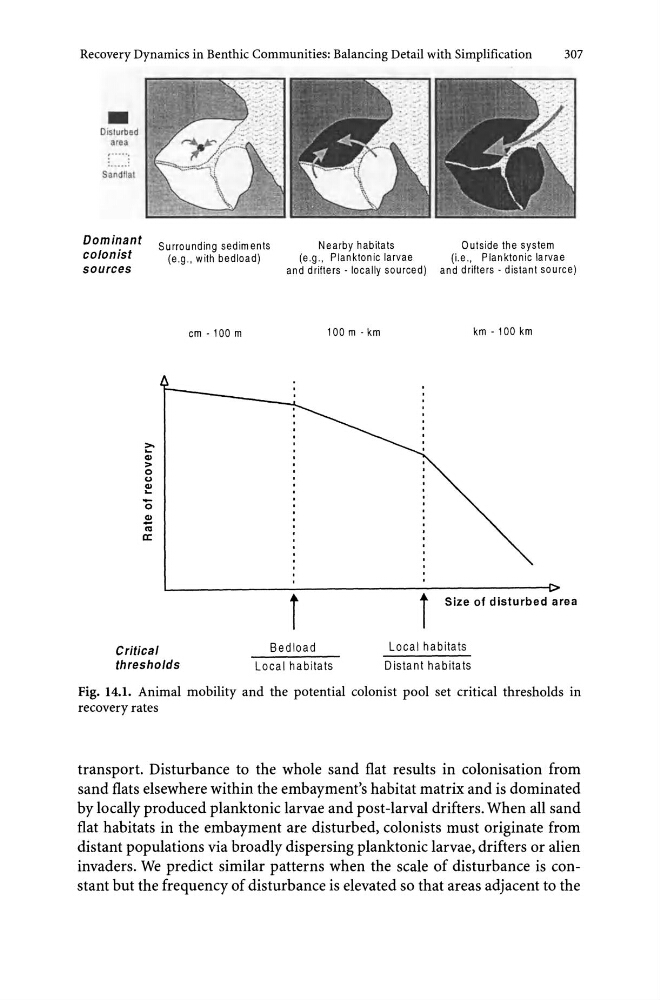
Fig. 14.1. Animal mobility and the potential colonist pool set critical thresholds in
recovery rates
transport. Disturbance to the whole sand flat results in colonisation from
sand flats elsewhere within the embayment's habitat matrix and is dominated
by locally produced planktonic larvae and post-larval drifters. When all sand
flat habitats in the embayment are disturbed, colonists must originate from
distant populations via broadly dispersing planktonic larvae, drifters or alien
invaders. We predict similar patterns when the scale of disturbance is constant but the frequency of disturbance is elevated so that areas adjacent to the
307
•
Disturbed
area
Sandllat
Dominant
colonist
sources
~
CI>
>
o
<..>
~
'0
.!!!
III
II:
Surrounding sediments
(e.g., with bedload)
em - 100 m
Nearby habitats
(e.g., Planktonic larvae
and drifters - locally sourced)
100 m - km
Bedload
Outside the system
(i.e., Planktonic larvae
and drifters - distant source)
km - 100 km
Size of disturbed area
Critical
thresholds
Local habitats
Local habitats
Distant habitats
Fig. 14.1. Animal mobility and the potential colonist pool set critical thresholds in
recovery rates
transport. Disturbance to the whole sand flat results in colonisation from
sand flats elsewhere within the embayment's habitat matrix and is dominated
by locally produced planktonic larvae and post-larval drifters. When all sand
flat habitats in the embayment are disturbed, colonists must originate from
distant populations via broadly dispersing planktonic larvae, drifters or alien
invaders. We predict similar patterns when the scale of disturbance is constant but the frequency of disturbance is elevated so that areas adjacent to the