

Recovery Dynamics in Benthic Communities: Balancing Detail with Simplification
305
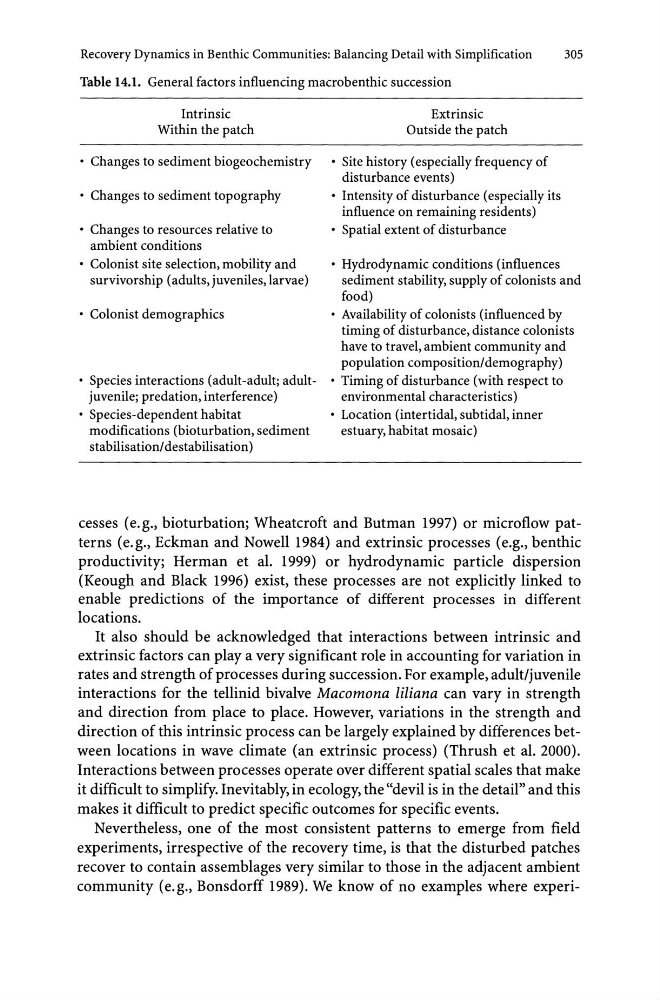
Table 14.1. General factors influencing macrobenthic succession
Intrinsic
Within the patch
• Changes to sediment biogeochemistry
• Changes to sediment topography
• Changes to resources relative to
ambient conditions
• Colonist site selection, mobility and
survivorship (adults, juveniles, larvae)
• Colonist demographics
• Species interactions (adult-adult; adultjuvenile; predation, interference)
• Species-dependent habitat
modifications (bioturbation, sediment
stabilisation/destabilisation)
Extrinsic
Outside the patch
• Site history (especially frequency of
disturbance events)
• Intensity of disturbance (especially its
influence on remaining residents)
• Spatial extent of disturbance
• Hydrodynamic conditions (influences
sediment stability, supply of colonists and
food)
• Availability of colonists (influenced by
timing of disturbance, distance colonists
have to travel, ambient community and
population composition/demography)
• Timing of disturbance (with respect to
environmental characteristics)
• Location (intertidal, subtidal, inner
estuary, habitat mosaic)
cesses (e. g., bioturbation; Wheatcroft and Butman 1997) or micro flow patterns (e.g., Eckman and Nowell 1984) and extrinsic processes (e.g., benthic
productivity; Herman et al. 1999) or hydrodynamic particle dispersion
(Keough and Black 1996) exist, these processes are not explicitly linked to
enable predictions of the importance of different processes in different
locations.
It also should be acknowledged that interactions between intrinsic and
extrinsic factors can playa very significant role in accounting for variation in
rates and strength of processes during succession. For example, adult/juvenile
interactions for the tellinid bivalve Macomona liliana can vary in strength
and direction from place to place. However, variations in the strength and
direction of this intrinsic process can be largely explained by differences between locations in wave climate (an extrinsic process) (Thrush et al. 2000).
Interactions between processes operate over different spatial scales that make
it difficult to simplify. Inevitably, in ecology, the "devil is in the detail" and this
makes it difficult to predict specific outcomes for specific events.
Nevertheless, one of the most consistent patterns to emerge from field
experiments, irrespective of the recovery time, is that the disturbed patches
recover to contain assemblages very similar to those in the adjacent ambient
community (e.g., Bonsdorff 1989). We know of no examples where experi-
305
Table 14.1. General factors influencing macrobenthic succession
Intrinsic
Within the patch
• Changes to sediment biogeochemistry
• Changes to sediment topography
• Changes to resources relative to
ambient conditions
• Colonist site selection, mobility and
survivorship (adults, juveniles, larvae)
• Colonist demographics
• Species interactions (adult-adult; adultjuvenile; predation, interference)
• Species-dependent habitat
modifications (bioturbation, sediment
stabilisation/destabilisation)
Extrinsic
Outside the patch
• Site history (especially frequency of
disturbance events)
• Intensity of disturbance (especially its
influence on remaining residents)
• Spatial extent of disturbance
• Hydrodynamic conditions (influences
sediment stability, supply of colonists and
food)
• Availability of colonists (influenced by
timing of disturbance, distance colonists
have to travel, ambient community and
population composition/demography)
• Timing of disturbance (with respect to
environmental characteristics)
• Location (intertidal, subtidal, inner
estuary, habitat mosaic)
cesses (e. g., bioturbation; Wheatcroft and Butman 1997) or micro flow patterns (e.g., Eckman and Nowell 1984) and extrinsic processes (e.g., benthic
productivity; Herman et al. 1999) or hydrodynamic particle dispersion
(Keough and Black 1996) exist, these processes are not explicitly linked to
enable predictions of the importance of different processes in different
locations.
It also should be acknowledged that interactions between intrinsic and
extrinsic factors can playa very significant role in accounting for variation in
rates and strength of processes during succession. For example, adult/juvenile
interactions for the tellinid bivalve Macomona liliana can vary in strength
and direction from place to place. However, variations in the strength and
direction of this intrinsic process can be largely explained by differences between locations in wave climate (an extrinsic process) (Thrush et al. 2000).
Interactions between processes operate over different spatial scales that make
it difficult to simplify. Inevitably, in ecology, the "devil is in the detail" and this
makes it difficult to predict specific outcomes for specific events.
Nevertheless, one of the most consistent patterns to emerge from field
experiments, irrespective of the recovery time, is that the disturbed patches
recover to contain assemblages very similar to those in the adjacent ambient
community (e.g., Bonsdorff 1989). We know of no examples where experi-