

Soft-Bottom Fauna of a Tropical and a Temperate Intertidal Area
271
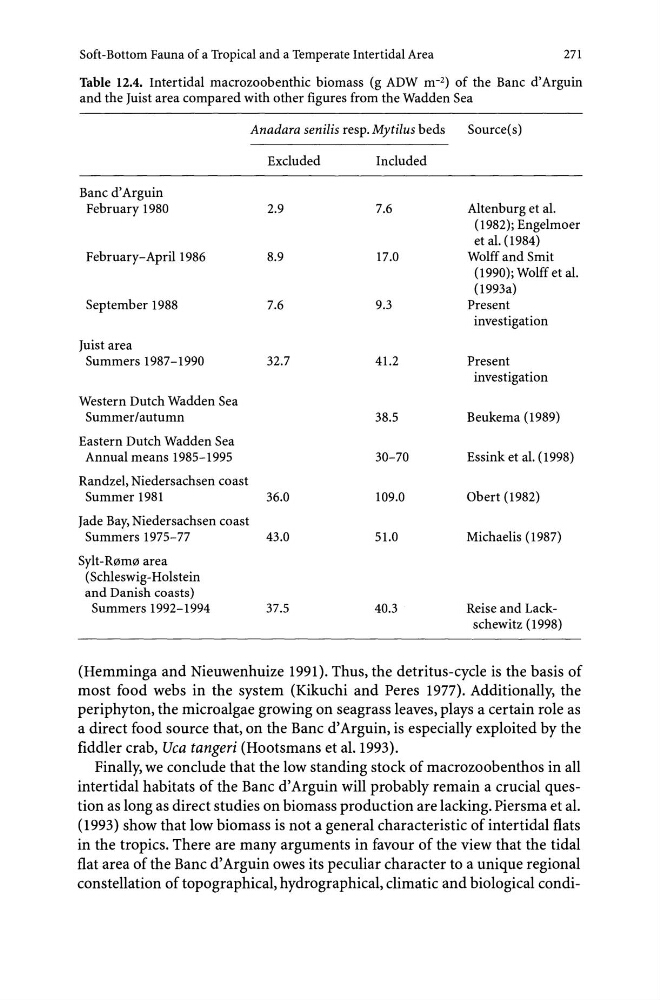
Table 12.4. Intertidal macrozoobenthic biomass (g ADW m- 2 ) of the Banc d'Arguin
and the Juist area compared with other figures from the Wadden Sea
Anadara senilis resp. Mytilus beds
Source(s)
Excluded
Included
Banc d' Arguin
February 1980
2.9
7.6
Altenburg et al.
(1982); Engelmoer
et al. (1984)
February-April 1986
8.9
17.0
Wolff and Smit
(1990); Wolff et al.
(1993a)
September 1988
7.6
9.3
Present
investigation
Juist area
Summers 1987-1990
32.7
41.2
Present
investigation
Western Dutch Wadden Sea
Summer/autumn
38.5
Beukema (1989)
Eastern Dutch Wadden Sea
Annual means 1985-1995
30-70
Essink et aI. (1998)
Randzel, Niedersachsen coast
Summer 1981
36.0
109.0
Obert (1982)
Jade Bay, Niedersachsen coast
Summers 1975-77
43.0
51.0
Michaelis (1987)
Sylt-R0m0 area
(Schleswig-Holstein
and Danish coasts)
Summers 1992-1994
37.5
40.3
Reise and Lackschewitz (1998)
(Hemminga and Nieuwenhuize 1991). Thus, the detritus-cycle is the basis of
most food webs in the system (Kikuchi and Peres 1977). Additionally, the
periphyton, the micro algae growing on seagrass leaves, plays a certain role as
a direct food source that, on the Bane d' Arguin, is especially exploited by the
fiddler crab, Uca tangeri (Hootsmans et al. 1993).
Finally, we conclude that the low standing stock of macrozoobenthos in all
intertidal habitats of the Bane d' Arguin will probably remain a crucial question as long as direct studies on biomass production are lacking. Piersma et al.
(1993) show that low biomass is not a general characteristic of intertidal flats
in the tropics. There are many arguments in favour of the view that the tidal
flat area of the Bane d' Arguin owes its peculiar character to a unique regional
constellation of topographical, hydrographical, climatic and biological condi-
271
Table 12.4. Intertidal macrozoobenthic biomass (g ADW m- 2 ) of the Banc d'Arguin
and the Juist area compared with other figures from the Wadden Sea
Anadara senilis resp. Mytilus beds
Source(s)
Excluded
Included
Banc d' Arguin
February 1980
2.9
7.6
Altenburg et al.
(1982); Engelmoer
et al. (1984)
February-April 1986
8.9
17.0
Wolff and Smit
(1990); Wolff et al.
(1993a)
September 1988
7.6
9.3
Present
investigation
Juist area
Summers 1987-1990
32.7
41.2
Present
investigation
Western Dutch Wadden Sea
Summer/autumn
38.5
Beukema (1989)
Eastern Dutch Wadden Sea
Annual means 1985-1995
30-70
Essink et aI. (1998)
Randzel, Niedersachsen coast
Summer 1981
36.0
109.0
Obert (1982)
Jade Bay, Niedersachsen coast
Summers 1975-77
43.0
51.0
Michaelis (1987)
Sylt-R0m0 area
(Schleswig-Holstein
and Danish coasts)
Summers 1992-1994
37.5
40.3
Reise and Lackschewitz (1998)
(Hemminga and Nieuwenhuize 1991). Thus, the detritus-cycle is the basis of
most food webs in the system (Kikuchi and Peres 1977). Additionally, the
periphyton, the micro algae growing on seagrass leaves, plays a certain role as
a direct food source that, on the Bane d' Arguin, is especially exploited by the
fiddler crab, Uca tangeri (Hootsmans et al. 1993).
Finally, we conclude that the low standing stock of macrozoobenthos in all
intertidal habitats of the Bane d' Arguin will probably remain a crucial question as long as direct studies on biomass production are lacking. Piersma et al.
(1993) show that low biomass is not a general characteristic of intertidal flats
in the tropics. There are many arguments in favour of the view that the tidal
flat area of the Bane d' Arguin owes its peculiar character to a unique regional
constellation of topographical, hydrographical, climatic and biological condi-