

256
m Breeding areas
§
Wintering areas
H. Michaelis and W.J. Wolff
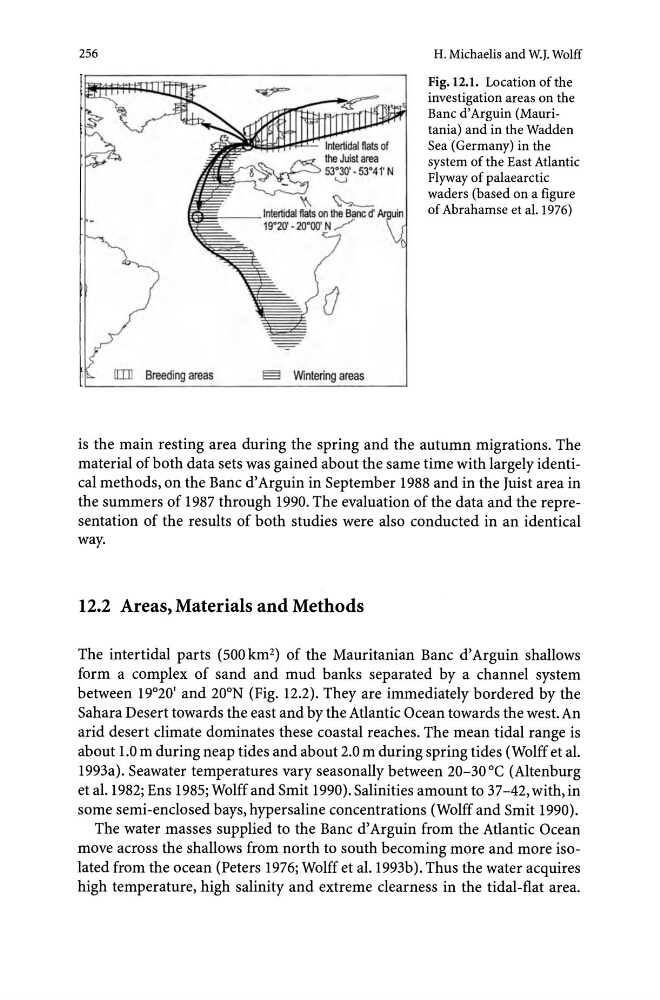
Fig.12.1. Location of the
investigation areas on the
Banc d' Arguin (Mauritania) and in the Wadden
Sea (Germany) in the
system of the East Atlantic
Flyway of palaearctic
waders (based on a figure
of Abrahamse et al. 1976)
is the main resting area during the spring and the autumn migrations. The
material of both data sets was gained about the same time with largely identical methods, on the Banc d'Arguin in September 1988 and in the Juist area in
the summers of 1987 through 1990. The evaluation of the data and the representation of the results of both studies were also conducted in an identical
way.
12.2 Areas, Materials and Methods
The intertidal parts (500 km 2 ) of the Mauritanian Banc d' Arguin shallows
form a complex of sand and mud banks separated by a channel system
between 19°20' and 200N (Fig. 12.2). They are immediately bordered by the
Sahara Desert towards the east and by the Atlantic Ocean towards the west. An
arid desert climate dominates these coastal reaches. The mean tidal range is
about 1.0 m during neap tides and about 2.0 m during spring tides (Wolff et al.
1993a). Seawater temperatures vary seasonally between 20-30°C (Altenburg
et al. 1982; Ens 1985; Wolff and Smit 1990). Salinities amount to 37-42, with, in
some semi-enclosed bays, hypersaline concentrations (Wolff and Smit 1990).
The water masses supplied to the Banc d' Arguin from the Atlantic Ocean
move across the shallows from north to south becoming more and more isolated from the ocean (Peters 1976; Wolff et al.1993b). Thus the water acquires
high temperature, high salinity and extreme clearness in the tidal-flat area.
m Breeding areas
§
Wintering areas
H. Michaelis and W.J. Wolff
Fig.12.1. Location of the
investigation areas on the
Banc d' Arguin (Mauritania) and in the Wadden
Sea (Germany) in the
system of the East Atlantic
Flyway of palaearctic
waders (based on a figure
of Abrahamse et al. 1976)
is the main resting area during the spring and the autumn migrations. The
material of both data sets was gained about the same time with largely identical methods, on the Banc d'Arguin in September 1988 and in the Juist area in
the summers of 1987 through 1990. The evaluation of the data and the representation of the results of both studies were also conducted in an identical
way.
12.2 Areas, Materials and Methods
The intertidal parts (500 km 2 ) of the Mauritanian Banc d' Arguin shallows
form a complex of sand and mud banks separated by a channel system
between 19°20' and 200N (Fig. 12.2). They are immediately bordered by the
Sahara Desert towards the east and by the Atlantic Ocean towards the west. An
arid desert climate dominates these coastal reaches. The mean tidal range is
about 1.0 m during neap tides and about 2.0 m during spring tides (Wolff et al.
1993a). Seawater temperatures vary seasonally between 20-30°C (Altenburg
et al. 1982; Ens 1985; Wolff and Smit 1990). Salinities amount to 37-42, with, in
some semi-enclosed bays, hypersaline concentrations (Wolff and Smit 1990).
The water masses supplied to the Banc d' Arguin from the Atlantic Ocean
move across the shallows from north to south becoming more and more isolated from the ocean (Peters 1976; Wolff et al.1993b). Thus the water acquires
high temperature, high salinity and extreme clearness in the tidal-flat area.