

Energy Flow in Benthic Assemblages: Portugal and North Sea Tidal Basins
249
Energy flow
Sylt-Romo Bay
Ria Formosa
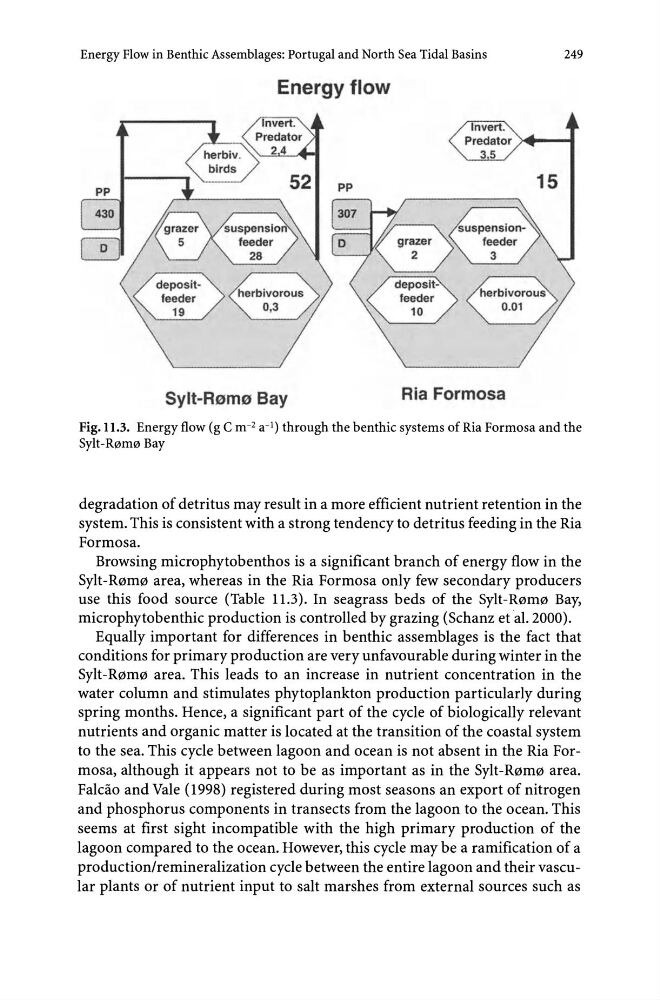
Fig. 11.3. Energy flow (g C m- 2 a-I) through the benthic systems of Ria Formosa and the
Sylt-R0m0 Bay
degradation of detritus may result in a more efficient nutrient retention in the
system. This is consistent with a strong tendency to detritus feeding in the Ria
Formosa.
Browsing microphytobenthos is a significant branch of energy flow in the
Sylt -R0m0 area, whereas in the Ria Formosa only few secondary producers
use this food source (Table 11.3). In seagrass beds of the Sylt-R0m0 Bay,
microphytobenthic production is controlled by grazing (Schanz et al. 2000).
Equally important for differences in benthic assemblages is the fact that
conditions for primary production are very unfavourable during winter in the
Sylt -R0m0 area. This leads to an increase in nutrient concentration in the
water column and stimulates phytoplankton production particularly during
spring months. Hence, a significant part of the cycle of biologically relevant
nutrients and organic matter is located at the transition of the coastal system
to the sea. This cycle between lagoon and ocean is not absent in the Ria Formosa, although it appears not to be as important as in the Sylt-R0m0 area.
Falcao and Vale (1998) registered during most seasons an export of nitrogen
and phosphorus components in transects from the lagoon to the ocean. This
seems at first sight incompatible with the high primary production of the
lagoon compared to the ocean. However, this cycle may be a ramification of a
production/remineralization cycle between the entire lagoon and their vascular plants or of nutrient input to salt marshes from external sources such as
249
Energy flow
Sylt-Romo Bay
Ria Formosa
Fig. 11.3. Energy flow (g C m- 2 a-I) through the benthic systems of Ria Formosa and the
Sylt-R0m0 Bay
degradation of detritus may result in a more efficient nutrient retention in the
system. This is consistent with a strong tendency to detritus feeding in the Ria
Formosa.
Browsing microphytobenthos is a significant branch of energy flow in the
Sylt -R0m0 area, whereas in the Ria Formosa only few secondary producers
use this food source (Table 11.3). In seagrass beds of the Sylt-R0m0 Bay,
microphytobenthic production is controlled by grazing (Schanz et al. 2000).
Equally important for differences in benthic assemblages is the fact that
conditions for primary production are very unfavourable during winter in the
Sylt -R0m0 area. This leads to an increase in nutrient concentration in the
water column and stimulates phytoplankton production particularly during
spring months. Hence, a significant part of the cycle of biologically relevant
nutrients and organic matter is located at the transition of the coastal system
to the sea. This cycle between lagoon and ocean is not absent in the Ria Formosa, although it appears not to be as important as in the Sylt-R0m0 area.
Falcao and Vale (1998) registered during most seasons an export of nitrogen
and phosphorus components in transects from the lagoon to the ocean. This
seems at first sight incompatible with the high primary production of the
lagoon compared to the ocean. However, this cycle may be a ramification of a
production/remineralization cycle between the entire lagoon and their vascular plants or of nutrient input to salt marshes from external sources such as