

Energy Flow in Benthic Assemblages: Portugal and North Sea Tidal Basins
239
in the Ria Formosa lagoon, direct freshwater input into the basin is insignificant. Both systems should be considered leaky lagoon areas according to the
classification by Kjerfve (1994a) but are situated in distinct climatic zones.
How do macrozoobenthic assemblages reflect primary production? Do more
favourable conditions at low latitudes stimulate productivity of the system by
more intense nutrient cycling?
11.2 Description of the Sites
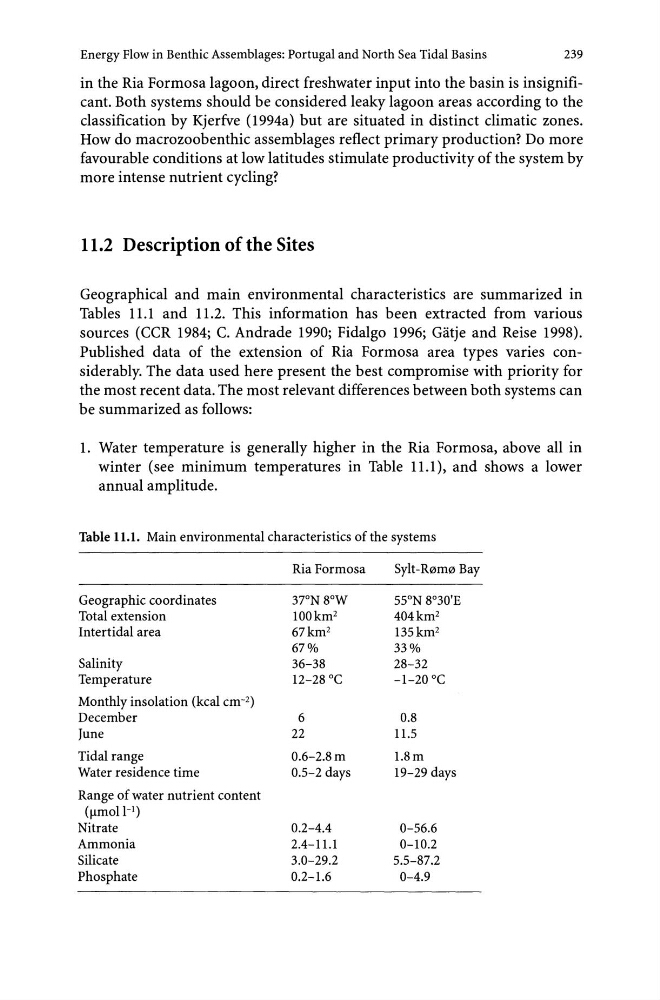
Geographical and main environmental characteristics are summarized in
Tables 11.1 and 11.2. This information has been extracted from various
sources (CCR 1984; C. Andrade 1990; Fidalgo 1996; Gatje and Reise 1998).
Published data of the extension of Ria Formosa area types varies considerably. The data used here present the best compromise with priority for
the most recent data. The most relevant differences between both systems can
be summarized as follows:
1. Water temperature is generally higher in the Ria Formosa, above all in
winter (see minimum temperatures in Table 11.1), and shows a lower
annual amplitude.
Table 11.1. Main environmental characteristics of the systems
Ria Formosa
Sylt-R0m0 Bay
Geographic coordinates
37°N 8°W
55°N 8°30'E
Total extension
100km 2
404km 2
Intertidal area
67km 2
135km 2
67%
33 %
Salinity
36-38
28-32
Temperature
12-28°C
-I-20°C
Monthly insolation (kcal cm- 2 )
December
6
0.8
June
22
11.5
Tidal range
0.6-2.8m
1.8m
Water residence time
0.5-2 days
19-29 days
Range of water nutrient content
(Ilmoll-l)
Nitrate
0.2-4.4
0-56.6
Ammonia
2.4-11.1
0-10.2
Silicate
3.0-29.2
5.5-87.2
Phosphate
0.2-1.6
0-4.9
239
in the Ria Formosa lagoon, direct freshwater input into the basin is insignificant. Both systems should be considered leaky lagoon areas according to the
classification by Kjerfve (1994a) but are situated in distinct climatic zones.
How do macrozoobenthic assemblages reflect primary production? Do more
favourable conditions at low latitudes stimulate productivity of the system by
more intense nutrient cycling?
11.2 Description of the Sites
Geographical and main environmental characteristics are summarized in
Tables 11.1 and 11.2. This information has been extracted from various
sources (CCR 1984; C. Andrade 1990; Fidalgo 1996; Gatje and Reise 1998).
Published data of the extension of Ria Formosa area types varies considerably. The data used here present the best compromise with priority for
the most recent data. The most relevant differences between both systems can
be summarized as follows:
1. Water temperature is generally higher in the Ria Formosa, above all in
winter (see minimum temperatures in Table 11.1), and shows a lower
annual amplitude.
Table 11.1. Main environmental characteristics of the systems
Ria Formosa
Sylt-R0m0 Bay
Geographic coordinates
37°N 8°W
55°N 8°30'E
Total extension
100km 2
404km 2
Intertidal area
67km 2
135km 2
67%
33 %
Salinity
36-38
28-32
Temperature
12-28°C
-I-20°C
Monthly insolation (kcal cm- 2 )
December
6
0.8
June
22
11.5
Tidal range
0.6-2.8m
1.8m
Water residence time
0.5-2 days
19-29 days
Range of water nutrient content
(Ilmoll-l)
Nitrate
0.2-4.4
0-56.6
Ammonia
2.4-11.1
0-10.2
Silicate
3.0-29.2
5.5-87.2
Phosphate
0.2-1.6
0-4.9