

The Leaf Canopy of Seagrass Beds: Faunal Community in a Salinity Gradient
221
2 5 0 - , - - - - - - - - - - - - - - - - - - - - ,
Biomass
Localities
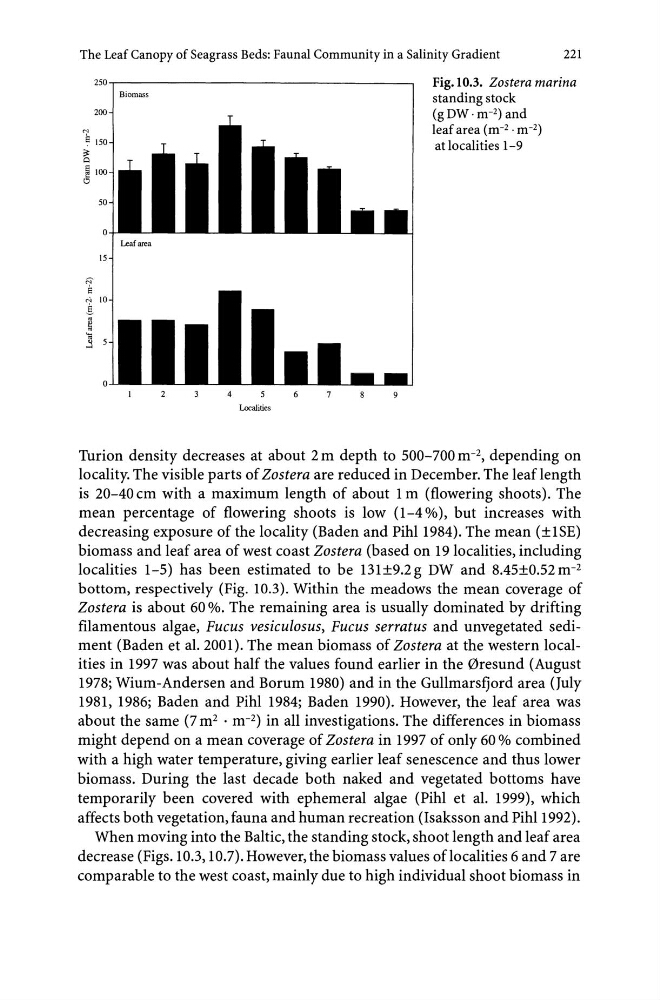
Fig.l0.3. Zostera marina
standing stock
(g DW . m- 2 ) and
leaf area (m-2 . m- 2 )
at localities 1-9
Turion density decreases at about 2m depth to 500-700m-z, depending on
locality. The visible parts of Zostera are reduced in December. The leaf length
is 20-40 cm with a maximum length of about 1 m (flowering shoots). The
mean percentage of flowering shoots is low (I -4 %), but increases with
decreasing exposure of the locality (Baden and PihI1984). The mean (±ISE)
biomass and leaf area of west coast Zostera (based on 19 localities, including
localities 1-5) has been estimated to be 131±9.2g DW and 8.45±0.52m- z
bottom, respectively (Fig. 10.3). Within the meadows the mean coverage of
Zostera is about 60 %. The remaining area is usually dominated by drifting
filamentous algae, Fucus vesiculosus, Fucus serratus and unvegetated sediment (Baden et al. 2001). The mean biomass of Zostera at the western localities in 1997 was about half the values found earlier in the 0resund (August
1978; Wium-Andersen and Borum 1980) and in the Gullmarsfjord area (July
1981, 1986; Baden and Pihl 1984; Baden 1990). However, the leaf area was
about the same (7 m Z . m-Z) in all investigations. The differences in biomass
might depend on a mean coverage of Zostera in 1997 of only 60 % combined
with a high water temperature, giving earlier leaf senescence and thus lower
biomass. During the last decade both naked and vegetated bottoms have
temporarily been covered with ephemeral algae (Pihl et al. 1999), which
affects both vegetation, fauna and human recreation (Isaksson and PihI1992).
When moving into the Baltic, the standing stock, shoot length and leaf area
decrease (Figs. 10.3, 10.7). However, the biomass values oflocalities 6 and 7 are
comparable to the west coast, mainly due to high individual shoot biomass in
221
2 5 0 - , - - - - - - - - - - - - - - - - - - - - ,
Biomass
Localities
Fig.l0.3. Zostera marina
standing stock
(g DW . m- 2 ) and
leaf area (m-2 . m- 2 )
at localities 1-9
Turion density decreases at about 2m depth to 500-700m-z, depending on
locality. The visible parts of Zostera are reduced in December. The leaf length
is 20-40 cm with a maximum length of about 1 m (flowering shoots). The
mean percentage of flowering shoots is low (I -4 %), but increases with
decreasing exposure of the locality (Baden and PihI1984). The mean (±ISE)
biomass and leaf area of west coast Zostera (based on 19 localities, including
localities 1-5) has been estimated to be 131±9.2g DW and 8.45±0.52m- z
bottom, respectively (Fig. 10.3). Within the meadows the mean coverage of
Zostera is about 60 %. The remaining area is usually dominated by drifting
filamentous algae, Fucus vesiculosus, Fucus serratus and unvegetated sediment (Baden et al. 2001). The mean biomass of Zostera at the western localities in 1997 was about half the values found earlier in the 0resund (August
1978; Wium-Andersen and Borum 1980) and in the Gullmarsfjord area (July
1981, 1986; Baden and Pihl 1984; Baden 1990). However, the leaf area was
about the same (7 m Z . m-Z) in all investigations. The differences in biomass
might depend on a mean coverage of Zostera in 1997 of only 60 % combined
with a high water temperature, giving earlier leaf senescence and thus lower
biomass. During the last decade both naked and vegetated bottoms have
temporarily been covered with ephemeral algae (Pihl et al. 1999), which
affects both vegetation, fauna and human recreation (Isaksson and PihI1992).
When moving into the Baltic, the standing stock, shoot length and leaf area
decrease (Figs. 10.3, 10.7). However, the biomass values oflocalities 6 and 7 are
comparable to the west coast, mainly due to high individual shoot biomass in