

218
S.P. Baden and C. Bostrom
material is lower (:::::5, Baden et al. 2001) compared with older material (C/N
:::::10, Pihl et al. 1999) incorporated in the detritus-based Zostera sediment.
This indicates an input of pelagic allocthonous material with high nutritional
value. In the more erosive, sandy substrates in the Baltic Zostera beds, where
resuspension and transport processes are important (Bostrom and Bonsdorff
2000), no data on C/N ratios from Zostera beds exist. Due to transport (winds
and waves), the importance of decaying Zostera leaves as a source of organic
material might be small in both systems but needs to be investigated. The low
nutrient value of the sandy substrates in the Baltic Sea may be partly compensated by increasing amounts of decaying drift algae (filamentous green
and brown algae originating from the littoral rocky shores) caught between
the eelgrass plants (Norkko and Bonsdorff 1996; Bostrom and Bonsdorff
2000). Also on the Swedish west coast, floating mats of ephemeral green algae
Swedish West Coast
Ephemeral Algae
Sheltered
<::==
Detrital Settlement
0-25· C
0-30 %.
Baltic Sea
0-20· C (lee Cover: 1-4 mol
5-10 %.
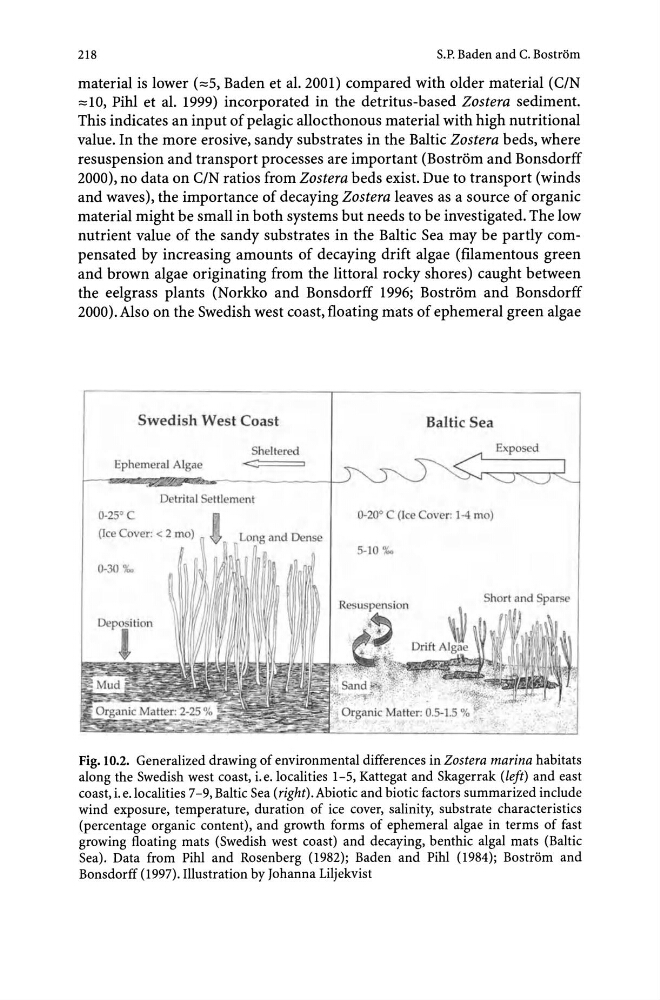
Fig.IO.2. Generalized drawing of environmental differences in Zostera marina habitats
along the Swedish west coast, i. e. localities 1-5, Kattegat and Skagerrak (left) and east
coast, i. e.localities 7-9, Baltic Sea (right) . Abiotic and biotic factors summarized include
wind exposure, temperature, duration of ice cover, salinity, substrate characteristics
(percentage organic content), and growth forms of ephemeral algae in terms of fast
growing floating mats (Swedish west coast) and decaying, benthic algal mats (Baltic
Sea). Data from Pihl and Rosenberg (1982); Baden and Pihl (1984); Bostrom and
Bonsdorff (1997). Illustration by Johanna Liljekvist
S.P. Baden and C. Bostrom
material is lower (:::::5, Baden et al. 2001) compared with older material (C/N
:::::10, Pihl et al. 1999) incorporated in the detritus-based Zostera sediment.
This indicates an input of pelagic allocthonous material with high nutritional
value. In the more erosive, sandy substrates in the Baltic Zostera beds, where
resuspension and transport processes are important (Bostrom and Bonsdorff
2000), no data on C/N ratios from Zostera beds exist. Due to transport (winds
and waves), the importance of decaying Zostera leaves as a source of organic
material might be small in both systems but needs to be investigated. The low
nutrient value of the sandy substrates in the Baltic Sea may be partly compensated by increasing amounts of decaying drift algae (filamentous green
and brown algae originating from the littoral rocky shores) caught between
the eelgrass plants (Norkko and Bonsdorff 1996; Bostrom and Bonsdorff
2000). Also on the Swedish west coast, floating mats of ephemeral green algae
Swedish West Coast
Ephemeral Algae
Sheltered
<::==
Detrital Settlement
0-25· C
0-30 %.
Baltic Sea
0-20· C (lee Cover: 1-4 mol
5-10 %.
Fig.IO.2. Generalized drawing of environmental differences in Zostera marina habitats
along the Swedish west coast, i. e. localities 1-5, Kattegat and Skagerrak (left) and east
coast, i. e.localities 7-9, Baltic Sea (right) . Abiotic and biotic factors summarized include
wind exposure, temperature, duration of ice cover, salinity, substrate characteristics
(percentage organic content), and growth forms of ephemeral algae in terms of fast
growing floating mats (Swedish west coast) and decaying, benthic algal mats (Baltic
Sea). Data from Pihl and Rosenberg (1982); Baden and Pihl (1984); Bostrom and
Bonsdorff (1997). Illustration by Johanna Liljekvist