

Common Structures and Properties of Seagrass Beds Fringing the Coasts of the World 203
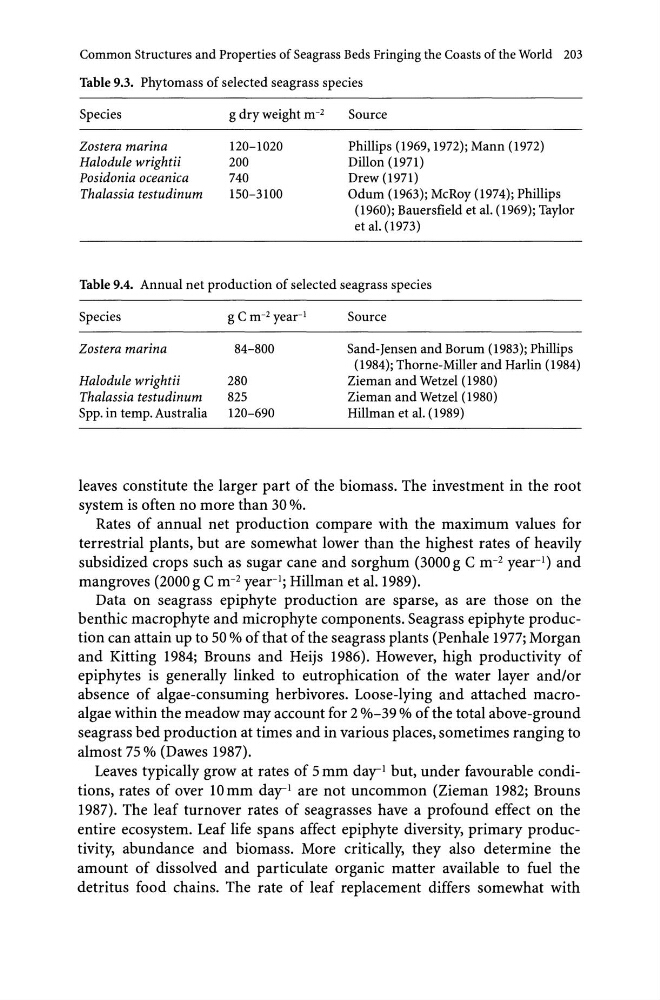
Table 9.3. Phytomass of selected seagrass species
Species
g dry weight m- 2
Source
Zostera marina
Halodule wrightii
Posidonia oceanica
Thalassia testudinum
120-1020
Phillips (1969, 1972); Mann (1972)
200
Dillon (1971)
740
Drew (1971)
150-3100
Odum (1963); McRoy (1974); Phillips
(1960); Bauersfield et al. (1969); Taylor
et al. (1973)
Table 9.4. Annual net production of selected seagrass species
Species
g C m- 2 year!
Zostera marina
84-800
Halodule wrightii
280
Thalassia testudinum
825
Spp. in temp. Australia
120-690
Source
Sand-Jensen and Borum (1983); Phillips
(1984); Thorne-Miller and Harlin (1984)
Zieman and Wetzel (1980)
Zieman and Wetzel (1980)
Hillman et al. (1989)
leaves constitute the larger part of the biomass. The investment in the root
system is often no more than 30 %.
Rates of annual net production compare with the maximum values for
terrestrial plants, but are somewhat lower than the highest rates of heavily
subsidized crops such as sugar cane and sorghum (3000g C m- 2 year-I) and
mangroves (2000 g C m- 2 year-I; Hillman et al. 1989).
Data on seagrass epiphyte production are sparse, as are those on the
benthic macrophyte and microphyte components. Seagrass epiphyte production can attain up to 50 % of that of the seagrass plants (Penhale 1977; Morgan
and Kitting 1984; Brouns and Heijs 1986). However, high productivity of
epiphytes is generally linked to eutrophication of the water layer and/or
absence of algae-consuming herbivores. Loose-lying and attached macroalgae within the meadow may account for 2 %-39 % of the total above-ground
seagrass bed production at times and in various places, sometimes ranging to
almost 75 % (Dawes 1987).
Leaves typically grow at rates of 5 mm day-I but, under favourable conditions, rates of over 10mm day-I are not uncommon (Zieman 1982; Brouns
1987). The leaf turnover rates of seagrasses have a profound effect on the
entire ecosystem. Leaf life spans affect epiphyte diversity, primary productivity, abundance and biomass. More critically, they also determine the
amount of dissolved and particulate organic matter available to fuel the
detritus food chains. The rate of leaf replacement differs somewhat with
Table 9.3. Phytomass of selected seagrass species
Species
g dry weight m- 2
Source
Zostera marina
Halodule wrightii
Posidonia oceanica
Thalassia testudinum
120-1020
Phillips (1969, 1972); Mann (1972)
200
Dillon (1971)
740
Drew (1971)
150-3100
Odum (1963); McRoy (1974); Phillips
(1960); Bauersfield et al. (1969); Taylor
et al. (1973)
Table 9.4. Annual net production of selected seagrass species
Species
g C m- 2 year!
Zostera marina
84-800
Halodule wrightii
280
Thalassia testudinum
825
Spp. in temp. Australia
120-690
Source
Sand-Jensen and Borum (1983); Phillips
(1984); Thorne-Miller and Harlin (1984)
Zieman and Wetzel (1980)
Zieman and Wetzel (1980)
Hillman et al. (1989)
leaves constitute the larger part of the biomass. The investment in the root
system is often no more than 30 %.
Rates of annual net production compare with the maximum values for
terrestrial plants, but are somewhat lower than the highest rates of heavily
subsidized crops such as sugar cane and sorghum (3000g C m- 2 year-I) and
mangroves (2000 g C m- 2 year-I; Hillman et al. 1989).
Data on seagrass epiphyte production are sparse, as are those on the
benthic macrophyte and microphyte components. Seagrass epiphyte production can attain up to 50 % of that of the seagrass plants (Penhale 1977; Morgan
and Kitting 1984; Brouns and Heijs 1986). However, high productivity of
epiphytes is generally linked to eutrophication of the water layer and/or
absence of algae-consuming herbivores. Loose-lying and attached macroalgae within the meadow may account for 2 %-39 % of the total above-ground
seagrass bed production at times and in various places, sometimes ranging to
almost 75 % (Dawes 1987).
Leaves typically grow at rates of 5 mm day-I but, under favourable conditions, rates of over 10mm day-I are not uncommon (Zieman 1982; Brouns
1987). The leaf turnover rates of seagrasses have a profound effect on the
entire ecosystem. Leaf life spans affect epiphyte diversity, primary productivity, abundance and biomass. More critically, they also determine the
amount of dissolved and particulate organic matter available to fuel the
detritus food chains. The rate of leaf replacement differs somewhat with