

196
C. den Hartog and R.C. Phillips
temperate areas into the tropics. They are absent only in Antarctica. Their
vertical distribution extends from the midlittoral zone down to considerable
depths. The greatest depth recorded for seagrass is 90m (Taylor 1928). This,
however, may be exceptional and possibly indicates an allochthonous origin
of the material. The occurrence of dense seagrass beds down to depths of
40-50 m has been repeatedly recorded. On a local scale, seagrass beds demonstrate great variation where the habitat is concerned. They can occur in the
open sea, unprotected from the ocean swell, to deep into the sheltered
environments of estuaries with reduced salinity. There are also some species
that inhabit sand-pocketed rocky shores.
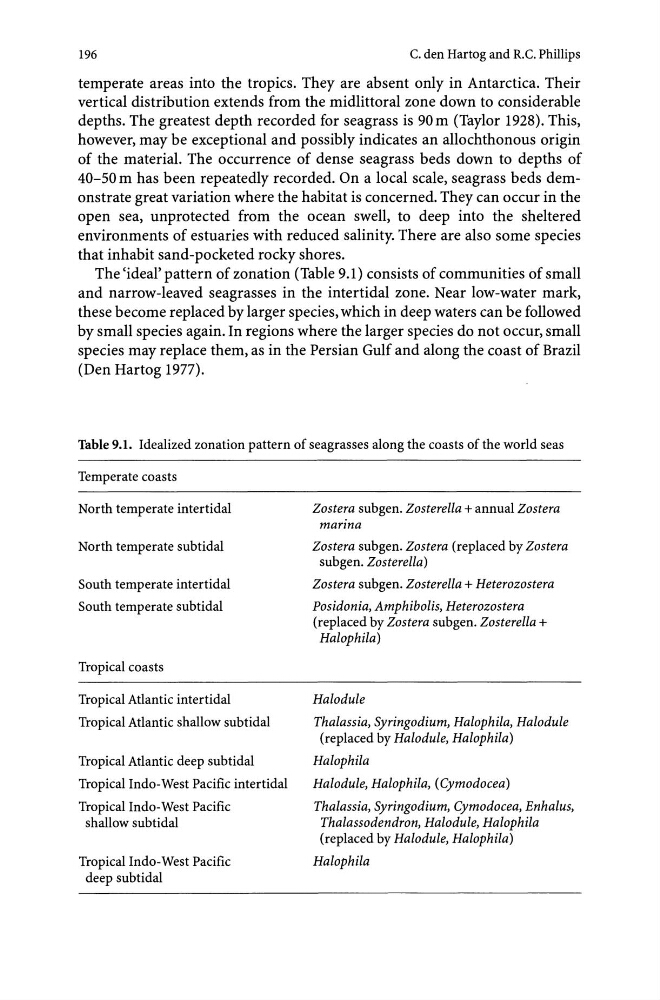
The 'ideal' pattern of zonation (Table 9.1) consists of communities of small
and narrow-leaved seagrasses in the intertidal zone. Near low-water mark,
these become replaced by larger species, which in deep waters can be followed
by small species again. In regions where the larger species do not occur, small
species may replace them, as in the Persian Gulf and along the coast of Brazil
(Den Hartog 1977).
Table 9.1. Idealized zonation pattern of seagrasses along the coasts of the world seas
Temperate coasts
North temperate intertidal
North temperate subtidal
South temperate intertidal
South temperate subtidal
Tropical coasts
Tropical Atlantic intertidal
Tropical Atlantic shallow subtidal
Tropical Atlantic deep subtidal
Tropical Indo-West Pacific intertidal
Tropical Indo-West Pacific
shallow subtidal
Tropical Indo-West Pacific
deep subtidal
Zostera sub gen. Zosterella + annual Zostera
marina
Zostera subgen. Zostera (replaced by Zostera
subgen. Zosterella)
Zostera subgen. Zosterella + Heterozostera
Posidonia, Amphibolis, Heterozostera
(replaced by Zostera subgen. Zosterella +
Halophila)
Halodule
Thalassia, Syringodium, Halophila, Halodule
(replaced by Halodule, Halophila)
Halophila
Halodule, Halophila, (Cymodocea)
Thalassia, Syringodium, Cymodocea, Enhalus,
Thalassodendron, Halodule, Halophila
(replaced by Halodule, Halophila)
Halophila
C. den Hartog and R.C. Phillips
temperate areas into the tropics. They are absent only in Antarctica. Their
vertical distribution extends from the midlittoral zone down to considerable
depths. The greatest depth recorded for seagrass is 90m (Taylor 1928). This,
however, may be exceptional and possibly indicates an allochthonous origin
of the material. The occurrence of dense seagrass beds down to depths of
40-50 m has been repeatedly recorded. On a local scale, seagrass beds demonstrate great variation where the habitat is concerned. They can occur in the
open sea, unprotected from the ocean swell, to deep into the sheltered
environments of estuaries with reduced salinity. There are also some species
that inhabit sand-pocketed rocky shores.
The 'ideal' pattern of zonation (Table 9.1) consists of communities of small
and narrow-leaved seagrasses in the intertidal zone. Near low-water mark,
these become replaced by larger species, which in deep waters can be followed
by small species again. In regions where the larger species do not occur, small
species may replace them, as in the Persian Gulf and along the coast of Brazil
(Den Hartog 1977).
Table 9.1. Idealized zonation pattern of seagrasses along the coasts of the world seas
Temperate coasts
North temperate intertidal
North temperate subtidal
South temperate intertidal
South temperate subtidal
Tropical coasts
Tropical Atlantic intertidal
Tropical Atlantic shallow subtidal
Tropical Atlantic deep subtidal
Tropical Indo-West Pacific intertidal
Tropical Indo-West Pacific
shallow subtidal
Tropical Indo-West Pacific
deep subtidal
Zostera sub gen. Zosterella + annual Zostera
marina
Zostera subgen. Zostera (replaced by Zostera
subgen. Zosterella)
Zostera subgen. Zosterella + Heterozostera
Posidonia, Amphibolis, Heterozostera
(replaced by Zostera subgen. Zosterella +
Halophila)
Halodule
Thalassia, Syringodium, Halophila, Halodule
(replaced by Halodule, Halophila)
Halophila
Halodule, Halophila, (Cymodocea)
Thalassia, Syringodium, Cymodocea, Enhalus,
Thalassodendron, Halodule, Halophila
(replaced by Halodule, Halophila)
Halophila