

Processes That Affect Saltmarsh Erosion and Saltmarsh Restoration
187
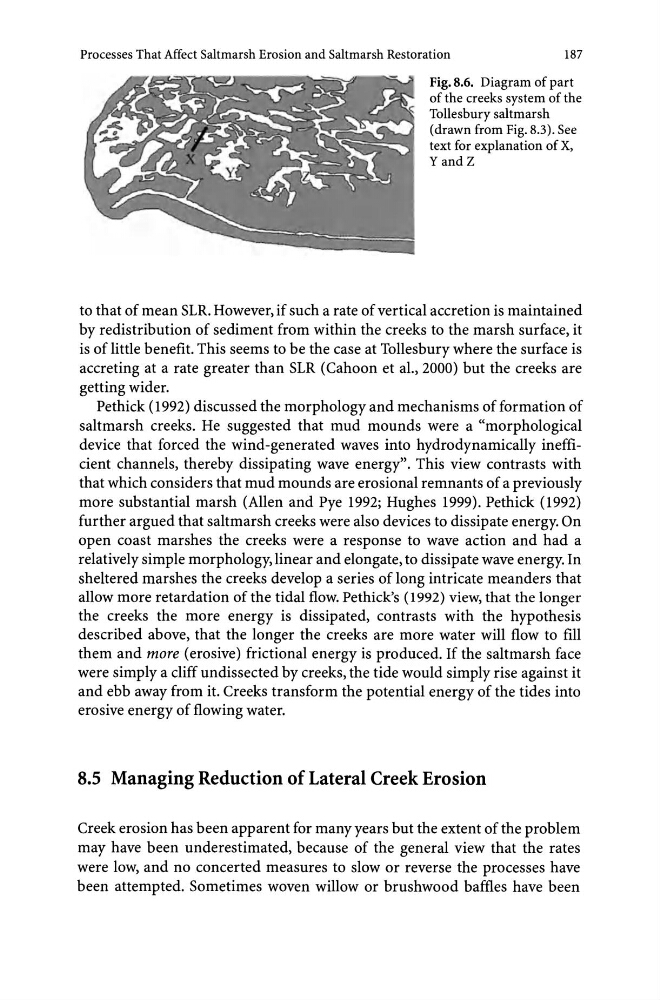
Fig. 8.6. Diagram of part
of the creeks system of the
Tollesbury saltmarsh
(drawn from Fig. 8.3). See
text for explanation of X,
YandZ
to that of mean SLR. However, if such a rate of vertical accretion is maintained
by redistribution of sediment from within the creeks to the marsh surface, it
is of little benefit. This seems to be the case at Tollesbury where the surface is
accreting at a rate greater than SLR (Cahoon et aI., 2000) but the creeks are
getting wider.
Pethick (1992) discussed the morphology and mechanisms of formation of
saltmarsh creeks. He suggested that mud mounds were a "morphological
device that forced the wind-generated waves into hydrodynamically inefficient channels, thereby dissipating wave energy". This view contrasts with
that which considers that mud mounds are erosional remnants of a previously
more substantial marsh (Allen and Pye 1992; Hughes 1999). Pethick (1992)
further argued that saltmarsh creeks were also devices to dissipate energy. On
open coast marshes the creeks were a response to wave action and had a
relatively simple morphology, linear and elongate, to dissipate wave energy. In
sheltered marshes the creeks develop a series of long intricate meanders that
allow more retardation of the tidal flow. Pethick's (1992) view, that the longer
the creeks the more energy is dissipated, contrasts with the hypothesis
described above, that the longer the creeks are more water will flow to fill
them and more (erosive) frictional energy is produced. If the saltmarsh face
were simply a cliff undissected by creeks, the tide would simply rise against it
and ebb away from it. Creeks transform the potential energy of the tides into
erosive energy of flowing water.
8.S Managing Reduction of Lateral Creek Erosion
Creek erosion has been apparent for many years but the extent of the problem
may have been underestimated, because of the general view that the rates
were low, and no concerted measures to slow or reverse the processes have
been attempted. Sometimes woven willow or brushwood baffles have been
187
Fig. 8.6. Diagram of part
of the creeks system of the
Tollesbury saltmarsh
(drawn from Fig. 8.3). See
text for explanation of X,
YandZ
to that of mean SLR. However, if such a rate of vertical accretion is maintained
by redistribution of sediment from within the creeks to the marsh surface, it
is of little benefit. This seems to be the case at Tollesbury where the surface is
accreting at a rate greater than SLR (Cahoon et aI., 2000) but the creeks are
getting wider.
Pethick (1992) discussed the morphology and mechanisms of formation of
saltmarsh creeks. He suggested that mud mounds were a "morphological
device that forced the wind-generated waves into hydrodynamically inefficient channels, thereby dissipating wave energy". This view contrasts with
that which considers that mud mounds are erosional remnants of a previously
more substantial marsh (Allen and Pye 1992; Hughes 1999). Pethick (1992)
further argued that saltmarsh creeks were also devices to dissipate energy. On
open coast marshes the creeks were a response to wave action and had a
relatively simple morphology, linear and elongate, to dissipate wave energy. In
sheltered marshes the creeks develop a series of long intricate meanders that
allow more retardation of the tidal flow. Pethick's (1992) view, that the longer
the creeks the more energy is dissipated, contrasts with the hypothesis
described above, that the longer the creeks are more water will flow to fill
them and more (erosive) frictional energy is produced. If the saltmarsh face
were simply a cliff undissected by creeks, the tide would simply rise against it
and ebb away from it. Creeks transform the potential energy of the tides into
erosive energy of flowing water.
8.S Managing Reduction of Lateral Creek Erosion
Creek erosion has been apparent for many years but the extent of the problem
may have been underestimated, because of the general view that the rates
were low, and no concerted measures to slow or reverse the processes have
been attempted. Sometimes woven willow or brushwood baffles have been