

162
E. Flach and A. Tamaki
~ 20
"
0
0
~
.l!l
15
:;
'C
..
'0 10
C
III
:!:!. 5
ci
c:
c:
m
:;
89 90 91
92 93 94
';'E
Umbonium moniliferum
15
"
'"
on the lower half of the transect
'" '?
12
.l!l 120
:;
9
'C
100
..
'0 80
C
6
III
60
+1
3
ci 40
c:
c:
20
.. .,
1996
:;
0 1979
87 88 89 90 91
92 93 94 95 96 97 98
Year
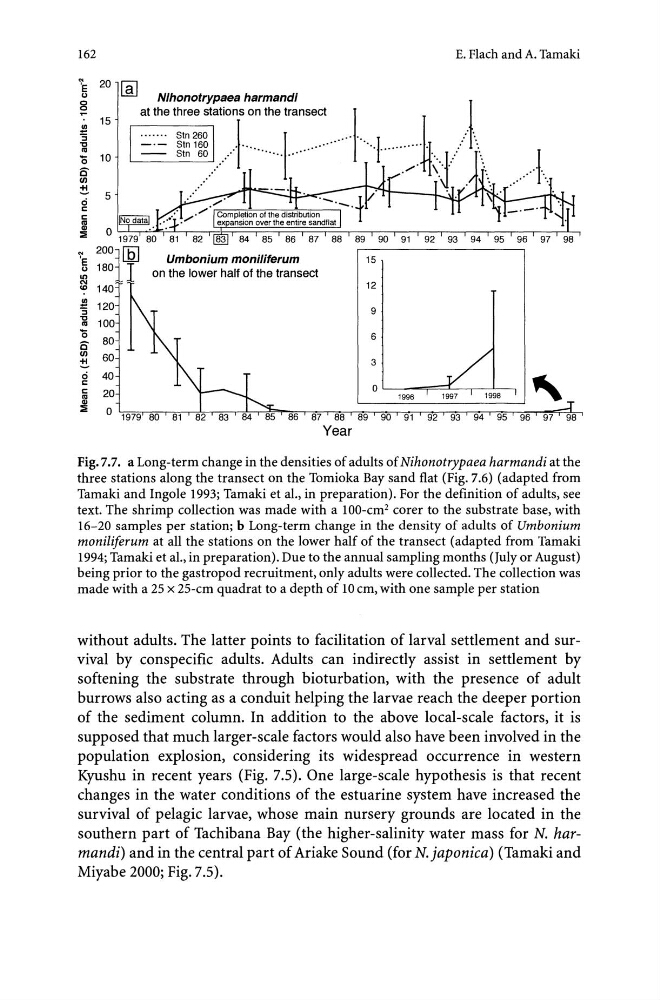
Fig. 7.7. a Long-term change in the densities of adults of Nihonotrypaea harmandi at the
three stations along the transect on the Tomioka Bay sand flat (Fig. 7.6) (adapted from
Tamaki and Ingole 1993; Tamaki et aI., in preparation). For the definition of adults, see
text. The shrimp collection was made with a 100-cm2 corer to the substrate base, with
16-20 samples per station; b Long-term change in the density of adults of Umbonium
moniliferum at all the stations on the lower half of the transect (adapted from Tamaki
1994; Tamaki et aI., in preparation). Due to the annual sampling months (July or August)
being prior to the gastropod recruitment, only adults were collected. The collection was
made with a 25 x 25-cm quadrat to a depth of 10 cm, with one sample per station
without adults. The latter points to facilitation of larval settlement and survival by conspecific adults. Adults can indirectly assist in settlement by
softening the substrate through bioturbation, with the presence of adult
burrows also acting as a conduit helping the larvae reach the deeper portion
of the sediment column. In addition to the above local-scale factors, it is
supposed that much larger-scale factors would also have been involved in the
population explosion, considering its widespread occurrence in western
Kyushu in recent years (Fig. 7.5). One large-scale hypothesis is that recent
changes in the water conditions of the estuarine system have increased the
survival of pelagic larvae, whose main nursery grounds are located in the
southern part of Tachibana Bay (the higher-salinity water mass for N. harmandi) and in the central part of Ariake Sound (for N. japonica) (Tamaki and
Miyabe 2000; Fig. 7.5).
E. Flach and A. Tamaki
~ 20
"
0
0
~
.l!l
15
:;
'C
..
'0 10
C
III
:!:!. 5
ci
c:
c:
m
:;
89 90 91
92 93 94
';'E
Umbonium moniliferum
15
"
'"
on the lower half of the transect
'" '?
12
.l!l 120
:;
9
'C
100
..
'0 80
C
6
III
60
+1
3
ci 40
c:
c:
20
.. .,
1996
:;
0 1979
87 88 89 90 91
92 93 94 95 96 97 98
Year
Fig. 7.7. a Long-term change in the densities of adults of Nihonotrypaea harmandi at the
three stations along the transect on the Tomioka Bay sand flat (Fig. 7.6) (adapted from
Tamaki and Ingole 1993; Tamaki et aI., in preparation). For the definition of adults, see
text. The shrimp collection was made with a 100-cm2 corer to the substrate base, with
16-20 samples per station; b Long-term change in the density of adults of Umbonium
moniliferum at all the stations on the lower half of the transect (adapted from Tamaki
1994; Tamaki et aI., in preparation). Due to the annual sampling months (July or August)
being prior to the gastropod recruitment, only adults were collected. The collection was
made with a 25 x 25-cm quadrat to a depth of 10 cm, with one sample per station
without adults. The latter points to facilitation of larval settlement and survival by conspecific adults. Adults can indirectly assist in settlement by
softening the substrate through bioturbation, with the presence of adult
burrows also acting as a conduit helping the larvae reach the deeper portion
of the sediment column. In addition to the above local-scale factors, it is
supposed that much larger-scale factors would also have been involved in the
population explosion, considering its widespread occurrence in western
Kyushu in recent years (Fig. 7.5). One large-scale hypothesis is that recent
changes in the water conditions of the estuarine system have increased the
survival of pelagic larvae, whose main nursery grounds are located in the
southern part of Tachibana Bay (the higher-salinity water mass for N. harmandi) and in the central part of Ariake Sound (for N. japonica) (Tamaki and
Miyabe 2000; Fig. 7.5).