

Competitive Bioturbators in the Wadden Sea and Ariake Sound
157
E
::J
E
a.
2 0
t)
E
::J
E
a.
2
0
t)
60
50
40
30
20
10
0
100
80
60
40
20
0
Percentage of Corophium in treatment-side.
-
o
2
3
Number of lugworms in treatment
Percentage survival of Corophium
no lugworms
D nopredators
D crabs
•
shrimps
51ugworms
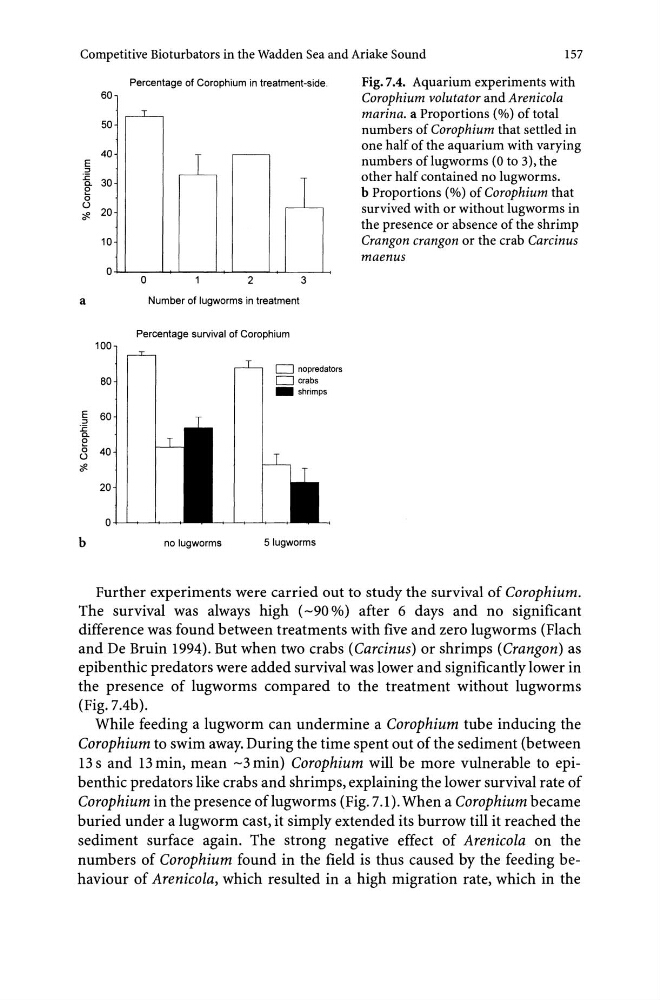
Fig.7.4. Aquarium experiments with
Corophium volutator and Arenicola
marina. a Proportions (%) of total
numbers of Corophium that settled in
one half of the aquarium with varying
numbers oflugworms (0 to 3), the
other half contained no lugworms.
b Proportions (%) of Corophium that
survived with or without lugworms in
the presence or absence of the shrimp
Crangon crangon or the crab Carcinus
maenus
Further experiments were carried out to study the survival of Corophium.
The survival was always high (-90 %) after 6 days and no significant
difference was found between treatments with five and zero lugworms (Flach
and De Bruin 1994). But when two crabs (Carcinus) or shrimps (Crangon) as
epibenthic predators were added survival was lower and significantly lower in
the presence of lugworms compared to the treatment without lugworms
(Fig.7.4b).
While feeding a lugworm can undermine a Corophium tube inducing the
Corophium to swim away. During the time spent out of the sediment (between
13 sand 13 min, mean -3 min) Corophium will be more vulnerable to epibenthic predators like crabs and shrimps, explaining the lower survival rate of
Corophium in the presence oflugworms (Fig. 7.1). When a Corophium became
buried under a lugworm cast, it simply extended its burrow till it reached the
sediment surface again. The strong negative effect of Arenicola on the
numbers of Corophium found in the field is thus caused by the feeding behaviour of Arenicola, which resulted in a high migration rate, which in the
157
E
::J
E
a.
2 0
t)
E
::J
E
a.
2
0
t)
60
50
40
30
20
10
0
100
80
60
40
20
0
Percentage of Corophium in treatment-side.
-
o
2
3
Number of lugworms in treatment
Percentage survival of Corophium
no lugworms
D nopredators
D crabs
•
shrimps
51ugworms
Fig.7.4. Aquarium experiments with
Corophium volutator and Arenicola
marina. a Proportions (%) of total
numbers of Corophium that settled in
one half of the aquarium with varying
numbers oflugworms (0 to 3), the
other half contained no lugworms.
b Proportions (%) of Corophium that
survived with or without lugworms in
the presence or absence of the shrimp
Crangon crangon or the crab Carcinus
maenus
Further experiments were carried out to study the survival of Corophium.
The survival was always high (-90 %) after 6 days and no significant
difference was found between treatments with five and zero lugworms (Flach
and De Bruin 1994). But when two crabs (Carcinus) or shrimps (Crangon) as
epibenthic predators were added survival was lower and significantly lower in
the presence of lugworms compared to the treatment without lugworms
(Fig.7.4b).
While feeding a lugworm can undermine a Corophium tube inducing the
Corophium to swim away. During the time spent out of the sediment (between
13 sand 13 min, mean -3 min) Corophium will be more vulnerable to epibenthic predators like crabs and shrimps, explaining the lower survival rate of
Corophium in the presence oflugworms (Fig. 7.1). When a Corophium became
buried under a lugworm cast, it simply extended its burrow till it reached the
sediment surface again. The strong negative effect of Arenicola on the
numbers of Corophium found in the field is thus caused by the feeding behaviour of Arenicola, which resulted in a high migration rate, which in the