

152
E. Flach and A. Tamaki
Marsdiep
:-.-;
1 km
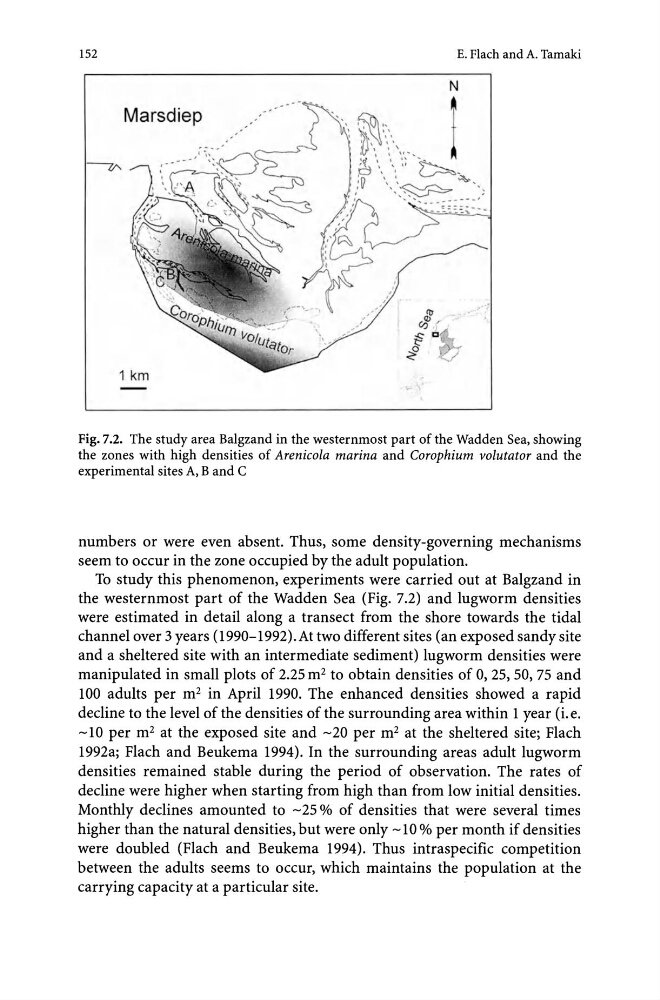
Fig.7.2. The study area Balgzand in the westernmost part of the Wadden Sea, showing
the zones with high densities of Arenicola marina and Corophium volutator and the
experimental sites A, Band C
numbers or were even absent. Thus, some density-governing mechanisms
seem to occur in the zone occupied by the adult population.
To study this phenomenon, experiments were carried out at Balgzand in
the westernmost part of the Wadden Sea (Fig. 7.2) and lugworm densities
were estimated in detail along a transect from the shore towards the tidal
channel over 3 years (l990-1992).At two different sites (an exposed sandy site
and a sheltered site with an intermediate sediment) lugworm densities were
manipulated in small plots of 2.25 m 2 to obtain densities of 0, 25, 50, 75 and
100 adults per m 2 in April 1990. The enhanced densities showed a rapid
decline to the level of the densities of the surrounding area within 1 year (i. e.
-10 per m 2 at the exposed site and -20 per m 2 at the sheltered site; Flach
1992a; Flach and Beukema 1994). In the surrounding areas adult lugworm
densities remained stable during the period of observation. The rates of
decline were higher when starting from high than from low initial densities.
Monthly declines amounted to -25 % of densities that were several times
higher than the natural densities, but were only -10 % per month if densities
were doubled (Flach and Beukema 1994). Thus intraspecific competition
between the adults seems to occur, which maintains the population at the
carrying capacity at a particular site.
E. Flach and A. Tamaki
Marsdiep
:-.-;
1 km
Fig.7.2. The study area Balgzand in the westernmost part of the Wadden Sea, showing
the zones with high densities of Arenicola marina and Corophium volutator and the
experimental sites A, Band C
numbers or were even absent. Thus, some density-governing mechanisms
seem to occur in the zone occupied by the adult population.
To study this phenomenon, experiments were carried out at Balgzand in
the westernmost part of the Wadden Sea (Fig. 7.2) and lugworm densities
were estimated in detail along a transect from the shore towards the tidal
channel over 3 years (l990-1992).At two different sites (an exposed sandy site
and a sheltered site with an intermediate sediment) lugworm densities were
manipulated in small plots of 2.25 m 2 to obtain densities of 0, 25, 50, 75 and
100 adults per m 2 in April 1990. The enhanced densities showed a rapid
decline to the level of the densities of the surrounding area within 1 year (i. e.
-10 per m 2 at the exposed site and -20 per m 2 at the sheltered site; Flach
1992a; Flach and Beukema 1994). In the surrounding areas adult lugworm
densities remained stable during the period of observation. The rates of
decline were higher when starting from high than from low initial densities.
Monthly declines amounted to -25 % of densities that were several times
higher than the natural densities, but were only -10 % per month if densities
were doubled (Flach and Beukema 1994). Thus intraspecific competition
between the adults seems to occur, which maintains the population at the
carrying capacity at a particular site.