

150
E. Flach and A. Tamaki
7.2 Large Bioturbators
Macrobenthic animals affect both rates and spatial distribution of sediment
processes by their feeding, burrowing and ventilation activities (Aller and
Yingst 1985; Andersen and Kristensen 1991). These sediment-reworking
activities are generally called bioturbation (see Chap. 6).
On tidal flats along the European coasts the lugworm Arenicola marina L.
(Polychaeta) is one of the dominating species. Lugworms are large deposit
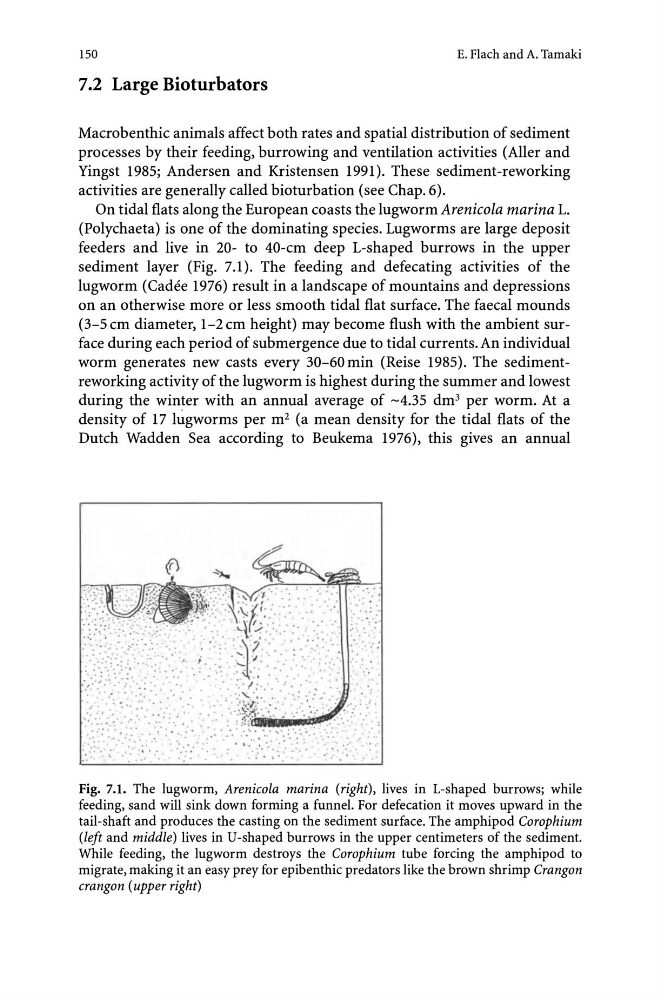
feeders and live in 20- to 40-cm deep L-shaped burrows in the upper
sediment layer (Fig. 7.1). The feeding and defecating activities of the
lugworm (Cadee 1976) result in a landscape of mountains and depressions
on an otherwise more or less smooth tidal flat surface. The faecal mounds
(3-5 cm diameter, 1-2 cm height) may become flush with the ambient surface during each period of submergence due to tidal currents. An individual
worm generates new casts every 30-60min (Reise 1985). The sedimentreworking activity of the lugworm is highest during the summer and lowest
during the winter with an annual average of -4.35 dm 3 per worm. At a
density of 17 h~gworms per m 2 (a mean density for the tidal flats of the
Dutch Wadden Sea according to Beukema 1976), this gives an annual
/\i;?i i , :\ ~)I>: . ' . ' . . ;; . '
" , ' . ' ,
.. -.
.
. . . . . ,
-: : .... : . : ..... , . . :' , ,:':,':.'" .. .' . ... :: ... -: . ~ -.. -' .... .
". ,
.. : ',: , ', . :. . ....
. ,. ' : -: ' ", :: . ", : . . . .. ,' ", : . . :.
. .. .. . . .". . ' . ~ . ; ; ' . .. .:." .-. "" ..
Fig. 7.1. The lugworm, Arenicola marina (right), lives in L-shaped burrows; while
feeding, sand will sink down forming a funnel. For defecation it moves upward in the
tail-shaft and produces the casting on the sediment surface. The amphipod Corophium
(left and middle) lives in V-shaped burrows in the upper centimeters of the sediment.
While feeding, the lugworm destroys the Corophium tube forcing the amphipod to
migrate, making it an easy prey for epibenthic predators like the brown shrimp Crangon
crangon (upper right)
E. Flach and A. Tamaki
7.2 Large Bioturbators
Macrobenthic animals affect both rates and spatial distribution of sediment
processes by their feeding, burrowing and ventilation activities (Aller and
Yingst 1985; Andersen and Kristensen 1991). These sediment-reworking
activities are generally called bioturbation (see Chap. 6).
On tidal flats along the European coasts the lugworm Arenicola marina L.
(Polychaeta) is one of the dominating species. Lugworms are large deposit
feeders and live in 20- to 40-cm deep L-shaped burrows in the upper
sediment layer (Fig. 7.1). The feeding and defecating activities of the
lugworm (Cadee 1976) result in a landscape of mountains and depressions
on an otherwise more or less smooth tidal flat surface. The faecal mounds
(3-5 cm diameter, 1-2 cm height) may become flush with the ambient surface during each period of submergence due to tidal currents. An individual
worm generates new casts every 30-60min (Reise 1985). The sedimentreworking activity of the lugworm is highest during the summer and lowest
during the winter with an annual average of -4.35 dm 3 per worm. At a
density of 17 h~gworms per m 2 (a mean density for the tidal flats of the
Dutch Wadden Sea according to Beukema 1976), this gives an annual
/\i;?i i , :\ ~)I>: . ' . ' . . ;; . '
" , ' . ' ,
.. -.
.
. . . . . ,
-: : .... : . : ..... , . . :' , ,:':,':.'" .. .' . ... :: ... -: . ~ -.. -' .... .
". ,
.. : ',: , ', . :. . ....
. ,. ' : -: ' ", :: . ", : . . . .. ,' ", : . . :.
. .. .. . . .". . ' . ~ . ; ; ' . .. .:." .-. "" ..
Fig. 7.1. The lugworm, Arenicola marina (right), lives in L-shaped burrows; while
feeding, sand will sink down forming a funnel. For defecation it moves upward in the
tail-shaft and produces the casting on the sediment surface. The amphipod Corophium
(left and middle) lives in V-shaped burrows in the upper centimeters of the sediment.
While feeding, the lugworm destroys the Corophium tube forcing the amphipod to
migrate, making it an easy prey for epibenthic predators like the brown shrimp Crangon
crangon (upper right)