

Sediment Dynamics by Bioturbating Organisms
135
form a mat that efficiently fixes the sediment surface and protects it from
scouring by currents. Current scouring enlarges whale-feeding pits. Pits also
act as loci of detritus accumulation during summer quiescence. Commonly,
erosion of areas between pits will leave a single large pit that can be as large as
8 x 20 m. Whales thus profoundly disturb the substrate. They trigger substantial current scouring. The volume of sediment injected into the water
column by feeding whales was estimated to be at least 1.2 x 10 9 m 3 per year (in
an area of 22.000 km 2 ). Fresh pits occupied 5.6 % of the feeding area. From this
we can calculate that they rework annually an amount of sediment equalling a
layer of 5 cm over the whole area. Gray whales also feed in intertidal areas
(Weitkamp et al. 1992): in Puget Sound they were feeding on ghost shrimps
(Callianassa californiensis), making holes of ca. 10 cm deep and ca. 2 x 3 m in
size.
During the same side-sonar studies, long linear traces were observed on
average 47 m long and 0.4 m deep, which were related to walrus feeding
(Nelson et al. 1987). Such traces had already been studied by scuba divers in
the same area (Oliver et al. 1983): they suggested that tusks were not used to
excavate prey. In a series of papers Kastelein and Mosterd (1989) and
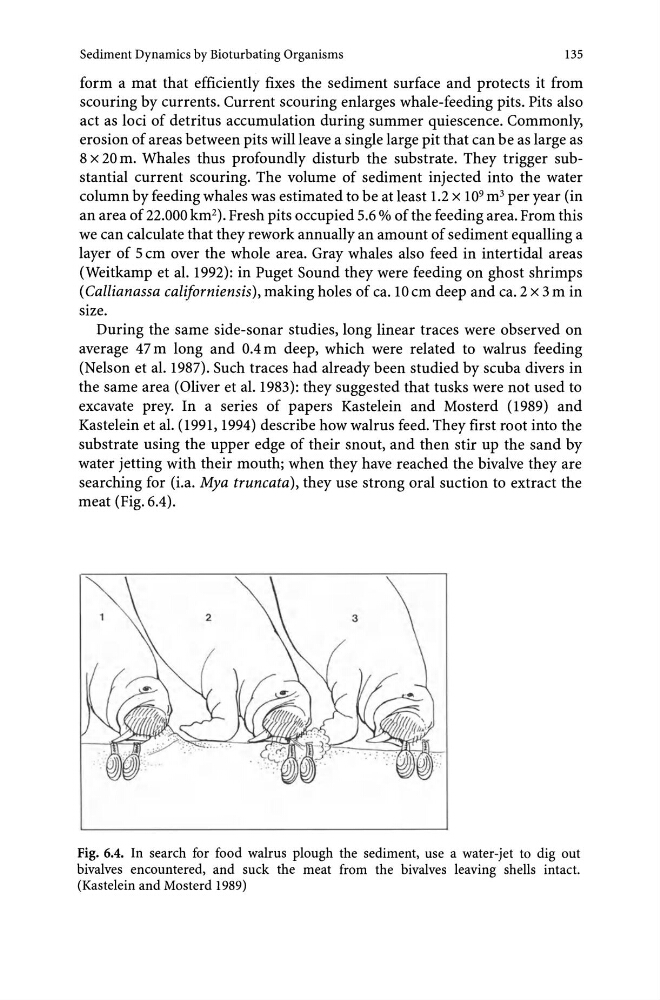
Kastelein et al. (1991, 1994) describe how walrus feed. They first root into the
substrate using the upper edge of their snout, and then stir up the sand by
water jetting with their mouth; when they have reached the bivalve they are
searching for (La. Mya truncata), they use strong oral suction to extract the
meat (Fig. 6.4).
Fig. 6.4. In search for food walrus plough the sediment, use a water-jet to dig out
bivalves encountered, and suck the meat from the bivalves leaving shells intact.
(Kastelein and Mosterd 1989)
135
form a mat that efficiently fixes the sediment surface and protects it from
scouring by currents. Current scouring enlarges whale-feeding pits. Pits also
act as loci of detritus accumulation during summer quiescence. Commonly,
erosion of areas between pits will leave a single large pit that can be as large as
8 x 20 m. Whales thus profoundly disturb the substrate. They trigger substantial current scouring. The volume of sediment injected into the water
column by feeding whales was estimated to be at least 1.2 x 10 9 m 3 per year (in
an area of 22.000 km 2 ). Fresh pits occupied 5.6 % of the feeding area. From this
we can calculate that they rework annually an amount of sediment equalling a
layer of 5 cm over the whole area. Gray whales also feed in intertidal areas
(Weitkamp et al. 1992): in Puget Sound they were feeding on ghost shrimps
(Callianassa californiensis), making holes of ca. 10 cm deep and ca. 2 x 3 m in
size.
During the same side-sonar studies, long linear traces were observed on
average 47 m long and 0.4 m deep, which were related to walrus feeding
(Nelson et al. 1987). Such traces had already been studied by scuba divers in
the same area (Oliver et al. 1983): they suggested that tusks were not used to
excavate prey. In a series of papers Kastelein and Mosterd (1989) and
Kastelein et al. (1991, 1994) describe how walrus feed. They first root into the
substrate using the upper edge of their snout, and then stir up the sand by
water jetting with their mouth; when they have reached the bivalve they are
searching for (La. Mya truncata), they use strong oral suction to extract the
meat (Fig. 6.4).
Fig. 6.4. In search for food walrus plough the sediment, use a water-jet to dig out
bivalves encountered, and suck the meat from the bivalves leaving shells intact.
(Kastelein and Mosterd 1989)