

Microphytobenthos in Contrasting Coastal Ecosystems: Biology and Dynamics
119
5.7 Conceptual Model
The stability of intertidal sediments is a function both of hydrodynamics and
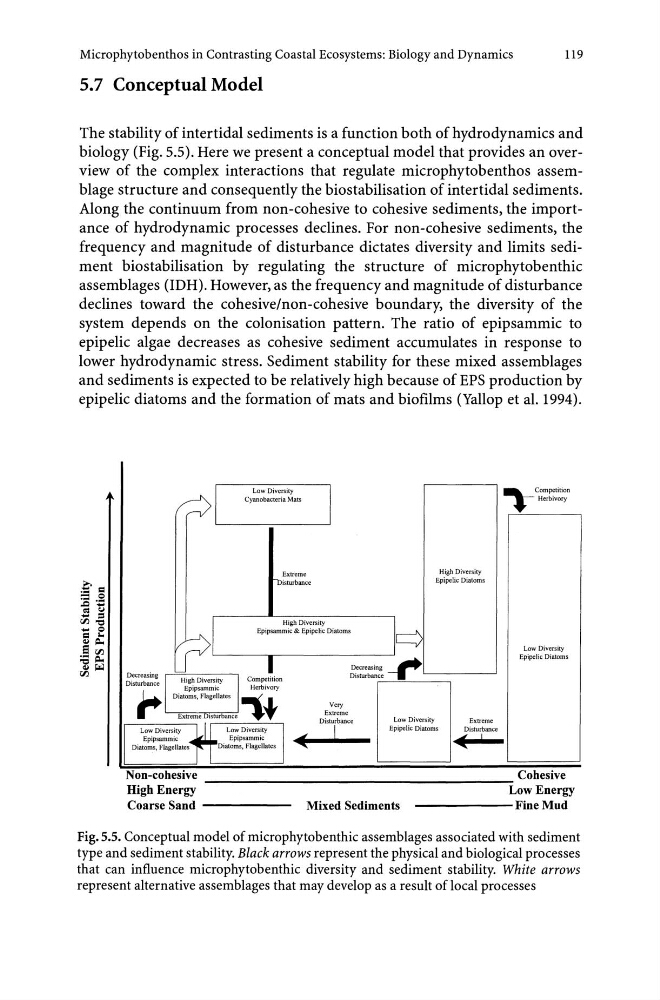
biology (Fig. 5.5). Here we present a conceptual model that provides an overview of the complex interactions that regulate microphytobenthos assemblage structure and consequently the biostabilisation of intertidal sediments.
Along the continuum from non-cohesive to cohesive sediments, the importance of hydrodynamic processes declines. For non-cohesive sediments, the
frequency and magnitude of disturbance dictates diversity and limits sediment biostabilisation by regulating the structure of microphytobenthic
assemblages (IDH). However, as the frequency and magnitude of disturbance
declines toward the cohesive/non-cohesive boundary, the diversity of the
system depends on the colonisation pattern. The ratio of epipsammic to
epipelic algae decreases as cohesive sediment accumulates in response to
lower hydrodynamic stress. Sediment stability for these mixed assemblages
and sediments is expected to be relatively high because of EPS production by
epipelic diatoms and the formation of mats and biofilms (Yallop et al. 1994).
Decreasing ,-'==--------,
Disturbance
Low Diversity
Cyanobacteria Mats
Extreme
Disturbance
High Diversity
Epipsammic & EpipeJic Diatoms
High Diversity
Epipelic Diatoms
Decreasing
~
Disturbance - . . . ' - - - - - - - - - - '
V'ry
Extreme
Disturbance
(
!
Low Diversity
Extreme
Epipelic Diatoms
Disturbance
(
!
,--Competition
-+ Herbivory
Low Diversity
Epipelic Diatoms
Non-cohesive
High Energy
_ _ _ _ _ _ _ _ _ _ _ _ _ _ _ _ _ _ ~ Cohesive
Coarse Sand - - - - - - Mixed Sediments
Low Energy
- - - - - - F i n e Mud
Fig. 5.5. Conceptual model of microphytobenthic assemblages associated with sediment
type and sediment stability. Black arrows represent the physical and biological processes
that can influence microphytobenthic diversity and sediment stability. White arrows
represent alternative assemblages that may develop as a result of local processes
119
5.7 Conceptual Model
The stability of intertidal sediments is a function both of hydrodynamics and
biology (Fig. 5.5). Here we present a conceptual model that provides an overview of the complex interactions that regulate microphytobenthos assemblage structure and consequently the biostabilisation of intertidal sediments.
Along the continuum from non-cohesive to cohesive sediments, the importance of hydrodynamic processes declines. For non-cohesive sediments, the
frequency and magnitude of disturbance dictates diversity and limits sediment biostabilisation by regulating the structure of microphytobenthic
assemblages (IDH). However, as the frequency and magnitude of disturbance
declines toward the cohesive/non-cohesive boundary, the diversity of the
system depends on the colonisation pattern. The ratio of epipsammic to
epipelic algae decreases as cohesive sediment accumulates in response to
lower hydrodynamic stress. Sediment stability for these mixed assemblages
and sediments is expected to be relatively high because of EPS production by
epipelic diatoms and the formation of mats and biofilms (Yallop et al. 1994).
Decreasing ,-'==--------,
Disturbance
Low Diversity
Cyanobacteria Mats
Extreme
Disturbance
High Diversity
Epipsammic & EpipeJic Diatoms
High Diversity
Epipelic Diatoms
Decreasing
~
Disturbance - . . . ' - - - - - - - - - - '
V'ry
Extreme
Disturbance
(
!
Low Diversity
Extreme
Epipelic Diatoms
Disturbance
(
!
,--Competition
-+ Herbivory
Low Diversity
Epipelic Diatoms
Non-cohesive
High Energy
_ _ _ _ _ _ _ _ _ _ _ _ _ _ _ _ _ _ ~ Cohesive
Coarse Sand - - - - - - Mixed Sediments
Low Energy
- - - - - - F i n e Mud
Fig. 5.5. Conceptual model of microphytobenthic assemblages associated with sediment
type and sediment stability. Black arrows represent the physical and biological processes
that can influence microphytobenthic diversity and sediment stability. White arrows
represent alternative assemblages that may develop as a result of local processes