

Microphytobenthos in Contrasting Coastal Ecosystems: Biology and Dynamics
117
o
500
2000 '
2500
PAR(%)
20
40
~ .
.I
l
-
Cohesive sediment (mud)
60
- 0 - Non-cohesive sediment (sand)
80
100
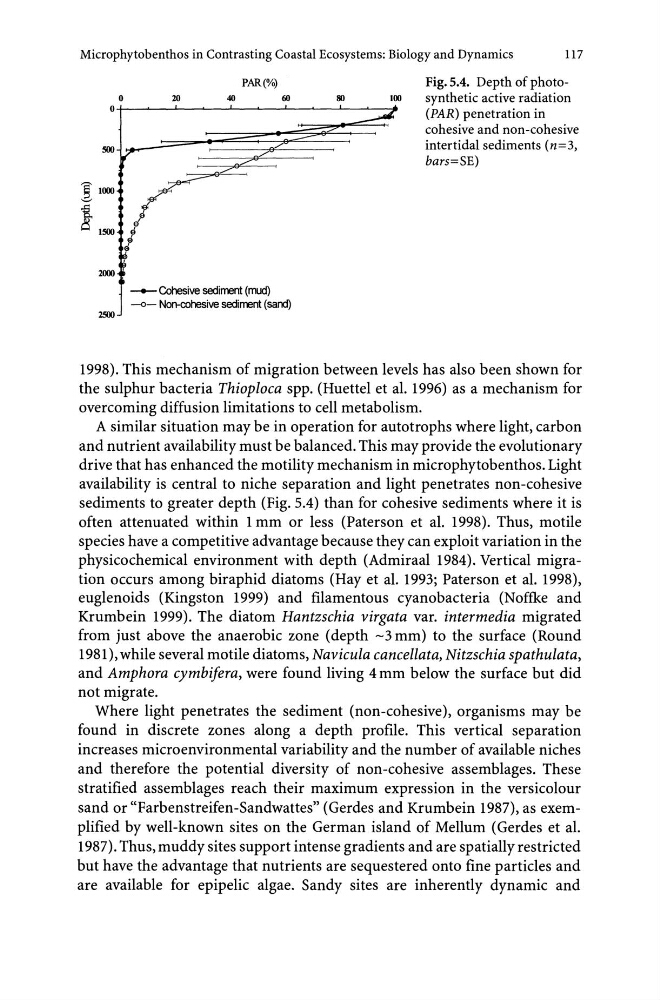
Fig.5.4. Depth of photosynthetic active radiation
(PAR) penetration in
cohesive and non-cohesive
intertidal sediments (n=3,
bars=SE)
1998). This mechanism of migration between levels has also been shown for
the sulphur bacteria Thioploca spp. (Huettel et al. 1996) as a mechanism for
overcoming diffusion limitations to cell metabolism.
A similar situation may be in operation for autotrophs where light, carbon
and nutrient availability must be balanced. This may provide the evolutionary
drive that has enhanced the motility mechanism in microphytobenthos. Light
availability is central to niche separation and light penetrates non-cohesive
sediments to greater depth (Fig. 5.4) than for cohesive sediments where it is
often attenuated within 1 mm or less (Paterson et al. 1998). Thus, motile
species have a competitive advantage because they can exploit variation in the
physicochemical environment with depth (Admiraal 1984). Vertical migration occurs among biraphid diatoms (Hay et al. 1993; Paterson et al. 1998),
euglenoids (Kingston 1999) and filamentous cyanobacteria (Noffke and
Krumbein 1999). The diatom Hantzschia virgata var. intermedia migrated
from just above the anaerobic zone (depth ~ 3 mm) to the surface (Round
1981), while several motile diatoms, Navicula cancellata, Nitzschia spathulata,
and Amphora cymbifera, were found living 4 mm below the surface but did
not migrate.
Where light penetrates the sediment (non-cohesive), organisms may be
found in discrete zones along a depth profile. This vertical separation
increases micro environmental variability and the number of available niches
and therefore the potential diversity of non-cohesive assemblages. These
stratified assemblages reach their maximum expression in the versicolour
sand or "Farbenstreifen-Sandwattes" (Gerdes and Krumbein 1987), as exemplified by well-known sites on the German island of Mellum (Gerdes et al.
1987). Thus, muddy sites support intense gradients and are spatially restricted
but have the advantage that nutrients are sequestered onto fine particles and
are available for epipelic algae. Sandy sites are inherently dynamic and
117
o
500
2000 '
2500
PAR(%)
20
40
~ .
.I
l
-
Cohesive sediment (mud)
60
- 0 - Non-cohesive sediment (sand)
80
100
Fig.5.4. Depth of photosynthetic active radiation
(PAR) penetration in
cohesive and non-cohesive
intertidal sediments (n=3,
bars=SE)
1998). This mechanism of migration between levels has also been shown for
the sulphur bacteria Thioploca spp. (Huettel et al. 1996) as a mechanism for
overcoming diffusion limitations to cell metabolism.
A similar situation may be in operation for autotrophs where light, carbon
and nutrient availability must be balanced. This may provide the evolutionary
drive that has enhanced the motility mechanism in microphytobenthos. Light
availability is central to niche separation and light penetrates non-cohesive
sediments to greater depth (Fig. 5.4) than for cohesive sediments where it is
often attenuated within 1 mm or less (Paterson et al. 1998). Thus, motile
species have a competitive advantage because they can exploit variation in the
physicochemical environment with depth (Admiraal 1984). Vertical migration occurs among biraphid diatoms (Hay et al. 1993; Paterson et al. 1998),
euglenoids (Kingston 1999) and filamentous cyanobacteria (Noffke and
Krumbein 1999). The diatom Hantzschia virgata var. intermedia migrated
from just above the anaerobic zone (depth ~ 3 mm) to the surface (Round
1981), while several motile diatoms, Navicula cancellata, Nitzschia spathulata,
and Amphora cymbifera, were found living 4 mm below the surface but did
not migrate.
Where light penetrates the sediment (non-cohesive), organisms may be
found in discrete zones along a depth profile. This vertical separation
increases micro environmental variability and the number of available niches
and therefore the potential diversity of non-cohesive assemblages. These
stratified assemblages reach their maximum expression in the versicolour
sand or "Farbenstreifen-Sandwattes" (Gerdes and Krumbein 1987), as exemplified by well-known sites on the German island of Mellum (Gerdes et al.
1987). Thus, muddy sites support intense gradients and are spatially restricted
but have the advantage that nutrients are sequestered onto fine particles and
are available for epipelic algae. Sandy sites are inherently dynamic and