

82
D. Seidov . B. J. Haupt
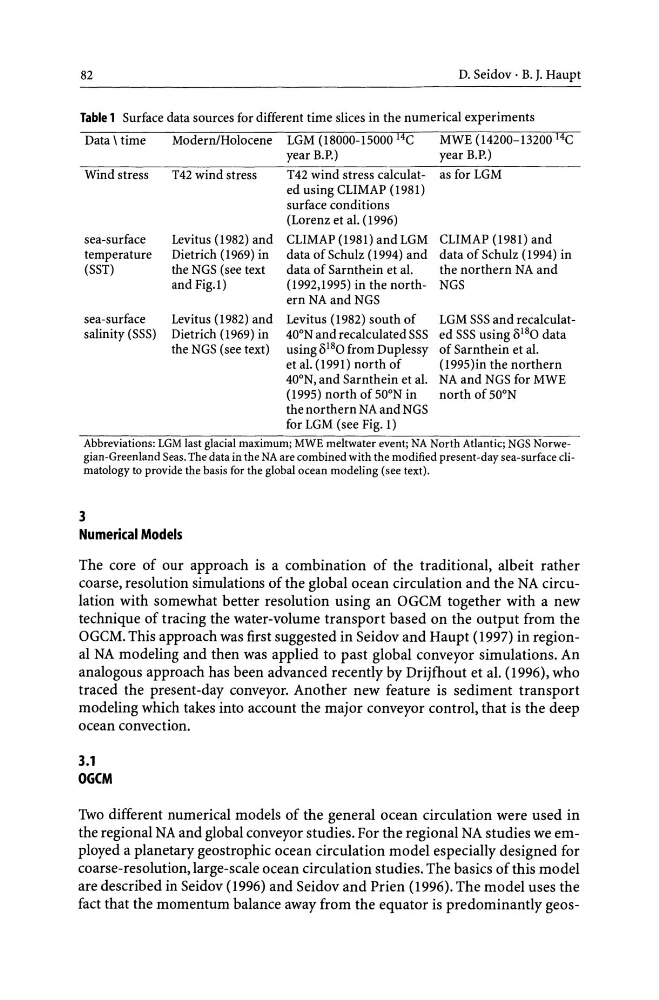
Table 1 Surface data sources for different time slices in the numerical experiments
Data \ time
ModernlHolocene LGM (18000-15000 14C
MWE (14200-13200 14C
Wind stress
sea -surface
temperature
(SST)
sea-surface
salinity (SSS)
T 42 wind stress
Levitus (1982) and
Dietrich (1969) in
the NGS (see text
and Fig.l)
Levitus (1982) and
Dietrich (1969) in
the NGS (see text)
year B.P.)
year B.P.)
T42 wind stress calculated using CLIMAP (1981)
surface conditions
(Lorenz et al. (1996)
CLIMAP (1981) and LGM
data of Schulz (1994) and
data of Sarnthein et al.
(1992,1995) in the northern NA and NGS
Levitus (1982) south of
400N and recalculated SSS
using i) lB O from Duplessy
et al. (1991) north of
40oN, and Sarnthein et al.
(1995) north of SOON in
the northern NA and NGS
for LGM (see Fig. 1)
as for LGM
CLIMAP (1981) and
data of Schulz (1994) in
the northern NA and
NGS
LGM SSS and recalculated SSS using i) lB O data
of Sarnthein et al.
(1995)in the northern
NA and NGS for MWE
north of SOON
Abbreviations: LGM last glacial maximum; MWE meltwater event; NA North Atlantic; NGS Norwegian-Greenland Seas. The data in the NA are combined with the modified present-day sea-surface climatology to provide the basis for the global ocean modeling (see text).
3
Numerical Models
The core of our approach is a combination of the traditional, albeit rather
coarse, resolution simulations of the global ocean circulation and the NA circulation with somewhat better resolution using an OGCM together with a new
technique of tracing the water-volume transport based on the output from the
OGCM. This approach was first suggested in Seidov and Haupt (1997) in regional NA modeling and then was applied to past global conveyor simulations. An
analogous approach has been advanced recently by Drijfhout et al. (1996), who
traced the present -day conveyor. Another new feature is sediment transport
modeling which takes into account the major conveyor control, that is the deep
ocean convection.
3.1
OGCM
Two different numerical models of the general ocean circulation were used in
the regional NA and global conveyor studies. For the regional NA studies we employed a planetary geostrophic ocean circulation model especially designed for
coarse-resolution, large-scale ocean circulation studies. The basics of this model
are described in Seidov (1996) and Seidov and Prien (1996). The model uses the
fact that the momentum balance away from the equator is predominantly geos-
D. Seidov . B. J. Haupt
Table 1 Surface data sources for different time slices in the numerical experiments
Data \ time
ModernlHolocene LGM (18000-15000 14C
MWE (14200-13200 14C
Wind stress
sea -surface
temperature
(SST)
sea-surface
salinity (SSS)
T 42 wind stress
Levitus (1982) and
Dietrich (1969) in
the NGS (see text
and Fig.l)
Levitus (1982) and
Dietrich (1969) in
the NGS (see text)
year B.P.)
year B.P.)
T42 wind stress calculated using CLIMAP (1981)
surface conditions
(Lorenz et al. (1996)
CLIMAP (1981) and LGM
data of Schulz (1994) and
data of Sarnthein et al.
(1992,1995) in the northern NA and NGS
Levitus (1982) south of
400N and recalculated SSS
using i) lB O from Duplessy
et al. (1991) north of
40oN, and Sarnthein et al.
(1995) north of SOON in
the northern NA and NGS
for LGM (see Fig. 1)
as for LGM
CLIMAP (1981) and
data of Schulz (1994) in
the northern NA and
NGS
LGM SSS and recalculated SSS using i) lB O data
of Sarnthein et al.
(1995)in the northern
NA and NGS for MWE
north of SOON
Abbreviations: LGM last glacial maximum; MWE meltwater event; NA North Atlantic; NGS Norwegian-Greenland Seas. The data in the NA are combined with the modified present-day sea-surface climatology to provide the basis for the global ocean modeling (see text).
3
Numerical Models
The core of our approach is a combination of the traditional, albeit rather
coarse, resolution simulations of the global ocean circulation and the NA circulation with somewhat better resolution using an OGCM together with a new
technique of tracing the water-volume transport based on the output from the
OGCM. This approach was first suggested in Seidov and Haupt (1997) in regional NA modeling and then was applied to past global conveyor simulations. An
analogous approach has been advanced recently by Drijfhout et al. (1996), who
traced the present -day conveyor. Another new feature is sediment transport
modeling which takes into account the major conveyor control, that is the deep
ocean convection.
3.1
OGCM
Two different numerical models of the general ocean circulation were used in
the regional NA and global conveyor studies. For the regional NA studies we employed a planetary geostrophic ocean circulation model especially designed for
coarse-resolution, large-scale ocean circulation studies. The basics of this model
are described in Seidov (1996) and Seidov and Prien (1996). The model uses the
fact that the momentum balance away from the equator is predominantly geos-