

Risk, Uncertainty and Priorities - Quantitative Models
447
4.3
Probability, Uncertainty and Relative Importance
Because the exact salt thickness, salt speed and underlying lithology are not
known, it follows that the estimated excess fluid-pressure at sub-salt break-out
is uncertain. What is needed are two factors: (i) the probability of encountering
an excess pressure less than (greater than) a prescribed value at break-out; and
(ii) the degree of uncertainty of the estimate made, together with information on
which parameter variation (salt thickness, salt speed, underlying lithology) is
providing the greatest fraction of the uncertainty in excess pressure variability,
i.e. the relative importance (RI) of variations in each contributory factor to excess pressure uncertainty. In this way one can assess which factor first needs to
have its range of uncertainty narrowed if a better job of estimating excess pressure is needed.
This RI then enables one to concentrate on the significant parameters,
without having to expend effort on improving parameter values which have a
lesser effect on uncertainties in excess pressure. Consider each component in
turn.
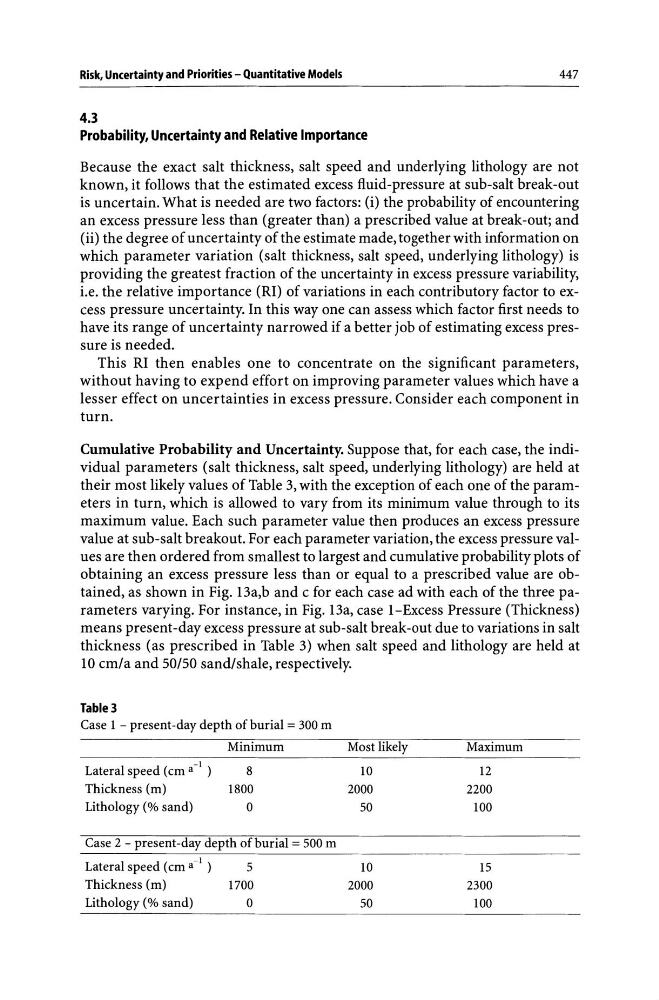
Cumulative Probability and Uncertainty. Suppose that, for each case, the individual parameters (salt thickness, salt speed, underlying lithology) are held at
their most likely values of Table 3, with the exception of each one of the parameters in turn, which is allowed to vary from its minimum value through to its
maximum value. Each such parameter value then produces an excess pressure
value at sub-salt breakout. For each parameter variation, the excess pressure values are then ordered from smallest to largest and cumulative probability plots of
obtaining an excess pressure less than or equal to a prescribed value are obtained, as shown in Fig. 13a,b and c for each case ad with each of the three parameters varying. For instance, in Fig. 13a, case I-Excess Pressure (Thickness)
means present-day excess pressure at sub-salt break-out due to variations in salt
thickness (as prescribed in Table 3) when salt speed and lithology are held at
10 cm/a and 50/50 sand/shale, respectively.
Table 3
Case 1 - present-day depth of burial = 300 m
Minimum
-1
Lateral speed (em a )
8
Thickness (m)
1800
Lithology (% sand)
0
Case 2 - present -day depth of burial = 500 m
Lateral speed (em a-I)
5
Thickness (m)
1700
Lithology (% sand)
0
Most likely
10
2000
50
10
2000
50
Maximum
12
2200
100
15
2300
100
447
4.3
Probability, Uncertainty and Relative Importance
Because the exact salt thickness, salt speed and underlying lithology are not
known, it follows that the estimated excess fluid-pressure at sub-salt break-out
is uncertain. What is needed are two factors: (i) the probability of encountering
an excess pressure less than (greater than) a prescribed value at break-out; and
(ii) the degree of uncertainty of the estimate made, together with information on
which parameter variation (salt thickness, salt speed, underlying lithology) is
providing the greatest fraction of the uncertainty in excess pressure variability,
i.e. the relative importance (RI) of variations in each contributory factor to excess pressure uncertainty. In this way one can assess which factor first needs to
have its range of uncertainty narrowed if a better job of estimating excess pressure is needed.
This RI then enables one to concentrate on the significant parameters,
without having to expend effort on improving parameter values which have a
lesser effect on uncertainties in excess pressure. Consider each component in
turn.
Cumulative Probability and Uncertainty. Suppose that, for each case, the individual parameters (salt thickness, salt speed, underlying lithology) are held at
their most likely values of Table 3, with the exception of each one of the parameters in turn, which is allowed to vary from its minimum value through to its
maximum value. Each such parameter value then produces an excess pressure
value at sub-salt breakout. For each parameter variation, the excess pressure values are then ordered from smallest to largest and cumulative probability plots of
obtaining an excess pressure less than or equal to a prescribed value are obtained, as shown in Fig. 13a,b and c for each case ad with each of the three parameters varying. For instance, in Fig. 13a, case I-Excess Pressure (Thickness)
means present-day excess pressure at sub-salt break-out due to variations in salt
thickness (as prescribed in Table 3) when salt speed and lithology are held at
10 cm/a and 50/50 sand/shale, respectively.
Table 3
Case 1 - present-day depth of burial = 300 m
Minimum
-1
Lateral speed (em a )
8
Thickness (m)
1800
Lithology (% sand)
0
Case 2 - present -day depth of burial = 500 m
Lateral speed (em a-I)
5
Thickness (m)
1700
Lithology (% sand)
0
Most likely
10
2000
50
10
2000
50
Maximum
12
2200
100
15
2300
100