

410
DiZhou
indicates a common event in which sediment becomes finer, better sorted and
negatively skewed during the transportation. Event CB+ represents an event
where sediment becomes coarser but also better-sorted and negatively skewed;
which appears only in a particular dynamic condition where sediment is transported from a high-energy regime (flow velocity 0.7 m/s) to a regime of low energy. For a binomial distribution, define the statistic
Z=(M-Np)IYNp(1-p),
where N is the number of tests; p the probability of given event; q=l-p; and M
the number of observations for the event. In our problem, let n be the number
of sediment pairs, then N=n(n- 1)/2, p=0.125, q=0.875, and the critical value for
Z at 0.05 significance levels ZO.05 = 1.645. If for a given direction the observed Z
is greater than the critical value, the zero hypothesis is rejected, and we say that
the direction is predominant.
This method is based on two assumptions: the sediment specimens are from
the same source; and the sample size is large (N2:30, which equals n2:8). Thus in
our application we used only type I terrigenous sediments. As possible directions of sediment dispersion, 18 lines with at least 8 sediment specimens were selected. The Z statistic was computed for the two directions of each line, and predominant directions were obtained when Z exceeds 1.645.
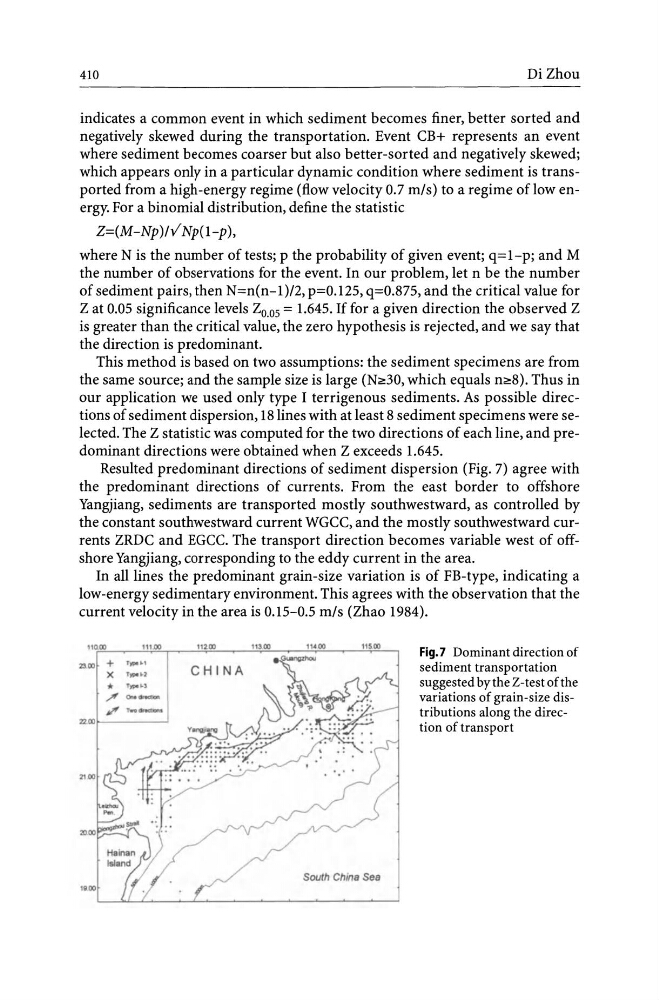
Resulted predominant directions of sediment dispersion (Fig. 7) agree with
the predominant directions of currents. From the east border to offshore
Yangjiang, sediments are transported mostly southwestward, as controlled by
the constant southwestward current WGCC, and the mostly southwestward currents ZRDC and EGCC. The transport direction becomes variable west of offshore Yangjiang, corresponding to the eddy current in the area.
In all lines the predominant grain-size variation is of FB-type, indicating a
low-energy sedimentary environment. This agrees with the observation that the
current velocity in the area is 0.15-0.5 mls (Zhao 1984).
11000
11100
2300 + -"
X _»
* ~H
/""'- /-_.
22.00t-- - - - '
'000
112.(0
CHI NA
,'COO
115.00
South China Sea
Fig.7 Dominant direction of
sediment transportation
suggested by the Z-test of the
variations of grain -size distributions along the direction of transport
DiZhou
indicates a common event in which sediment becomes finer, better sorted and
negatively skewed during the transportation. Event CB+ represents an event
where sediment becomes coarser but also better-sorted and negatively skewed;
which appears only in a particular dynamic condition where sediment is transported from a high-energy regime (flow velocity 0.7 m/s) to a regime of low energy. For a binomial distribution, define the statistic
Z=(M-Np)IYNp(1-p),
where N is the number of tests; p the probability of given event; q=l-p; and M
the number of observations for the event. In our problem, let n be the number
of sediment pairs, then N=n(n- 1)/2, p=0.125, q=0.875, and the critical value for
Z at 0.05 significance levels ZO.05 = 1.645. If for a given direction the observed Z
is greater than the critical value, the zero hypothesis is rejected, and we say that
the direction is predominant.
This method is based on two assumptions: the sediment specimens are from
the same source; and the sample size is large (N2:30, which equals n2:8). Thus in
our application we used only type I terrigenous sediments. As possible directions of sediment dispersion, 18 lines with at least 8 sediment specimens were selected. The Z statistic was computed for the two directions of each line, and predominant directions were obtained when Z exceeds 1.645.
Resulted predominant directions of sediment dispersion (Fig. 7) agree with
the predominant directions of currents. From the east border to offshore
Yangjiang, sediments are transported mostly southwestward, as controlled by
the constant southwestward current WGCC, and the mostly southwestward currents ZRDC and EGCC. The transport direction becomes variable west of offshore Yangjiang, corresponding to the eddy current in the area.
In all lines the predominant grain-size variation is of FB-type, indicating a
low-energy sedimentary environment. This agrees with the observation that the
current velocity in the area is 0.15-0.5 mls (Zhao 1984).
11000
11100
2300 + -"
X _»
* ~H
/""'- /-_.
22.00t-- - - - '
'000
112.(0
CHI NA
,'COO
115.00
South China Sea
Fig.7 Dominant direction of
sediment transportation
suggested by the Z-test of the
variations of grain -size distributions along the direction of transport