

Methods Used in a Mass-Balance Study of Holocene
Sediment Accumulation on the Southern North Sea Coast
of Germany
C. Hoselmann and H. Streif
1
Introduction
A quantitative analysis of the accumulation of coastal Holocene deposits is carried out in the form of a mass-balance study for the lowland area between the
Ems and Weser Rivers on the North Sea coast of Germany. The area investigated
comprises various geomorphological elements and depositional environments
such as the East Frisian barrier islands, sheltered and open tidal fiats, bay fiats of
Dollart and Jadebusen, estuaries of the Ems and Weser Rivers, and extensive
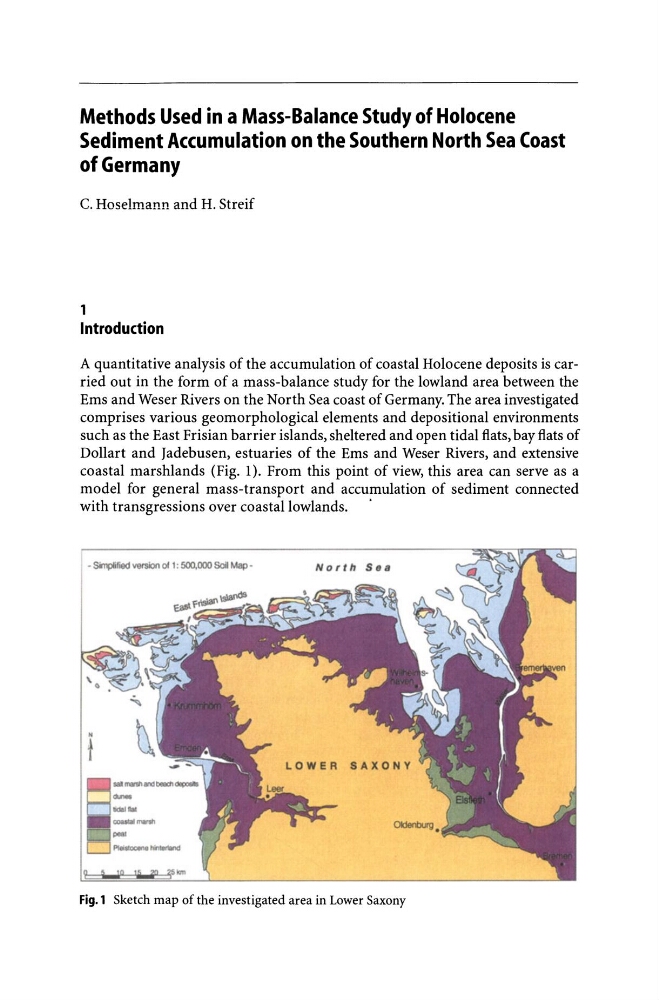
coastal marshlands (Fig. 1). From this point of view, this area can serve as a
model for general mass-transport and accumulation of sediment connected
with transgressions over coastal lowlands. .
- Simpliroecl V1l<>llon 0/1 : 500,000 SoIl Map -
North 5/18
LOWER SAXONY
- -
Fig.l Sketch map of the investigated area in Lower Saxony
Sediment Accumulation on the Southern North Sea Coast
of Germany
C. Hoselmann and H. Streif
1
Introduction
A quantitative analysis of the accumulation of coastal Holocene deposits is carried out in the form of a mass-balance study for the lowland area between the
Ems and Weser Rivers on the North Sea coast of Germany. The area investigated
comprises various geomorphological elements and depositional environments
such as the East Frisian barrier islands, sheltered and open tidal fiats, bay fiats of
Dollart and Jadebusen, estuaries of the Ems and Weser Rivers, and extensive
coastal marshlands (Fig. 1). From this point of view, this area can serve as a
model for general mass-transport and accumulation of sediment connected
with transgressions over coastal lowlands. .
- Simpliroecl V1l<>llon 0/1 : 500,000 SoIl Map -
North 5/18
LOWER SAXONY
- -
Fig.l Sketch map of the investigated area in Lower Saxony