

High-Resolution Forward Stratigraphic Modeling of Ca2-Carbonate Platforms ••.
309
German
Zechstein Cycles
fICHTE~ .• BERNBUAG (1955
KADING 1976
Transit. Z8
Cycle
Molin
Z7
Friesland Z6
Ohre
Z5
Aller
Z4
c:
CIS
'E
:r
~
Leine
Z3
....I
Stassfurt Z2
Werra Z1
Early Permian
German Zechstein
Lithostratigraphy
KULICK 6. PAUL (1987)
SUBKOMMISSION PERM-TRIAS 1993
B2
Upper
"Brockelschiefer"
B1
Lower
"Brbckelschiefer"
A6
Friesland Salt
Friesland
T6
Anhydrite
Na5
Ohre Salt Ohre
A5
Anhydrite
T5
Ohre Clay
Na4
Aller Salt
A4
Pegmatite Anhydrite
T4
Red Salt Clay
Na3
Leine Salt
A3
Main Anhydrite
Ca3
Platy Dolomite
T3
Gray Salt Clay
Na2
Stassfurt Salt
A2
Basal Anhydrite
Ca2
Stassfurt Carbonate
~
;;: Upper
Werra
A1 ;;;
z
Werra Salt~ Anhydrite
.
;;: Lower
Ca1
Zechstein Limestone
T1
Copper Shale
(T1Ca) (»MutterfI6z« Carbonate)
Z1C
Zechstein Conglomerate
R~ Late
Carboniferous
German Zechstein
Sequences
STROHMENGER et al. 1996
ZS8
ZSB8
ZS7
ZSB7
ZS 6
ZSB6
ZS5
ZSB5
ZS4
ZSB4
ZS3
ZSB3
ZS2
ZSB2
ZS 1
ZSB 1
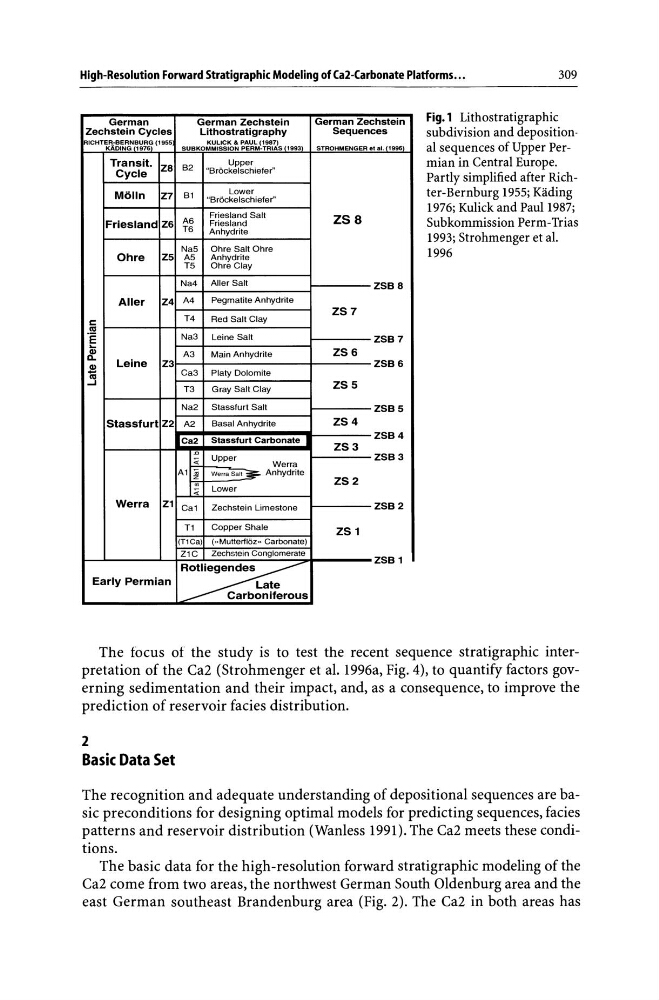
Fig.l Lithostratigraphic
subdivision and deposition·
al sequences of Upper Permian in Central Europe.
Partly simplified after Richter-Bernburg 1955; Kading
1976; Kulick and Paul 1987;
Subkommission Perm-Trias
1993; Strohmenger et al.
1996
The focus of the study is to test the recent sequence stratigraphic interpretation of the Ca2 (Strohmenger et al. 1996a, Fig. 4), to quantify factors governing sedimentation and their impact, and, as a consequence, to improve the
prediction of reservoir facies distribution.
2
Basic Data Set
The recognition and adequate understanding of depositional sequences are basic preconditions for designing optimal models for predicting sequences, facies
patterns and reservoir distribution (Wanless 1991). The Ca2 meets these conditions.
The basic data for the high-resolution forward stratigraphic modeling of the
Ca2 come from two areas, the northwest German South Oldenburg area and the
east German southeast Brandenburg area (Fig. 2). The Ca2 in both areas has
309
German
Zechstein Cycles
fICHTE~ .• BERNBUAG (1955
KADING 1976
Transit. Z8
Cycle
Molin
Z7
Friesland Z6
Ohre
Z5
Aller
Z4
c:
CIS
'E
:r
~
Leine
Z3
....I
Stassfurt Z2
Werra Z1
Early Permian
German Zechstein
Lithostratigraphy
KULICK 6. PAUL (1987)
SUBKOMMISSION PERM-TRIAS 1993
B2
Upper
"Brockelschiefer"
B1
Lower
"Brbckelschiefer"
A6
Friesland Salt
Friesland
T6
Anhydrite
Na5
Ohre Salt Ohre
A5
Anhydrite
T5
Ohre Clay
Na4
Aller Salt
A4
Pegmatite Anhydrite
T4
Red Salt Clay
Na3
Leine Salt
A3
Main Anhydrite
Ca3
Platy Dolomite
T3
Gray Salt Clay
Na2
Stassfurt Salt
A2
Basal Anhydrite
Ca2
Stassfurt Carbonate
~
;;: Upper
Werra
A1 ;;;
z
Werra Salt~ Anhydrite
.
;;: Lower
Ca1
Zechstein Limestone
T1
Copper Shale
(T1Ca) (»MutterfI6z« Carbonate)
Z1C
Zechstein Conglomerate
R~ Late
Carboniferous
German Zechstein
Sequences
STROHMENGER et al. 1996
ZS8
ZSB8
ZS7
ZSB7
ZS 6
ZSB6
ZS5
ZSB5
ZS4
ZSB4
ZS3
ZSB3
ZS2
ZSB2
ZS 1
ZSB 1
Fig.l Lithostratigraphic
subdivision and deposition·
al sequences of Upper Permian in Central Europe.
Partly simplified after Richter-Bernburg 1955; Kading
1976; Kulick and Paul 1987;
Subkommission Perm-Trias
1993; Strohmenger et al.
1996
The focus of the study is to test the recent sequence stratigraphic interpretation of the Ca2 (Strohmenger et al. 1996a, Fig. 4), to quantify factors governing sedimentation and their impact, and, as a consequence, to improve the
prediction of reservoir facies distribution.
2
Basic Data Set
The recognition and adequate understanding of depositional sequences are basic preconditions for designing optimal models for predicting sequences, facies
patterns and reservoir distribution (Wanless 1991). The Ca2 meets these conditions.
The basic data for the high-resolution forward stratigraphic modeling of the
Ca2 come from two areas, the northwest German South Oldenburg area and the
east German southeast Brandenburg area (Fig. 2). The Ca2 in both areas has