

14
K. Black· M. Green· T. Healy· R. Bell· J. Oldman· T. Hume
realistically simulate hysteresis. The Lagrangian model assigns mass to particles
of exactly known position and so mass conservation is always guaranteed. This
is not always true of Eulerian solution schemes which are mostly not suited to
the modelling of a field of sources and sinks (Black 1987).
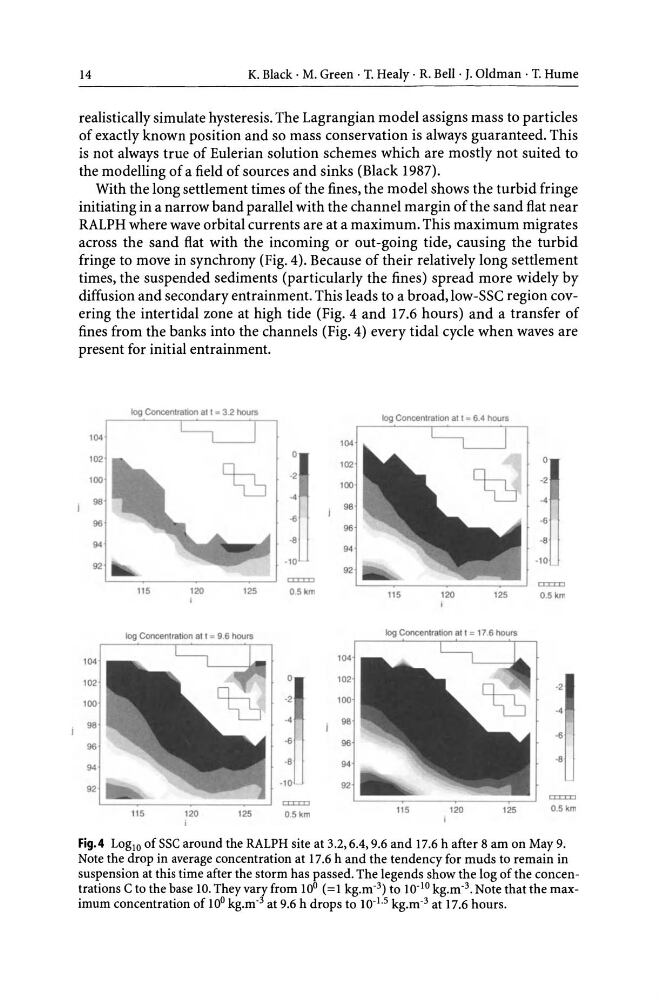
With the long settlement times of the fines, the model shows the turbid fringe
initiating in a narrow band parallel with the channel margin of the sand flat near
RALPH where wave orbital currents are at a maximum. This maximum migrates
across the sand flat with the incoming or out-going tide, causing the turbid
fringe to move in synchrony (Fig. 4). Because of their relatively long settlement
times, the suspended sediments (particularly the fines) spread more widely by
diffusion and secondary entrainment. This leads to a broad, low-Sse region covering the intertidal zone at high tide (Fig. 4 and 17.6 hours) and a transfer of
fines from the banks into the channels (Fig. 4) every tidal cycle when waves are
present for initial entrainment.
log ConcenlrallOn all . 3.2 hours
'04
"5
120
125
log Concentration al I ~ 9.6 hours
"5
'20
125
0
·2
-4
-6
-8
" 0
=
O.5km
o
·2
·4
·6
-8
-'0
=
0.5 km
94
92
log Concentralion at t ~ 6_4 hours
'15
120
I
'25
log Concenlralion al 1 ~ 17.6 hours
'15
120
125
·2
·4
·6
·8
= 0.5km
Fig.4 Log lO of sse around the RALPH site at 3.2,6.4,9.6 and 17.6 h after 8 am on May 9.
Note the drop in average concentration at 17.6 h and the tendency for muds to remain in
sus~ension at this time after the storm has ~assed. The legends show the log of the concentratIOns e to the base lO. They vary from lO (=1 kg.m- 3 ) to 10- 10 kg.m- 3 • Note that the maximum concentration oflO o kg.m- 3 at 9.6 h drops to 10- L5 kg.m- 3 at 17.6 hours.
K. Black· M. Green· T. Healy· R. Bell· J. Oldman· T. Hume
realistically simulate hysteresis. The Lagrangian model assigns mass to particles
of exactly known position and so mass conservation is always guaranteed. This
is not always true of Eulerian solution schemes which are mostly not suited to
the modelling of a field of sources and sinks (Black 1987).
With the long settlement times of the fines, the model shows the turbid fringe
initiating in a narrow band parallel with the channel margin of the sand flat near
RALPH where wave orbital currents are at a maximum. This maximum migrates
across the sand flat with the incoming or out-going tide, causing the turbid
fringe to move in synchrony (Fig. 4). Because of their relatively long settlement
times, the suspended sediments (particularly the fines) spread more widely by
diffusion and secondary entrainment. This leads to a broad, low-Sse region covering the intertidal zone at high tide (Fig. 4 and 17.6 hours) and a transfer of
fines from the banks into the channels (Fig. 4) every tidal cycle when waves are
present for initial entrainment.
log ConcenlrallOn all . 3.2 hours
'04
"5
120
125
log Concentration al I ~ 9.6 hours
"5
'20
125
0
·2
-4
-6
-8
" 0
=
O.5km
o
·2
·4
·6
-8
-'0
=
0.5 km
94
92
log Concentralion at t ~ 6_4 hours
'15
120
I
'25
log Concenlralion al 1 ~ 17.6 hours
'15
120
125
·2
·4
·6
·8
= 0.5km
Fig.4 Log lO of sse around the RALPH site at 3.2,6.4,9.6 and 17.6 h after 8 am on May 9.
Note the drop in average concentration at 17.6 h and the tendency for muds to remain in
sus~ension at this time after the storm has ~assed. The legends show the log of the concentratIOns e to the base lO. They vary from lO (=1 kg.m- 3 ) to 10- 10 kg.m- 3 • Note that the maximum concentration oflO o kg.m- 3 at 9.6 h drops to 10- L5 kg.m- 3 at 17.6 hours.