

Quantitative Stratigraphy of Sedimentary Sequences
279
Tartu
Stage. m,
VORMSI
--282,6
NABALA
--285,3
RAKVERE
,"H··I··I
..............
- - - - - - "."."."., .
+++1,.+ ....... \
.+., .. ,'", ..
OANDU
.;:~:.!:.;!.:.~:~
·;.'.i'.~·;!.;.~·;
--295.7 ·i".i·.':i".~·.':i ..
'j ":i.~·; .':i.~·;
··I··H··'·'
!,' ;.' ,' ;!:;.' ,' ;!.
299,1
KEILA
--313,7
HALJALA
o
813C.%o
1
2
,I..
. • . 1.
,
,
RistikUla
o
813C.%o
1
2
° i , "I' 'I-I'l~i' ", "'3958
• • ~
I
16 I
•
,,0 i"11~131415 , "i, " : '4006- '"''
' , , i
'4025- 1111 •
22
I
: .
:
:~~!,~"::'.I::'
. . ' I' ' I' : : , .. ...... I
.,
;,' ,;,' ,;,' ,;,' ,;
.11: :
. . . . +++
!h! l;!lf~ .:: ~~ft~I' :I·!!:~::!·· : : : . . • :
o
....... ·0 ' j ' • • .
, ,
, 424,6
18
,
= =! •
I
1 3
'
o
E2i::3
fr'.r'.1 2
ri:.~!:i.i:;.'.11 3
IIIIIIIIIIIII 4
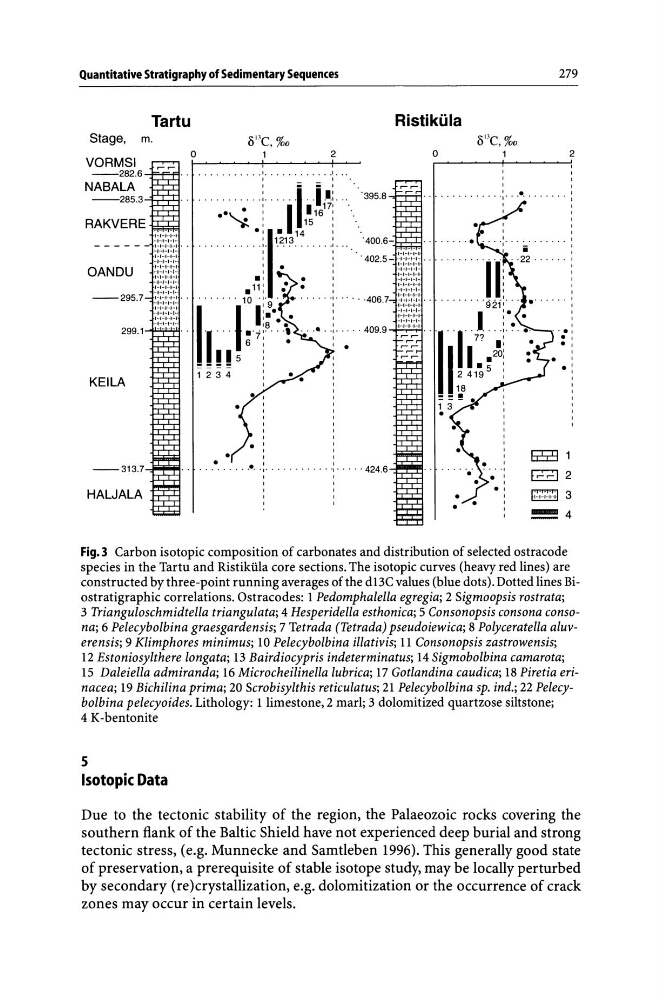
Fig.3 Carbon isotopic composition of carbonates and distribution of selected ostracode
species in the Tartu and Ristikiila core sections. The isotopic curves (heavy red lines) are
constructed by three-point running averages of the d13C values (blue dots). Dotted lines Bi0stratigraphic correlations. Ostracodes: 1 Pedomphalella egregia; 2 Sigmoopsis rostrata;
3 Trianguloschmidtella triangulata; 4 Hesperidella esthonica; 5 Consonopsis consona consona; 6 Pelecybolbina graesgardensis; 7 Tetrada (Tetrada) pseudoiewica; 8 Polyceratella aluverensis; 9 Klimphores minimus; 10 Pelecybolbina illativis; 11 Consonopsis zastrowensis;
12 Estoniosylthere longata; 13 Bairdiocypris indeterminatus; 14 Sigmobolbina camarata;
15 Daleiella admiranda; 16 Micracheilinella lubrica; 17 GotIandina caudica; 18 Piretia erinacea; 19 Bichilina prima; 20 Scrobisylthis reticulatus; 21 Pelecybolbina sp. ind.; 22 Pelecybolbina pelecyoides. Lithology: 1 limestone,2 marl; 3 dolomitized quartzose siltstone;
4 K-bentonite
5
Isotopic Data
Due to the tectonic stability of the region, the Palaeozoic rocks covering the
southern flank of the Baltic Shield have not experienced deep burial and strong
tectonic stress, (e.g. Munnecke and Samtleben 1996). This generally good state
of preservation, a prerequisite of stable isotope study, may be locally perturbed
by secondary (re)crystallization, e.g. dolomitization or the occurrence of crack
zones may occur in certain levels.
279
Tartu
Stage. m,
VORMSI
--282,6
NABALA
--285,3
RAKVERE
,"H··I··I
..............
- - - - - - "."."."., .
+++1,.+ ....... \
.+., .. ,'", ..
OANDU
.;:~:.!:.;!.:.~:~
·;.'.i'.~·;!.;.~·;
--295.7 ·i".i·.':i".~·.':i ..
'j ":i.~·; .':i.~·;
··I··H··'·'
!,' ;.' ,' ;!:;.' ,' ;!.
299,1
KEILA
--313,7
HALJALA
o
813C.%o
1
2
,I..
. • . 1.
,
,
RistikUla
o
813C.%o
1
2
° i , "I' 'I-I'l~i' ", "'3958
• • ~
I
16 I
•
,,0 i"11~131415 , "i, " : '4006- '"''
' , , i
'4025- 1111 •
22
I
: .
:
:~~!,~"::'.I::'
. . ' I' ' I' : : , .. ...... I
.,
;,' ,;,' ,;,' ,;,' ,;
.11: :
. . . . +++
!h! l;!lf~ .:: ~~ft~I' :I·!!:~::!·· : : : . . • :
o
....... ·0 ' j ' • • .
, ,
, 424,6
18
,
= =! •
I
1 3
'
o
E2i::3
fr'.r'.1 2
ri:.~!:i.i:;.'.11 3
IIIIIIIIIIIII 4
Fig.3 Carbon isotopic composition of carbonates and distribution of selected ostracode
species in the Tartu and Ristikiila core sections. The isotopic curves (heavy red lines) are
constructed by three-point running averages of the d13C values (blue dots). Dotted lines Bi0stratigraphic correlations. Ostracodes: 1 Pedomphalella egregia; 2 Sigmoopsis rostrata;
3 Trianguloschmidtella triangulata; 4 Hesperidella esthonica; 5 Consonopsis consona consona; 6 Pelecybolbina graesgardensis; 7 Tetrada (Tetrada) pseudoiewica; 8 Polyceratella aluverensis; 9 Klimphores minimus; 10 Pelecybolbina illativis; 11 Consonopsis zastrowensis;
12 Estoniosylthere longata; 13 Bairdiocypris indeterminatus; 14 Sigmobolbina camarata;
15 Daleiella admiranda; 16 Micracheilinella lubrica; 17 GotIandina caudica; 18 Piretia erinacea; 19 Bichilina prima; 20 Scrobisylthis reticulatus; 21 Pelecybolbina sp. ind.; 22 Pelecybolbina pelecyoides. Lithology: 1 limestone,2 marl; 3 dolomitized quartzose siltstone;
4 K-bentonite
5
Isotopic Data
Due to the tectonic stability of the region, the Palaeozoic rocks covering the
southern flank of the Baltic Shield have not experienced deep burial and strong
tectonic stress, (e.g. Munnecke and Samtleben 1996). This generally good state
of preservation, a prerequisite of stable isotope study, may be locally perturbed
by secondary (re)crystallization, e.g. dolomitization or the occurrence of crack
zones may occur in certain levels.