

276
L. Ainsaar, T. Martma, T. Meidla, M. Rubel and N. SidaraviCiene
Baltic
Sea
@
I
ESTONIA _~
..,---. \
• ~istiki.ila Tartu
_~
l"'-.
'"
'-,
i - /
'\\"\'/~'~ ' / I
/1
LATVIA /
("',.
/
"
..",'" , /
..I
oJ
- - " " " " , _ . . .
_f..
r
,,/
-
; ' " - - .
r
•
- "
J
. / "\ .. -
LITHUANIA / • •
•
-r
"
~I
.r.··· · I
~,
..
,~- -.... •• •
fii!'
~ ••
"eJ
- - - - - - -I·!! "
100 km
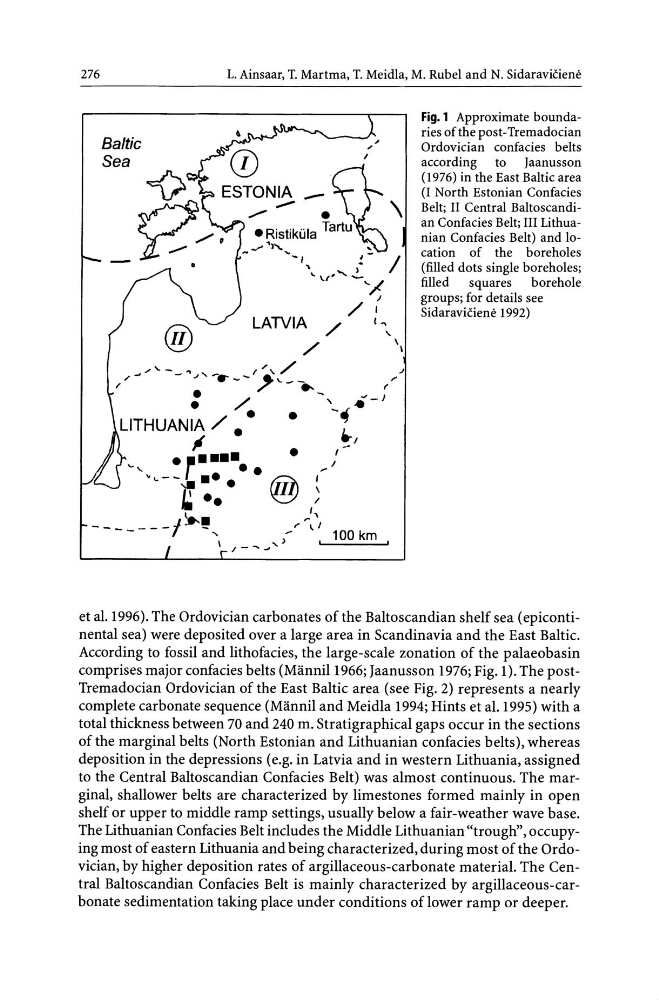
Fig.l Approximate boundaries of the post -Tremadocian
Ordovician confacies belts
according to Jaanusson
(1976) in the East Baltic area
(I North Estonian Confacies
Belt; II Central Baltoscandian Confacies Belt; III Lithuanian Confacies Belt) and location of the boreholes
(filled dots single boreholes;
filled
squares borehole
groups; for details see
Sidaraviciene 1992)
et al. 1996). The Ordovician carbonates of the Baltoscandian shelf sea (epicontinental sea) were deposited over a large area in Scandinavia and the East Baltic.
According to fossil and lithofacies, the large-scale zonation of the palaeobasin
comprises major confacies belts (ManniI1966; Jaanusson 1976; Fig. I). The postTremadocian Ordovician of the East Baltic area (see Fig. 2) represents a nearly
complete carbonate sequence (Mannil and Meidla 1994; Hints et al.1995) with a
total thickness between 70 and 240 m. Stratigraphical gaps occur in the sections
of the marginal belts (North Estonian and Lithuanian confacies belts), whereas
deposition in the depressions (e.g. in Latvia and in western Lithuania, assigned
to the Central Baltoscandian Confacies Belt) was almost continuous. The marginal, shallower belts are characterized by limestones formed mainly in open
shelf or upper to middle ramp settings, usually below a fair-weather wave base.
The Lithuanian Confacies Belt includes the Middle Lithuanian "trough", occupying most of eastern Lithuania and being characterized, during most of the Ordovician, by higher deposition rates of argillaceous-carbonate material. The Central Baltoscandian Confacies Belt is mainly characterized by argillaceous-carbonate sedimentation taking place under conditions of lower ramp or deeper.
L. Ainsaar, T. Martma, T. Meidla, M. Rubel and N. SidaraviCiene
Baltic
Sea
@
I
ESTONIA _~
..,---. \
• ~istiki.ila Tartu
_~
l"'-.
'"
'-,
i - /
'\\"\'/~'~ ' / I
/1
LATVIA /
("',.
/
"
..",'" , /
..I
oJ
- - " " " " , _ . . .
_f..
r
,,/
-
; ' " - - .
r
•
- "
J
. / "\ .. -
LITHUANIA / • •
•
-r
"
~I
.r.··· · I
~,
..
,~- -.... •• •
fii!'
~ ••
"eJ
- - - - - - -I·!! "
100 km
Fig.l Approximate boundaries of the post -Tremadocian
Ordovician confacies belts
according to Jaanusson
(1976) in the East Baltic area
(I North Estonian Confacies
Belt; II Central Baltoscandian Confacies Belt; III Lithuanian Confacies Belt) and location of the boreholes
(filled dots single boreholes;
filled
squares borehole
groups; for details see
Sidaraviciene 1992)
et al. 1996). The Ordovician carbonates of the Baltoscandian shelf sea (epicontinental sea) were deposited over a large area in Scandinavia and the East Baltic.
According to fossil and lithofacies, the large-scale zonation of the palaeobasin
comprises major confacies belts (ManniI1966; Jaanusson 1976; Fig. I). The postTremadocian Ordovician of the East Baltic area (see Fig. 2) represents a nearly
complete carbonate sequence (Mannil and Meidla 1994; Hints et al.1995) with a
total thickness between 70 and 240 m. Stratigraphical gaps occur in the sections
of the marginal belts (North Estonian and Lithuanian confacies belts), whereas
deposition in the depressions (e.g. in Latvia and in western Lithuania, assigned
to the Central Baltoscandian Confacies Belt) was almost continuous. The marginal, shallower belts are characterized by limestones formed mainly in open
shelf or upper to middle ramp settings, usually below a fair-weather wave base.
The Lithuanian Confacies Belt includes the Middle Lithuanian "trough", occupying most of eastern Lithuania and being characterized, during most of the Ordovician, by higher deposition rates of argillaceous-carbonate material. The Central Baltoscandian Confacies Belt is mainly characterized by argillaceous-carbonate sedimentation taking place under conditions of lower ramp or deeper.