

Milankovitch Cycles and Sequences: Two Different Stratigraphic Tools
T,. T 2 • T 3 are different thresholds
Signal
T2 T,
255
Response
R2
R,
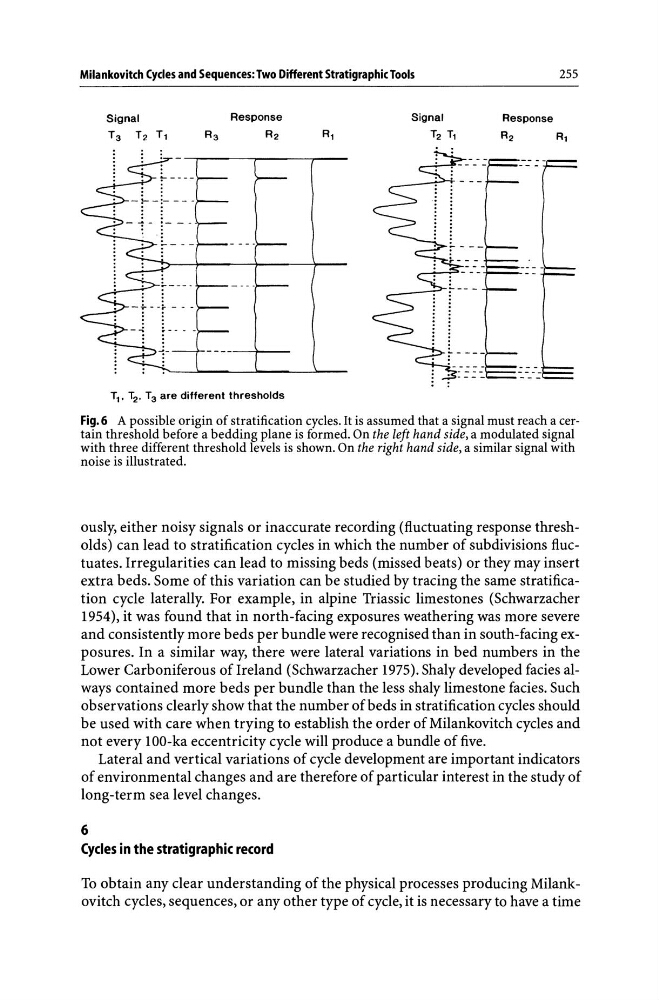
Fig.6 A possible origin of stratification cycles. It is assumed that a signal must reach a certain threshold before a bedding plane is formed. On the left hand side, a modulated signal
with three different threshold levels is shown. On the right hand side, a similar signal with
noise is illustrated.
ously, either noisy signals or inaccurate recording (fluctuating response thresholds) can lead to stratification cycles in which the number of subdivisions fluctuates. Irregularities can lead to missing beds (missed beats) or they may insert
extra beds. Some of this variation can be studied by tracing the same stratification cycle laterally. For example, in alpine Triassic limestones (Schwarzacher
1954), it was found that in north-facing exposures weathering was more severe
and consistently more beds per bundle were recognised than in south-facing exposures. In a similar way, there were lateral variations in bed numbers in the
Lower Carboniferous of Ireland (Schwarzacher 1975). Shaly developed facies always contained more beds per bundle than the less shaly limestone facies. Such
observations clearly show that the number of beds in stratification cycles should
be used with care when trying to establish the order of Milankovitch cycles and
not every 100-ka eccentricity cycle will produce a bundle of five.
Lateral and vertical variations of cycle development are important indicators
of environmental changes and are therefore of particular interest in the study of
long-term sea level changes.
6
Cycles in the stratigraphic record
To obtain any clear understanding of the physical processes producing Milankovitch cycles, sequences, or any other type of cycle, it is necessary to have a time
T,. T 2 • T 3 are different thresholds
Signal
T2 T,
255
Response
R2
R,
Fig.6 A possible origin of stratification cycles. It is assumed that a signal must reach a certain threshold before a bedding plane is formed. On the left hand side, a modulated signal
with three different threshold levels is shown. On the right hand side, a similar signal with
noise is illustrated.
ously, either noisy signals or inaccurate recording (fluctuating response thresholds) can lead to stratification cycles in which the number of subdivisions fluctuates. Irregularities can lead to missing beds (missed beats) or they may insert
extra beds. Some of this variation can be studied by tracing the same stratification cycle laterally. For example, in alpine Triassic limestones (Schwarzacher
1954), it was found that in north-facing exposures weathering was more severe
and consistently more beds per bundle were recognised than in south-facing exposures. In a similar way, there were lateral variations in bed numbers in the
Lower Carboniferous of Ireland (Schwarzacher 1975). Shaly developed facies always contained more beds per bundle than the less shaly limestone facies. Such
observations clearly show that the number of beds in stratification cycles should
be used with care when trying to establish the order of Milankovitch cycles and
not every 100-ka eccentricity cycle will produce a bundle of five.
Lateral and vertical variations of cycle development are important indicators
of environmental changes and are therefore of particular interest in the study of
long-term sea level changes.
6
Cycles in the stratigraphic record
To obtain any clear understanding of the physical processes producing Milankovitch cycles, sequences, or any other type of cycle, it is necessary to have a time