

Lagrangian Modelling Techniques Simulating Wave and Sediment Dynamics ...
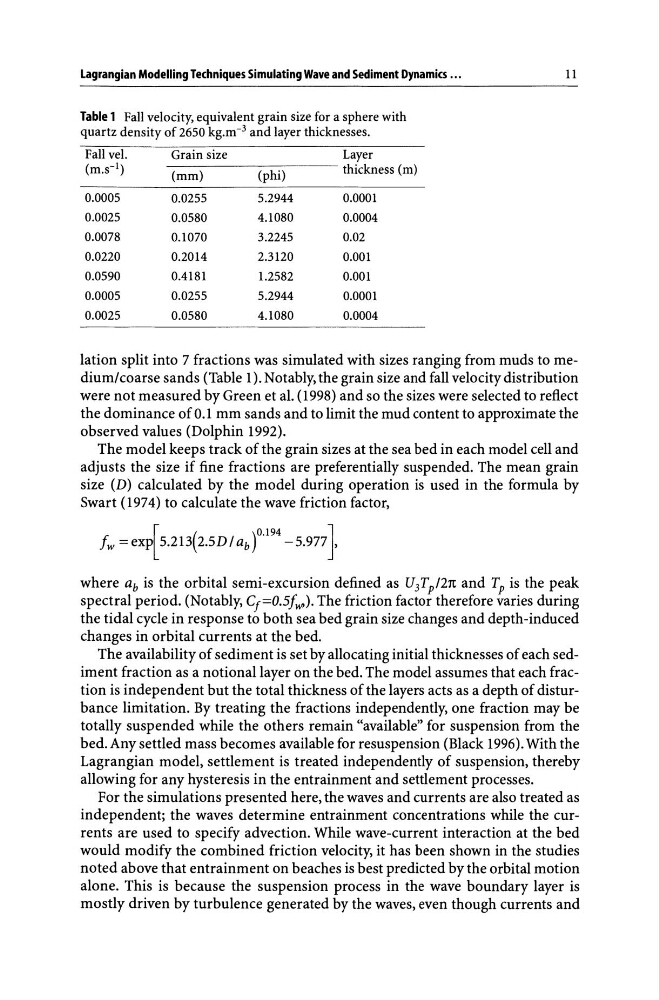
Table 1 Fall velocity, equivalent grain size for a sphere with
quartz density of 2650 kg.m- 3 and layer thicknesses.
Fall vel.
Grain size
Layer
(m.s- 1 )
(mm)
(phi)
thickness (m)
0.0005
0.0255
5.2944
0.0001
0.0025
0.0580
4.1080
0.0004
0.0078
0.1070
3.2245
0.02
0.0220
0.2014
2.3120
0.001
0.0590
004181
1.2582
0.001
0.0005
0.0255
5.2944
0.0001
0.0025
0.0580
4.1080
0.0004
11
lation split into 7 fractions was simulated with sizes ranging from muds to medium/coarse sands (Table 1). Notably, the grain size and fall velocity distribution
were not measured by Green et al. (1998) and so the sizes were selected to reflect
the dominance of 0.1 mm sands and to limit the mud content to approximate the
observed values (Dolphin 1992).
The model keeps track of the grain sizes at the sea bed in each model cell and
adjusts the size if fine fractions are preferentially suspended. The mean grain
size (D) calculated by the model during operation is used in the formula by
Swart (1974) to calculate the wave friction factor,
[
(
)
00194
]
fw = exp 5.213 2.5D / ab
- 5.977 ,
where ab is the orbital semi-excursion defined as U 3 Tp/2n and Tp is the peak
spectral period. (Notably, C f =O.5fw». The friction factor therefore varies during
the tidal cycle in response to both sea bed grain size changes and depth-induced
changes in orbital currents at the bed.
The availability of sediment is set by allocating initial thicknesses of each sediment fraction as a notional layer on the bed. The model assumes that each fraction is independent but the total thickness of the layers acts as a depth of disturbance limitation. By treating the fractions independently, one fraction may be
totally suspended while the others remain "available" for suspension from the
bed. Any settled mass becomes available for resuspension (Black 1996). With the
Lagrangian model, settlement is treated independently of suspension, thereby
allowing for any hysteresis in the entrainment and settlement processes.
For the simulations presented here, the waves and currents are also treated as
independent; the waves determine entrainment concentrations while the currents are used to specify advection. While wave-current interaction at the bed
would modify the combined friction velocity, it has been shown in the studies
noted above that entrainment on beaches is best predicted by the orbital motion
alone. This is because the suspension process in the wave boundary layer is
mostly driven by turbulence generated by the waves, even though currents and
Table 1 Fall velocity, equivalent grain size for a sphere with
quartz density of 2650 kg.m- 3 and layer thicknesses.
Fall vel.
Grain size
Layer
(m.s- 1 )
(mm)
(phi)
thickness (m)
0.0005
0.0255
5.2944
0.0001
0.0025
0.0580
4.1080
0.0004
0.0078
0.1070
3.2245
0.02
0.0220
0.2014
2.3120
0.001
0.0590
004181
1.2582
0.001
0.0005
0.0255
5.2944
0.0001
0.0025
0.0580
4.1080
0.0004
11
lation split into 7 fractions was simulated with sizes ranging from muds to medium/coarse sands (Table 1). Notably, the grain size and fall velocity distribution
were not measured by Green et al. (1998) and so the sizes were selected to reflect
the dominance of 0.1 mm sands and to limit the mud content to approximate the
observed values (Dolphin 1992).
The model keeps track of the grain sizes at the sea bed in each model cell and
adjusts the size if fine fractions are preferentially suspended. The mean grain
size (D) calculated by the model during operation is used in the formula by
Swart (1974) to calculate the wave friction factor,
[
(
)
00194
]
fw = exp 5.213 2.5D / ab
- 5.977 ,
where ab is the orbital semi-excursion defined as U 3 Tp/2n and Tp is the peak
spectral period. (Notably, C f =O.5fw». The friction factor therefore varies during
the tidal cycle in response to both sea bed grain size changes and depth-induced
changes in orbital currents at the bed.
The availability of sediment is set by allocating initial thicknesses of each sediment fraction as a notional layer on the bed. The model assumes that each fraction is independent but the total thickness of the layers acts as a depth of disturbance limitation. By treating the fractions independently, one fraction may be
totally suspended while the others remain "available" for suspension from the
bed. Any settled mass becomes available for resuspension (Black 1996). With the
Lagrangian model, settlement is treated independently of suspension, thereby
allowing for any hysteresis in the entrainment and settlement processes.
For the simulations presented here, the waves and currents are also treated as
independent; the waves determine entrainment concentrations while the currents are used to specify advection. While wave-current interaction at the bed
would modify the combined friction velocity, it has been shown in the studies
noted above that entrainment on beaches is best predicted by the orbital motion
alone. This is because the suspension process in the wave boundary layer is
mostly driven by turbulence generated by the waves, even though currents and