

190
W. Ritzrau . H. Fohrmann
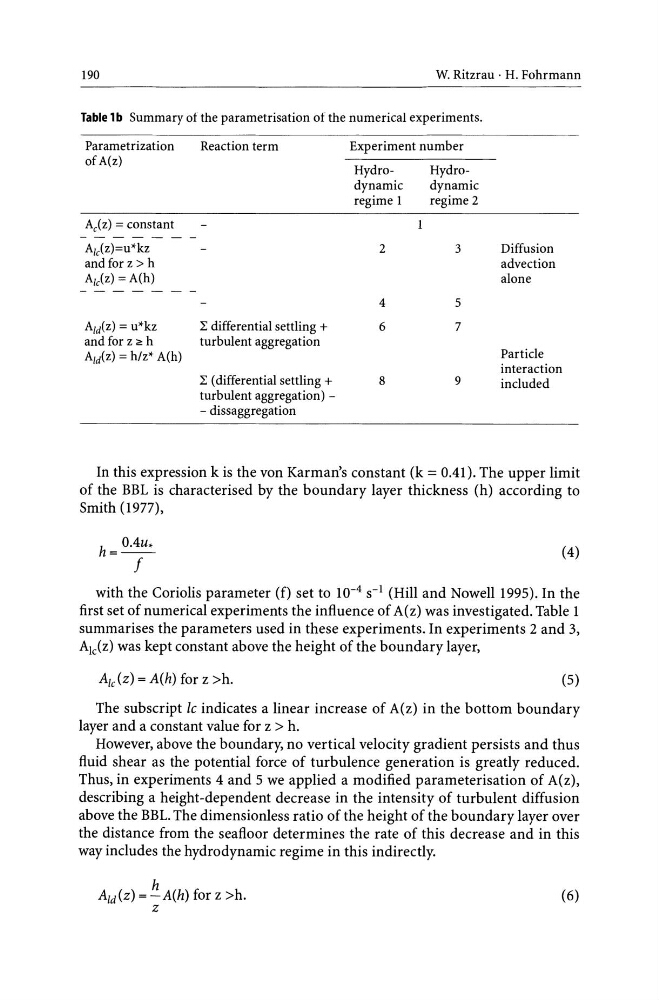
Table 1 b Summary of the parametrisation of the numerical experiments.
Parametrization
Reaction term
Experiment number
of A(z)
Hydrodynamic
dynamic
regime 1
regime 2
Ac(z) = constant
- -
-
- -
A1c(z)=u*kz
2
3
Diffusion
and for z > h
advection
A1c(z) = A(h)
alone
- - - - -
4
5
A1d(z) = u*kz
~ differential settling +
6
7
and for z;;, h
turbulent aggregation
A1d(z) = h/z* A(h)
Particle
interaction
~ (differential settling +
8
9
included
turbulent aggregation) -
- dissaggregation
In this expression k is the von Karman's constant (k = 0.41). The upper limit
of the BBL is characterised by the boundary layer thickness (h) according to
Smith (1977),
h = O.4u.
f
(4)
with the Coriolis parameter (f) set to 10- 4 S-1 (Hill and Nowell 1995). In the
first set of numerical experiments the influence of A(z) was investigated. Table 1
summarises the parameters used in these experiments. In experiments 2 and 3,
Alc(z) was kept constant above the height of the boundary layer,
A/c(z) = A(h) for z >h.
(5)
The subscript lc indicates a linear increase of A(z) in the bottom boundary
layer and a constant value for z > h.
However, above the boundary, no vertical velocity gradient persists and thus
fluid shear as the potential force of turbulence generation is greatly reduced.
Thus, in experiments 4 and 5 we applied a modified parameterisation of A(z),
describing a height-dependent decrease in the intensity of turbulent diffusion
above the BBL. The dimensionless ratio of the height of the boundary layer over
the distance from the seafloor determines the rate of this decrease and in this
way includes the hydrodynamic regime in this indirectly.
h
A/d(z) = - A(h) for z >h.
z
(6)
W. Ritzrau . H. Fohrmann
Table 1 b Summary of the parametrisation of the numerical experiments.
Parametrization
Reaction term
Experiment number
of A(z)
Hydrodynamic
dynamic
regime 1
regime 2
Ac(z) = constant
- -
-
- -
A1c(z)=u*kz
2
3
Diffusion
and for z > h
advection
A1c(z) = A(h)
alone
- - - - -
4
5
A1d(z) = u*kz
~ differential settling +
6
7
and for z;;, h
turbulent aggregation
A1d(z) = h/z* A(h)
Particle
interaction
~ (differential settling +
8
9
included
turbulent aggregation) -
- dissaggregation
In this expression k is the von Karman's constant (k = 0.41). The upper limit
of the BBL is characterised by the boundary layer thickness (h) according to
Smith (1977),
h = O.4u.
f
(4)
with the Coriolis parameter (f) set to 10- 4 S-1 (Hill and Nowell 1995). In the
first set of numerical experiments the influence of A(z) was investigated. Table 1
summarises the parameters used in these experiments. In experiments 2 and 3,
Alc(z) was kept constant above the height of the boundary layer,
A/c(z) = A(h) for z >h.
(5)
The subscript lc indicates a linear increase of A(z) in the bottom boundary
layer and a constant value for z > h.
However, above the boundary, no vertical velocity gradient persists and thus
fluid shear as the potential force of turbulence generation is greatly reduced.
Thus, in experiments 4 and 5 we applied a modified parameterisation of A(z),
describing a height-dependent decrease in the intensity of turbulent diffusion
above the BBL. The dimensionless ratio of the height of the boundary layer over
the distance from the seafloor determines the rate of this decrease and in this
way includes the hydrodynamic regime in this indirectly.
h
A/d(z) = - A(h) for z >h.
z
(6)